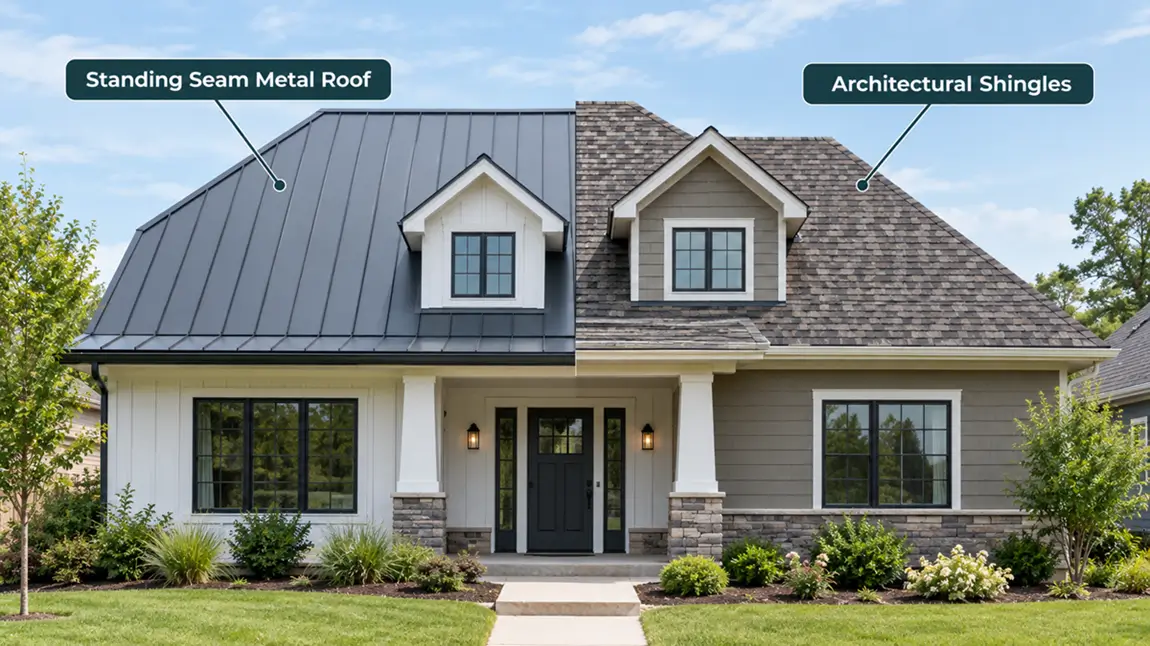
A metal roof usually lasts 40 to 70 years, stands up well to wind, fire and snow, and weighs far less than shingles, but it often costs about two to three times as much up front. Asphalt shingles cost much less, are easy to repair and are installed by almost every roofer, but they last about 15 to 30 years, so you may replace them two or three times during the life of one metal roof.
In short, metal is the better long-term roof if you plan to stay in your home for many years, or live where storms, wildfire or heavy snow are common. Shingles make more sense on a tighter budget, if you may sell within several years, or on a complex roof with many valleys and dormers. This guide compares the two side by side, explains what drives the cost, and works out the materials for the same roof with our metal roofing calculator.
Metal roof vs shingles at a glance
| Metal roof | Asphalt shingles | |
|---|---|---|
| Lifespan | About 40 to 70 years | About 15 to 30 years |
| Up-front cost | Often 2 to 3 times as much | The lowest of the common roofs |
| Cost per year of life | Often the same or lower if you stay many years | Lower if you sell within several years |
| Weight per square (100 sq ft) | Steel about 75 to 150 lb, aluminum less | About 200 to 400 lb |
| Wind | Fastened along the whole panel, no tabs to lift | Rated by class, up to Class H (150 mph) |
| Hail | Rarely leaks after hail, but can dent | Can crack and lose granules. Class 4 shingles are available. |
| Fire | Doesn’t burn. Most systems are Class A. | Most fiberglass shingles are Class A |
| Snow | Slides off. Snow guards help over doors and walkways. | Holds snow longer. Needs an ice barrier at the eaves in cold areas. |
| Heat | Light and reflective finishes bounce back much of the sun’s heat | Dark shingles absorb heat. Reflective shingles are available. |
| Rain noise | Similar to shingles over a solid deck and insulated attic | Quiet |
| Lowest pitch allowed | ¼/12 for standing seam, 3/12 for most other metal | 2/12, with double underlayment up to 4/12 |
| Repairs | Fewer, but harder. Needs a metal roofing crew. | Easy and cheap to patch |
| Looks | Panels, or metal shingles shaped like shingles, shakes, slate or tile | Flat 3-tab or textured architectural shingles |
Lifespan: how many roofs will you buy?
Asphalt shingles usually last 15 to 30 years. Basic 3-tab shingles sit at the low end, and thicker architectural shingles at the high end. Metal roofs usually last 40 to 70 years. Exposed-fastener panels sit nearer the low end, mainly because their screws and washers wear out, and standing seam with hidden clips lasts the longest.
Over 50 years, a typical home may need two or three shingle roofs, each with its own tear-off, disposal and installation, but only one metal roof. Sun, heat, storms, attic ventilation and the quality of the installation all change these numbers, as our guide to how long a roof lasts explains.
Metal roof vs shingles cost
A metal roof often costs about two to three times as much as an architectural shingle roof on the same house, and standing seam usually costs the most. These are the main things that set the gap:
- The metal system. Exposed-fastener panels are the cheapest metal, metal shingles and stone-coated steel sit in the middle, and standing seam costs the most.
- Labor. Metal needs a trained crew and special tools, and fewer roofers install it. Almost every roofer installs shingles.
- Roof shape. Valleys, hips, dormers, skylights and chimneys need custom-bent flashing and more cutting on a metal roof, so a complex roof raises the cost of metal more than the cost of shingles.
- Tear-off and decking. Removing old layers and replacing soft sheathing adds cost to either roof.
- Trim and accessories. Metal roofs need ridge cap, eave and gable trim, foam closures and special screws, which add to the material bill.
Cost per year of roof life
The price on the quote isn’t the whole story. Divide each quote by the number of years you expect the roof to last. If a metal roof costs 2.5 times as much as shingles but lasts 2.5 times as long, the cost per year is the same, and you also skip a future tear-off and re-roof. If you may sell within several years, shingles usually come out ahead, because you rarely get all of metal’s extra cost back when you sell.
How to compare quotes
Ask each roofer to price the job per square (100 sq ft) and to list tear-off, decking, flashing and trim separately, so you compare like with like. Then enter both quotes in the roof replacement cost calculator, once with Metal and once with Asphalt shingles, to see the two totals for your roof size.
Weather: wind, hail, fire, snow and heat
Wind
Shingles are rated by wind class. Under the ASTM D7158 test, Class D shingles are rated for 90 mph, Class G for 120 mph and Class H for 150 mph, and many shingles sold today carry Class H. Metal panels are fastened along their whole length, and standing seam panels are held by hidden clips, so there are no tabs for the wind to lift. In hurricane and high-wind areas, check the wind rating of the exact product and fastening pattern, whichever roof you choose.
Hail
Roof hail ratings use the UL 2218 test, from Class 1 to Class 4. A Class 4 product survives a 2-inch steel ball dropped from 20 feet without cracking. Large hail can crack shingles and knock off their granules, which shortens their life. Metal rarely lets water in after hail, but it can dent, and dents show most on smooth, flat panels. Many metal products and impact-resistant shingles are rated Class 4.
Fire
Metal doesn’t burn, and most metal roofing is Class A fire rated as an installed system. Most fiberglass asphalt shingles are Class A too. In wildfire areas metal has the edge, because the surface itself can’t catch fire, but either roof still needs clean gutters and ember-resistant vents.
Snow and ice
Snow slides off metal, which takes the load off the roof but can drop heavy sheets of snow onto walkways, decks and doorways, so snow guards are often fitted above them. Shingles hold snow longer. In cold areas, both roofs need good attic insulation and ventilation to limit ice dams, and shingle roofs need an ice barrier along the eaves.
Hot, sunny climates
Light colors and reflective “cool” finishes on metal bounce back much of the sun’s heat, which keeps the attic cooler and can lower air-conditioning bills in hot, sunny areas. Dark shingles absorb more heat, which also speeds up their aging. Reflective shingles are available too, but metal with a cool finish usually reflects more. In cold climates the energy difference is small.
Are metal roofs noisy in the rain?
Not on a typical house. The noise most people remember comes from barns and sheds, where thin panels sit on open framing with nothing underneath. On a home, the panels go over a solid deck and underlayment, with an insulated attic below, so rain sounds much like it does on shingles. Rooms with vaulted ceilings right under the roof may hear a little more, and extra insulation or a sound-damping underlayment helps there.
Weight and roof pitch
Metal is one of the lightest roofs you can buy. Steel roofing weighs roughly 75 to 150 lb per square and aluminum less, while asphalt shingles weigh about 200 to 400 lb per square. The light weight is one reason metal can sometimes go over an existing layer of shingles.
Roof pitch can make the choice for you. These are the lowest pitches the International Residential Code (IRC) allows:
| Roof covering | Lowest pitch allowed |
|---|---|
| Asphalt shingles | 2/12, with a double layer of underlayment from 2/12 up to 4/12 |
| Metal shingles | 3/12 |
| Lapped metal panels without lap sealant | 3/12 |
| Lapped metal panels with lap sealant | ½/12 |
| Standing seam metal | ¼/12 |
So on a low-slope porch or addition below 2/12, standing seam is often the right choice where shingles aren’t allowed. Manufacturers may require more slope than the code minimum, so check the product instructions. If you don’t know your slope, the roof pitch calculator works it out from the rise and run.
Types of metal roofing compared with shingles
| Type | What it is | Best for |
|---|---|---|
| Standing seam | Flat panels, usually 12 to 18 inches wide, joined at raised seams and held by hidden clips | The longest life, low slopes and a clean, modern look |
| Exposed-fastener panels (corrugated, ribbed or R-panel) | Overlapping panels, often 36 inches wide, screwed through the face with rubber-washer screws | The lowest-cost metal roof. Barns, sheds and simple roofs. |
| Metal shingles and stone-coated steel | Small pressed panels shaped like shingles, shakes, slate or tile | A metal roof that looks like a shingle roof |
| Architectural asphalt shingles | Thick, layered shingles with a textured look | Most new roofs on homes |
| 3-tab asphalt shingles | Thin, flat, single-layer shingles | The lowest cost, with the shortest life |
Most residential steel panels are 29, 26 or 24 gauge. A lower gauge number means thicker steel, which dents less. “Tin roof” is an old name, and roofs called tin today are almost always steel or aluminum. Near salt water, aluminum or steel with a coastal-rated finish lasts longer.
Pros and cons
Metal roof pros and cons
Pros
- Lasts 40 to 70 years, so many homeowners never need to re-roof again.
- Stands up well to wind, fire and snow, and many products are rated Class 4 for hail.
- Weighs half or less of a shingle roof.
- Reflective finishes help keep the attic cooler in hot climates.
- Needs little routine care, and the metal can be recycled at the end of its life.
Cons
- Costs about two to three times as much up front.
- Fewer roofers install it, and repairs need a metal roofing crew and matching panels.
- Can dent in large hail, and dents on smooth panels are easy to see.
- Screws on exposed-fastener panels need checking over the years as their washers age.
- Snow can slide off in sheets, so snow guards may be needed.
Asphalt shingle pros and cons
Pros
- The lowest up-front cost of the common roofing materials.
- Almost every roofer installs them, so quotes are easy to get.
- Easy and cheap to replace a few damaged shingles.
- Many colors and styles, including Class 4 impact and Class H wind ratings.
Cons
- A shorter life, about 15 to 30 years.
- Heavier, and they age faster in strong sun and heat.
- Can crack, curl or lose granules in hail and high winds.
- Most old shingles end up in landfills.
Which is better for your home?
| If you | The better choice |
|---|---|
| Plan to stay 20 years or more | Metal. One roof may last the rest of your time in the home. |
| May sell within 5 to 10 years | Shingles. You’ll get little of metal’s extra cost back. |
| Have a tight budget now | Architectural shingles |
| Live in hurricane or high-wind country | Either, if the product and fastening are rated for your wind zone |
| Get a lot of hail | A Class 4 product in either material. Check how your policy treats dents on metal. |
| Live in a hot, sunny climate | Metal with a light or cool finish |
| Live near the ocean | Aluminum or a coastal-rated metal finish |
| Live in wildfire country | Metal, with ember-resistant vents |
| Have a roof flatter than 2/12 | Standing seam metal |
| Have a complex roof with many valleys and dormers | Shingles, which cost much less to fit around them |
| Live under a homeowners association | Check the rules first. Some limit metal roofs or colors. |
Can you put a metal roof over shingles?
Often, yes. Metal is light enough to go over one layer of asphalt shingles, which saves the cost and mess of a tear-off. Building codes generally don’t allow a new roof over two or more existing layers, over wet or badly worn shingles, or over a soft deck. The installer usually lays new underlayment over the old shingles, and some systems use wood or metal strips called battens to give the panels a flat, ventilated base.
Many roofers still prefer a tear-off, because it’s the only way to check and repair the deck, and some panel makers limit their warranty over old shingles. Ask your building department and the panel maker before you decide.
Insurance and resale value
Some insurers give a discount for impact-resistant roofs, usually tied to a UL 2218 Class 4 rating, and some hail-prone states run programs for it, such as the one explained by the Texas Department of Insurance. The discount isn’t automatic, and some policies that offer it exclude cosmetic hail damage, meaning dents that don’t let water in. Read that part of your policy before choosing a metal roof for the discount.
For resale, a newer roof of either type helps a home sell. A metal roof’s long remaining life can be a selling point, but buyers rarely pay back the full extra cost, especially in the first few years.
How much material? A worked example
Say you’re roofing a building that is 40 ft long and 24 ft wide, with a 4/12 gable roof and a 12-inch overhang at the eaves. These are the default numbers in our metal roofing calculator, using 36-inch exposed-fastener panels:
- Pitch factor for 4/12: 1.054
- Panel length: (12 ft from eave to ridge + 1 ft overhang) × 1.054 = 13 ft 8½ in, so order 13 ft 9 in panels
- Panels per side: 40 ft × 12 ÷ 36 in = 13.3, so 14 panels
- Both sides plus 5% extra: 14 × 2 × 1.05 = 29.4, so 30 panels
- Panel area: 30 × 3 ft × 13.7 ft = 1,233 sq ft, or 12.3 squares
- Trim: 40 ft of ridge cap, 80 ft of eave trim and 55 ft of gable trim
For shingles on the same roof, enter 40 × 26 ft (the building width plus both overhangs) at 4/12 in the roofing calculator:
- Roof area: 40 × 26 × 1.054 = 1,096 sq ft
- Plus 10% extra: 12.1 squares
- At 3 bundles per square: 37 bundles
- Trim: 135 ft of drip edge and starter strip, and 40 ft of ridge cap
Both roofs come to about 12 squares of material, which is why a price per square is the fairest way to compare quotes. In the roof replacement cost calculator, the same roof is 11.0 squares before extra material, and you can add tear-off, decking and fees to each quote.
Not sure what pitch your roof has? Our roof pitch chart lists the angle, slope and minimum roofing for every common pitch.
Frequently asked questions
Is a metal roof cheaper than shingles in the long run?
Often, if you stay long enough. A metal roof costs about two to three times as much up front but can last two to three times as long, so over 40 or 50 years it can cost the same as or less than two or three shingle roofs, each with its own tear-off. Over a short stay, shingles are cheaper.
Do metal roofs leak more than shingles?
No, not when they’re installed well. Most leaks on either roof start at the flashing around chimneys, vents, skylights and walls. On exposed-fastener metal, aging screw washers are another common cause, so check the screws every few years. Standing seam has hidden fasteners and fewer places for water to get in.
Do metal roofs rust?
Steel roofing is coated with zinc or an aluminum-zinc mix and then painted, so it resists rust for decades. Rust usually starts at deep scratches, cut edges, the wrong screws, or where steel touches copper. Aluminum doesn’t rust, which is why it’s often used near salt water.
Does a metal roof lower your insurance?
It can. Some insurers discount roofs rated UL 2218 Class 4 for impact, and some states have programs for it. Discounts vary by company and state, and some come with a cosmetic damage exclusion, so ask your insurer before you buy.
Does a metal roof increase home value?
A new roof of either type helps a home sell, and a metal roof’s long life can be a selling point. You rarely get the full extra cost back when you sell, so metal pays off mostly when you stay in the home for many years.
Is a tin roof the same as a metal roof?
In everyday speech, yes. True tin roofing is rare today, and most roofs called tin roofs are steel or aluminum panels.
Is a metal roof or shingles better in Florida?
Metal handles hurricane winds, heat and heavy rain well, and a light or cool finish keeps the attic cooler. Near the coast, choose aluminum or a coastal-rated finish to avoid corrosion. Whichever roof you choose, the product needs Florida product approval for your wind zone and must be installed to the Florida Building Code.
Lifespans, ratings and cost comparisons in this guide are typical ranges for planning. The real numbers depend on the product, the installer, your local code and your climate, so compare written quotes, check each product’s ratings, and read your insurance policy before you choose.
Keep reading
 Roofing & SidingRoof Pitch Chart: Common Roof Pitches Explained (4/12, 6/12, 8/12 and More)Roof pitch is how many inches a roof rises for every 12 inches it runs across, written as…Read the guide →7 min read
 Roofing & SidingHow Long Does a Roof Last? Shingles, Metal and MoreMost roofs last 15 to 30 years with asphalt shingles, 40 to 70 years with metal, and 50…Read the guide →9 min read
 Walls, Ceilings & LightingPaint Sheens Explained: Flat, Eggshell, Satin, Semi-GlossPaint sheen is how shiny the dried paint looks. From least to most shiny, the common sheens are…Read the guide →8 min read