These calculators help you plan masonry and hardscape projects, from a concrete block wall to a paver patio or a garden retaining wall. Enter your measurements and get the number of blocks, bricks or pavers, plus the mortar, sand, gravel and fill to order.
Wall calculators
- Concrete block calculator: blocks for a CMU or cinder block wall, with mortar bags and the concrete to fill the cores.
- Brick calculator: bricks for a wall, a veneer or a round fire pit, with mortar and mason sand for eight common brick sizes.
- Retaining wall calculator: wall blocks, caps, base gravel and drainage gravel for straight or round walls, or concrete for a poured wall.
Patio and walkway calculators
- Paver calculator: pavers, paver base, bedding sand and polymeric sand for patios, walkways and driveways, with the depth to dig.
Which calculator should I use?
| Your project | Use this |
|---|---|
| Garden wall, garage wall or foundation wall in hollow block | Concrete block calculator |
| Filling block cores with concrete or grout | Concrete block calculator, with a fill option chosen |
| Brick wall, brick veneer or brick planter | Brick calculator |
| Round brick fire pit | Brick calculator, “Round fire pit” tab |
| Wall that holds back a slope, or a raised garden bed | Retaining wall calculator |
| Tree ring or round planter in wall block | Retaining wall calculator, “Round block wall” tab |
| Paver patio, walkway or driveway | Paver calculator |
| The concrete footing under a block or brick wall | Concrete footing calculator |
Before you start
- Measure every wall and add the lengths together. Measure height from the top of the footing or base, not from the ground.
- Check the real size of the block, brick or paver with your supplier. Names like “queen” or “standard wall block” can mean slightly different sizes from one maker to another.
- Plan what goes underneath first. Masonry walls sit on a concrete footing or a compacted gravel base, and pavers need a compacted base and a sand bed.
- Walls that hold back soil, or are taller than about 4 ft, often need an engineered design and a permit. Check with your local building department before you buy.
- Call 811 before you dig, so buried utility lines are marked first.
- Order a few extra units from the same batch. Color can change between batches, and the difference shows on brick, pavers and colored block.
Every result is an estimate for planning. See How We Calculate for the formulas and values we use.
Masonry & Hardscape guides
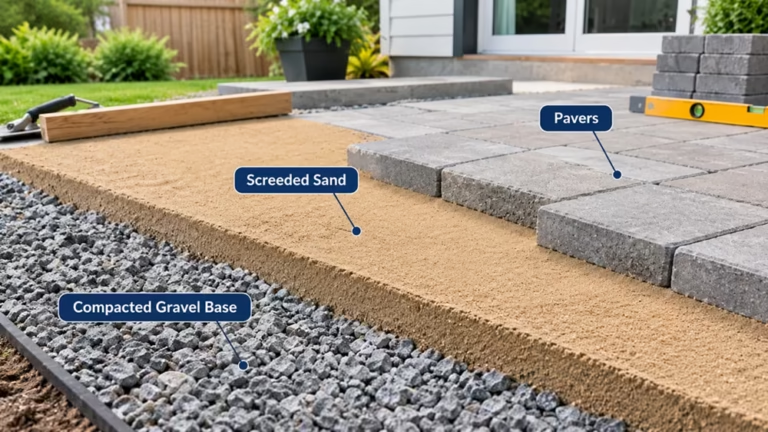 Masonry & HardscapePaver Base Material: What to Put Under Pavers and How DeepUnder pavers you need two built layers: a compacted base of crushed stone and a thin bed of…Read the guide →9 min read
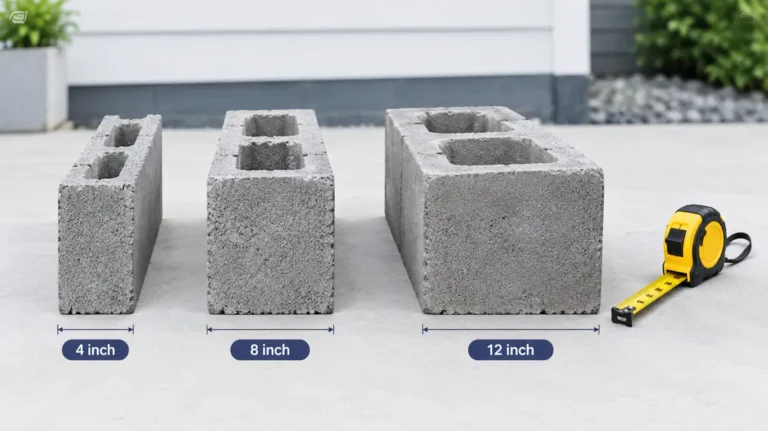 Masonry & HardscapeCMU Block Sizes: Standard Concrete and Cinder Block DimensionsA standard concrete block, often called a cinder block or CMU (concrete masonry unit), is 8 × 8…Read the guide →9 min read
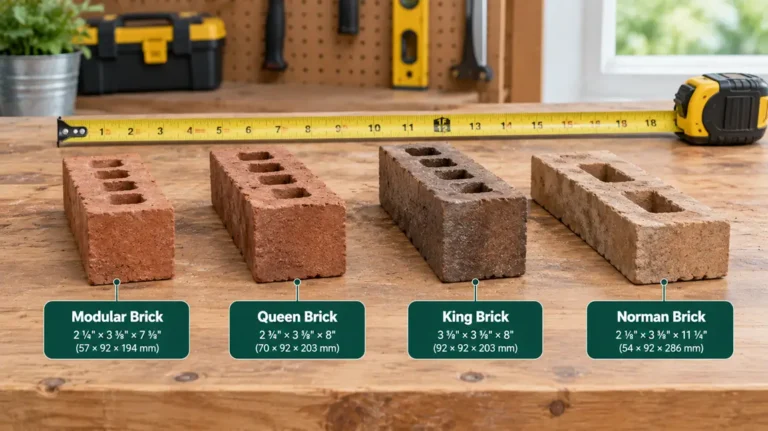 Masonry & HardscapeStandard Brick Dimensions: Size Chart, Types and WeightsThe most common brick in the United States is the modular brick: 3⅝ in deep, 2¼ in tall…Read the guide →9 min read