Use this brick calculator to work out how many bricks you need for a wall, a brick veneer or a round fire pit. Choose your brick size and mortar joint to get the brick count, the bags of mortar and the mason sand to order.
Extra and cost
Mortar uses typical bag yields for modular brick, adjusted for brick size and joint width. Real use depends on the mason, so keep a spare bag.
How the brick calculator works
Each brick covers its own face plus one mortar joint. A modular brick is 7⅝ × 2¼ inches on the face, so with a ⅜ inch joint it covers 8 × 2⅝ inches, or 21 square inches.
- Bricks per square foot = 144 ÷ ((brick length + joint) × (brick height + joint))
- Wall: bricks = (length × height − openings) × bricks per square foot × wall thickness in bricks, plus 5% extra
- Round fire pit: bricks per course = 3.1416 × (inside diameter + brick depth) ÷ (brick length + joint), rounded up
- Fire pit courses = wall height ÷ (brick height + joint), rounded up
- Mortar bags = bricks ÷ bricks per bag
For mortar, we start from typical bag yields for modular brick with ⅜ inch joints: about 37 bricks per 80 lb bag of premixed mortar, or 144 bricks per 70 lb bag of masonry cement mixed with 240 lb of sand. Bigger bricks and wider joints use more mortar per brick, so the yield is scaled by brick length, height, depth and joint width.
Worked example
A garden wall 20 ft long and 6 ft high, one brick thick, in modular brick with ⅜ inch joints:
- Wall area: 20 × 6 = 120 sq ft
- Bricks per sq ft: 144 ÷ (8 × 2⅝) = 144 ÷ 21 = 6.86
- Bricks: 120 × 6.857 = 823, plus 5% = 864 bricks
- Layout: 30 bricks per course and about 27.4 courses
- Premixed mortar: 864 ÷ 37 = 23.4, rounded up to 24 bags
- Or masonry cement: 864 ÷ 144 = 6 bags, plus 6 × 240 lb = 1,440 lb (0.72 tons) of mason sand
A round fire pit with a 3 ft inside diameter and 18 in walls, in the same brick, works out like this. The ring through the middle of the bricks is 36 + 3⅝ = 39⅝ in across, so it is 3.1416 × 39.625 = 124.5 in around. That gives 124.5 ÷ 8 = 15.6, so 16 bricks per course. The courses are 18 ÷ 2⅝ = 6.9, so 7 courses (18⅜ in high). That is 112 bricks plus 5%, or 118 bricks and 4 bags of premixed mortar.
Brick sizes
Sizes are depth × height × length. Counts are worked out from these sizes, and the mortar yield is for 80 lb bags of premixed mortar with ⅜ inch joints. Queen and king sizes vary most between makers, so measure a sample brick if you can.
| Brick | Real size | Bricks per sq ft, ⅜ in joint | Bricks per sq ft, ½ in joint | Bricks per 80 lb bag |
|---|---|---|---|---|
| Modular | 3⅝ × 2¼ × 7⅝ in | 6.86 | 6.44 | About 37 |
| Standard | 3⅝ × 2¼ × 8 in | 6.55 | 6.16 | About 36 |
| Queen | 3 × 2¾ × 8 in | 5.50 | 5.21 | About 41 |
| King | 3 × 2⅝ × 9⅝ in | 4.80 | 4.55 | About 36 |
| Engineer modular | 3⅝ × 2 13/16 × 7⅝ in | 5.65 | 5.35 | About 35 |
| Norman | 3⅝ × 2¼ × 11⅝ in | 4.57 | 4.32 | About 26 |
| Roman | 3⅝ × 1⅝ × 11⅝ in | 6.00 | 5.59 | About 28 |
| Utility | 3⅝ × 3⅝ × 11⅝ in | 3.00 | 2.88 | About 24 |
Tips for brick projects
- Line a fire pit with firebrick. Ordinary clay brick close to the flames can crack, so many builders use firebrick and a heat-rated mortar for the inner ring. Follow the instructions on the products you buy.
- Brick veneer on a house needs metal ties and an air gap behind the brick. Tie spacing and flashing are set by code, so follow common US code and check your local code.
- Match the mortar to the job. Type N is a common choice for walls above ground, and Type S for walls below ground, retaining walls and paving. Your supplier can confirm which type fits your project.
- For a thicker structural wall, many builders lay concrete block and face it with brick. The concrete block calculator counts the block for the back of the wall.
- For a bigger job where you buy sand by the ton or cubic yard, the sand calculator converts between the two.
- Mix bricks from several pallets as you lay them. This spreads out small color differences instead of leaving a patch.
Frequently asked questions
How many bricks are in a square foot?
About 6.86 modular bricks with ⅜ inch joints, often rounded to 7. Larger bricks need fewer: about 4.57 Norman bricks or 3 utility bricks per square foot. Wider joints also lower the count a little.
How do I calculate bricks for a wall?
Multiply the wall length by the height to get square feet, and subtract doors and windows. Multiply by the bricks per square foot for your brick size, then add 5% for cuts and breakage. For a wall two bricks thick, double the count.
How much mortar do I need for 1,000 bricks?
For modular brick with ⅜ inch joints, about 27 to 28 bags of 80 lb premixed mortar, or 7 bags of masonry cement with about 0.84 tons of mason sand. Real use depends on the mason and the joints, so keep a spare bag.
How many bricks do I need for a fire pit?
A round pit with a 3 ft inside diameter and walls about 18 in high takes 16 modular bricks per course and 7 courses. That is 112 bricks, or about 118 with 5% extra. Use the “Round fire pit” tab for your own size.
How much does a brick wall cost?
It depends on the brick, the mortar and labor where you live, and prices vary a lot by region. Enter your supplier’s price per brick and per bag in the calculator’s cost settings to get a materials total, then add labor from a local mason’s quote.
Results are estimates for planning. Brick sizes and mortar use vary, so confirm quantities with your supplier. See How We Calculate for the formulas we use.
Guides for this project
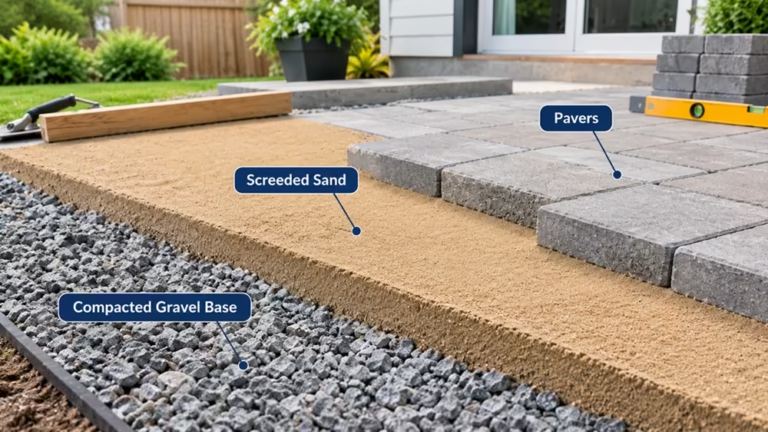 Masonry & HardscapePaver Base Material: What to Put Under Pavers and How DeepUnder pavers you need two built layers: a compacted base of crushed stone and a thin bed of…Read the guide →9 min read
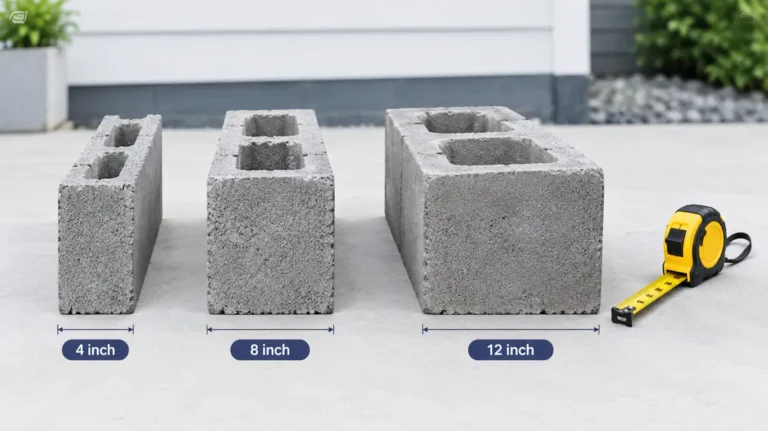 Masonry & HardscapeCMU Block Sizes: Standard Concrete and Cinder Block DimensionsA standard concrete block, often called a cinder block or CMU (concrete masonry unit), is 8 × 8…Read the guide →9 min read
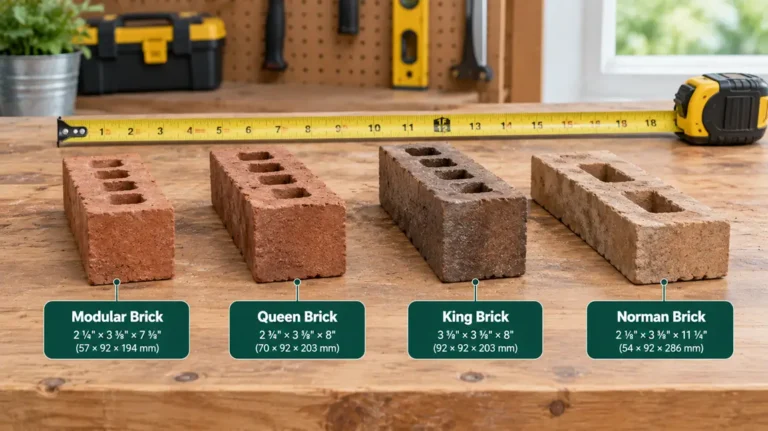 Masonry & HardscapeStandard Brick Dimensions: Size Chart, Types and WeightsThe most common brick in the United States is the modular brick: 3⅝ in deep, 2¼ in tall…Read the guide →9 min read