Use this retaining wall calculator to plan a garden wall, a raised bed or a tree ring. Enter the wall length and height and pick your block size. You get the wall blocks, cap blocks, base gravel, drainage gravel and drain pipe. For a poured wall, it works out the concrete for the wall and its footing.
Gravel, extra and cost
How the retaining wall calculator works
- Blocks per course = wall length in inches ÷ block length, rounded up
- Courses = height above ground ÷ block height, rounded up, plus one buried course
- Wall blocks = blocks per course × courses, plus 5% extra
- Cap blocks = blocks per course, plus 5% extra
- Base gravel = wall length × trench width × base depth, plus 15% for compaction, at 1.55 tons per cubic yard
- Drainage gravel = wall length × gravel width × built height, plus 10%, at 1.35 tons per cubic yard
- Round walls use the distance around the front of the wall: 3.1416 × diameter
- Poured walls: concrete = wall length × (height + depth below ground) × thickness, plus the footing (length × width × thickness), plus 10%
Worked example
A garden wall 20 ft long and 3 ft high, built with 16 × 6 in face block, one course buried and caps on top:
- Blocks per course: 240 in ÷ 16 in = 15
- Courses: 36 in ÷ 6 in = 6, plus 1 buried = 7 courses (3 ft 6 in of wall)
- Wall blocks: 15 × 7 = 105, plus 5% = 110.25, rounded up to 111 blocks
- Caps: 15, plus 5% = 15.75, rounded up to 16 caps
- Base gravel: 20 ft × 2 ft × 0.5 ft = 20 cu ft, plus 15% = 23 cu ft, or 0.85 cu yd, which is 1.32 tons
- Drainage gravel: 20 ft × 1 ft × 3.5 ft = 70 cu ft, plus 10% = 77 cu ft, or 2.85 cu yd, which is 3.85 tons
- Drain pipe: 20 ft of perforated pipe along the back of the wall
The same wall poured in concrete, 8 in thick with 12 in below ground and a 24 × 12 in footing, takes 53.3 cu ft for the wall and 40 cu ft for the footing. That is 93.3 cu ft plus 10% = 102.7 cu ft, or 3.80 cu yd, or 172 bags of 80 lb concrete mix.
Retaining wall block sizes
| Face size | Typical use | Blocks per sq ft of face | Courses per ft of height | Blocks per 10 ft course |
|---|---|---|---|---|
| 12 × 4 in | Garden borders, tree rings, low beds | 3.0 | 3 | 10 |
| 16 × 6 in | Most DIY walls up to about 3 ft | 1.5 | 2 | 8 |
| 18 × 8 in | Longer and taller walls | 1.0 | 1.5 | 7 |
Gravel per 10 ft of wall
For 16 × 6 in block with one buried course, a 24 × 6 in base and 12 in of drainage gravel behind the wall, extra included:
| Height above ground | Built height | Base gravel | Drainage gravel |
|---|---|---|---|
| 2 ft | 2 ft 6 in | About 0.66 tons | About 1.4 tons |
| 3 ft | 3 ft 6 in | About 0.66 tons | About 1.9 tons |
| 4 ft | 4 ft 6 in | About 0.66 tons | About 2.5 tons |
Tips for building a retaining wall
- The base matters most. Most block makers call for a compacted gravel base about 6 in deep and twice as wide as the block. Get the first course perfectly level.
- Bury the first course. A common rule is at least one course, or about one tenth of the wall height, whichever is more.
- Keep water out from behind the wall. Clean gravel behind the blocks and a perforated pipe at the bottom stop water pressure from building up.
- Put filter fabric between the gravel and the soil, so fine soil doesn’t wash in and clog the gravel.
- Glue the caps with masonry adhesive made for landscape block.
- Poured walls need a footing and steel. The concrete footing calculator sizes the concrete, and the gravel calculator covers gravel for other parts of the job.
- For a mortared wall in hollow block, use the concrete block calculator instead.
Frequently asked questions
How many retaining wall blocks do I need?
Divide the wall length by the block length to get blocks per course, then multiply by the number of courses, including the buried one. A 20 ft wall, 3 ft high in 16 × 6 in block, needs 15 blocks per course and 7 courses: 105 blocks, or 111 with 5% extra.
How much gravel do I need behind a retaining wall?
Multiply the wall length by the gravel width and the built height. A strip 12 in wide behind a 20 ft wall with 3 ft 6 in of block takes 70 cu ft, or about 3.85 tons of clean gravel with 10% extra.
How deep should the base be for a retaining wall?
About 6 in of compacted gravel is common for a small block wall, in a trench about 24 in wide, with the first course buried below that. Taller walls and soft soil need more, so follow the block maker’s guide.
How tall can a retaining wall be without an engineer?
Under common US code, a wall that holds back more than about 4 ft of soil usually needs an engineered design. A lower limit can apply if the wall holds up a slope, a driveway or a building. Check your local code before you build.
How much does a retaining wall cost?
It depends on the block or concrete, the gravel, the height and labor, and prices vary a lot by region. Enter your supplier’s prices per block, per cap and per ton of gravel, or per cubic yard of concrete, to get a materials total. Then add labor from a local quote.
Results are estimates for planning. Block sizes and base details vary by maker, so follow the installation guide for your block and check your local code. See How We Calculate for the formulas we use.
Guides for this project
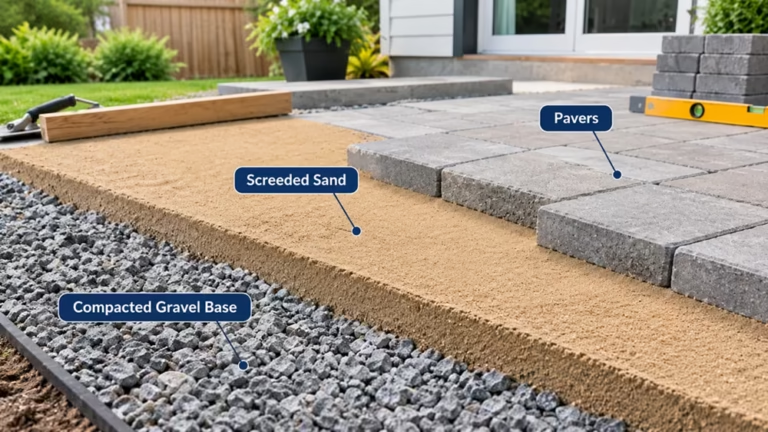 Masonry & HardscapePaver Base Material: What to Put Under Pavers and How DeepUnder pavers you need two built layers: a compacted base of crushed stone and a thin bed of…Read the guide →9 min read
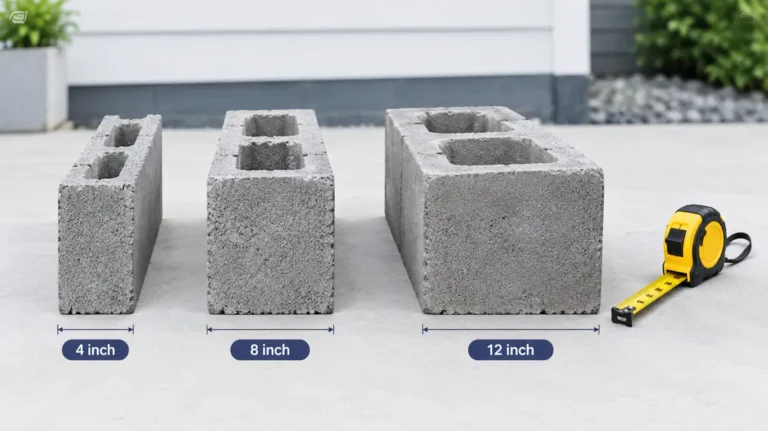 Masonry & HardscapeCMU Block Sizes: Standard Concrete and Cinder Block DimensionsA standard concrete block, often called a cinder block or CMU (concrete masonry unit), is 8 × 8…Read the guide →9 min read
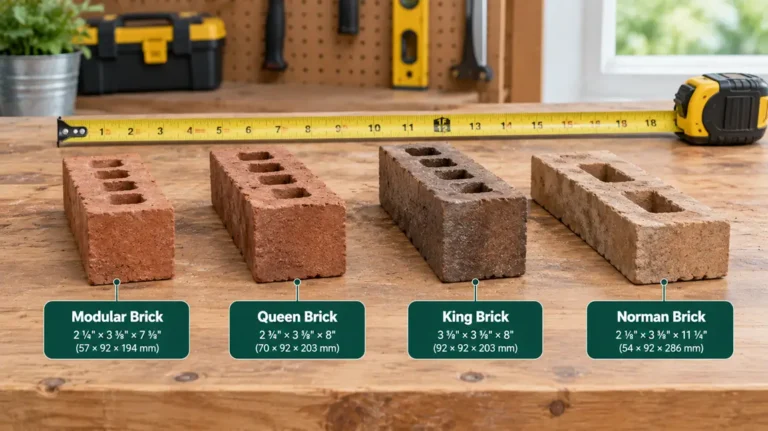 Masonry & HardscapeStandard Brick Dimensions: Size Chart, Types and WeightsThe most common brick in the United States is the modular brick: 3⅝ in deep, 2¼ in tall…Read the guide →9 min read