Use this paver calculator to plan a patio, walkway or driveway. Enter the size of the area and your paver size. It works as a paver base and paver sand calculator too: you get the pavers, base gravel, bedding sand, polymeric sand, edge restraint and the depth to dig out.
Joints, extra and cost
Set by the laying pattern. You can change it.
Base gravel includes 15% for compaction and bedding sand 10%. Polymeric sand coverage depends on the joints, so check the chart on the bag.
How the paver calculator works
- Area: length × width for a rectangle, or 3.1416 × radius × radius for a circle
- Pavers = area × 144 ÷ (paver length × paver width in inches), plus extra for cuts: 5% for straight or running bond, 10% for herringbone or diagonal, 15% for curves
- Base gravel = area × base depth ÷ 12, plus 15% for compaction, at 1.55 tons per cubic yard
- Bedding sand = area × sand depth ÷ 12, plus 10%, at 1.35 tons per cubic yard
- Polymeric sand = joint length × joint width × paver thickness, at about 100 lb per cubic foot, plus 10%
- Edge restraint = the outside edge of the area, for a rectangle 2 × (length + width)
- Depth to dig = base + sand + paver thickness
Worked example
A 16 × 12 ft patio in 4 × 8 in brick pavers, 2⅜ in thick, laid in running bond with ⅛ in joints, on 4 in of base and 1 in of sand:
- Area: 16 × 12 = 192 sq ft
- Pavers: 144 ÷ (8 × 4) = 4.5 per sq ft, so 192 × 4.5 = 864, plus 5% = 907.2, rounded up to 908 pavers
- Base: 192 × 4 ÷ 12 = 64 cu ft, plus 15% = 73.6 cu ft, or 2.73 cu yd. At 1.55 tons per cubic yard that is 4.23 tons (or 148 bags of 0.5 cu ft).
- Bedding sand: 192 × 1 ÷ 12 = 16 cu ft, plus 10% = 17.6 cu ft, or 0.65 cu yd, which is 0.88 tons (or 36 bags)
- Polymeric sand: each sq ft has 144 × (8 + 4) ÷ 32 = 54 in of joint. 54 × ⅛ × 2⅜ = 16 cu in per sq ft. Over 192 sq ft that is 1.78 cu ft, or about 178 lb, plus 10% = 196 lb, which is 4 bags of 50 lb.
- Edge restraint: 2 × (16 + 12) = 56 ft, less any side against the house
- Dig out: 4 + 1 + 2⅜ = 7⅜ in
Pavers per square foot and polymeric sand coverage
Coverage is for 50 lb bags with 10% extra, based on 2⅜ in thick pavers. Thinner slabs have shallower joints, so a bag covers more. The coverage chart on your bag comes first.
| Paver size | Pavers per sq ft | Sq ft per 50 lb bag, ⅛ in joints | Sq ft per 50 lb bag, ¼ in joints |
|---|---|---|---|
| 4 × 8 in | 4.5 | About 49 | About 24 |
| 6 × 6 in | 4.0 | About 55 | About 28 |
| 6 × 9 in | 2.67 | About 66 | About 33 |
| 12 × 12 in | 1.0 | About 110 | About 55 |
| 16 × 16 in | 0.56 | About 147 | About 73 |
| 12 × 24 in | 0.5 | About 147 | About 73 |
| 24 × 24 in | 0.25 | About 220 | About 110 |
How deep should the base be?
These are typical depths used in the paving trade. Soft or clay soil, and areas that stay wet, need the deeper end of each range.
| Project | Base gravel | Bedding sand | Dig out, with 2⅜ in pavers |
|---|---|---|---|
| Patio or walkway | 4 to 6 in | 1 in | About 7⅜ to 9⅜ in |
| Driveway | 8 to 12 in | 1 in | About 11⅜ to 15⅜ in |
Tips for a paver project
- Use a dense-graded base that packs hard, not round stone. Compact it in layers of about 2 to 3 in. The crushed stone calculator covers the base stone types.
- Use coarse concrete sand for the bedding layer and screed it flat. Don’t compact it before laying the pavers, and keep it to about 1 in.
- Slope the patio away from the house so water runs off. A common target is about ¼ in of fall per foot.
- Fit edge restraint on every open edge, or the pavers creep apart over time. Edges against a house or a wall don’t need it.
- Sweep polymeric sand in only when the pavers are dry, then wet it as the bag says. Leftover dust on the surface can leave a haze.
- If a raised patio needs a low wall around it, the retaining wall calculator counts the blocks and caps.
Frequently asked questions
How much sand do I need for pavers?
For a 1 in bedding layer, 100 sq ft takes 8.3 cu ft of sand, or about 0.34 cu yd with 10% extra. That is about 0.46 tons of concrete sand. Joint sand is separate: use polymeric sand or fine joint sand after the pavers are laid.
How much paver base do I need?
Multiply the area by the base depth in feet, then add about 15% for compaction. For 100 sq ft at 4 in deep, that is 33.3 cu ft plus 15%, or about 1.42 cu yd. At 1.55 tons per cubic yard, that is about 2.2 tons of base gravel.
How many pavers are in a square foot?
Divide 144 by the paver length times its width in inches. Standard 4 × 8 in brick pavers come to 4.5 per sq ft, 6 × 6 in pavers to 4, and 12 × 12 in pavers to 1. Add extra for cuts, more for herringbone and curved edges.
How much polymeric sand do I need?
For 4 × 8 in pavers with ⅛ in joints, a 50 lb bag covers about 45 to 55 sq ft. Large slabs cover much more, and wide joints much less. Enter your joint width and paver thickness in the calculator’s settings, and check the coverage chart on the bag.
How deep do I need to dig for pavers?
Add the base depth, the sand bed and the paver thickness. A patio with 4 in of base, 1 in of sand and 2⅜ in pavers needs about 7⅜ in. A driveway with 8 in of base needs about 11⅜ in.
Results are estimates for planning. Base depths, sand and joint widths vary with the soil and the product, so confirm quantities with your supplier. See How We Calculate for the formulas we use.
Guides for this project
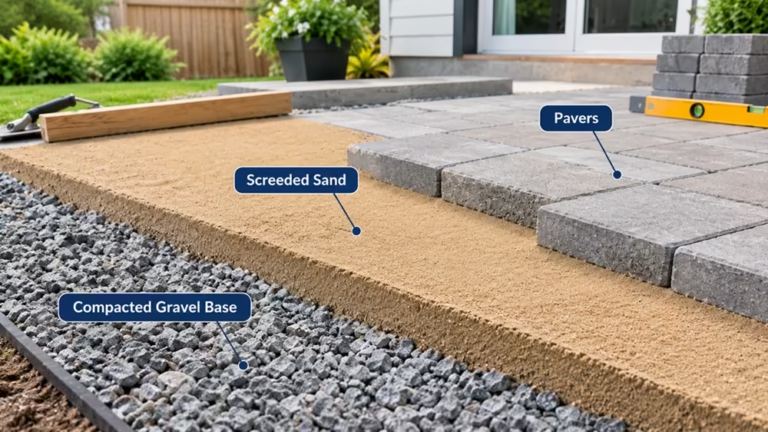 Masonry & HardscapePaver Base Material: What to Put Under Pavers and How DeepUnder pavers you need two built layers: a compacted base of crushed stone and a thin bed of…Read the guide →9 min read
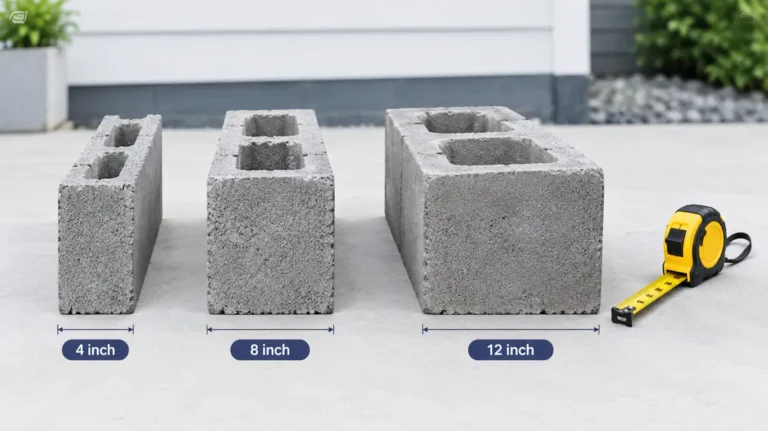 Masonry & HardscapeCMU Block Sizes: Standard Concrete and Cinder Block DimensionsA standard concrete block, often called a cinder block or CMU (concrete masonry unit), is 8 × 8…Read the guide →9 min read
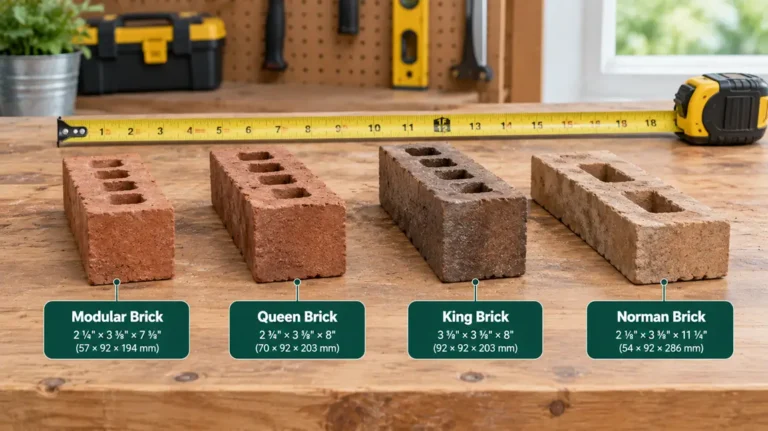 Masonry & HardscapeStandard Brick Dimensions: Size Chart, Types and WeightsThe most common brick in the United States is the modular brick: 3⅝ in deep, 2¼ in tall…Read the guide →9 min read