Use this concrete block calculator, also called a cinder block calculator, to find how many blocks you need for a wall. Enter the wall length and height and pick the block size. You get the block count, the number of courses, the bags of mortar and the concrete needed to fill the cores.
Extra, fill and cost settings
Set from the block size. Change it if your supplier gives a figure.
Mortar counts use typical bag yields for 8 × 8 × 16 in block. Rebar, footings and bond beams are not included.
How the block count works
A standard concrete block is sold as 8 × 8 × 16 inches, but its real size is 7⅝ × 7⅝ × 15⅝ inches. The missing ⅜ inch is the mortar joint. Each block plus its joint covers 8 × 16 inches of wall face, which is 128 square inches.
- Blocks per square foot = 144 ÷ (block length × block height, with joints) = 144 ÷ 128 = 1.125
- Courses (rows) = wall height in inches ÷ block height, rounded up to a whole course
- Blocks per course = wall length in inches ÷ block length
- Blocks = courses × blocks per course − openings × 1.125, plus extra for cuts and breakage (5% by default)
- Core fill = blocks × fill for one block × share of cores filled, plus 10% for spills
- Bags of fill = cubic feet of fill ÷ 0.6, the yield of an 80 lb bag of concrete mix
The height is rounded up to whole courses because a block wall is built in full rows. A 4 ft 6 in wall in 8 in block becomes 7 courses, or 4 ft 8 in. If you need an exact height, plan for a half-high block or a cap on the top course.
Worked example
A garden wall 30 ft long and 4 ft high, built with standard 8 × 8 × 16 in block and 80 lb bags of premixed mortar:
- Courses: 48 in ÷ 8 in = 6 courses
- Blocks per course: 360 in ÷ 16 in = 22.5 blocks
- Blocks: 6 × 22.5 = 135, plus 5% = 141.75, rounded up to 142 blocks
- Mortar: 142 ÷ 13 blocks per bag = 10.9, rounded up to 11 bags
- Fill at rebar every 48 in (1 core in 6): 135 × 0.25 cu ft × 1/6 × 1.10 = 6.2 cu ft, or 0.23 cu yd. That is 11 bags of 80 lb concrete mix.
- Solid grouted instead: 135 × 0.25 × 1.10 = 37.1 cu ft, or 1.38 cu yd, which is 62 bags. At that size, ready-mix or bulk grout is usually easier than bags.
If you mix your own mortar from 70 lb bags of masonry cement and sand, the same wall needs 4 bags of masonry cement and about 0.48 tons of mason sand.
Block sizes and core fill
Every block below has an 8 × 16 in face with joints, except the half-high block. The fill figures are typical values for hollow block with every core filled and nothing extra added. Core shapes vary by maker, so you can change the fill per block in the calculator’s settings.
| Block (nominal) | Real size | Blocks per sq ft | Fill per block | Fill per 100 sq ft, solid grouted |
|---|---|---|---|---|
| 4 × 8 × 16 in | 3⅝ × 7⅝ × 15⅝ in | 1.125 | Usually not filled | – |
| 6 × 8 × 16 in | 5⅝ × 7⅝ × 15⅝ in | 1.125 | 0.18 cu ft | 20.3 cu ft (0.75 cu yd) |
| 8 × 8 × 16 in | 7⅝ × 7⅝ × 15⅝ in | 1.125 | 0.25 cu ft | 28.1 cu ft (1.04 cu yd) |
| 10 × 8 × 16 in | 9⅝ × 7⅝ × 15⅝ in | 1.125 | 0.34 cu ft | 38.3 cu ft (1.42 cu yd) |
| 12 × 8 × 16 in | 11⅝ × 7⅝ × 15⅝ in | 1.125 | 0.42 cu ft | 47.3 cu ft (1.75 cu yd) |
| 8 × 4 × 16 in half-high | 7⅝ × 3⅝ × 15⅝ in | 2.25 | 0.12 cu ft | 27.0 cu ft (1.00 cu yd) |
Mortar per 100 blocks
| Mortar | Blocks per bag | For 100 blocks |
|---|---|---|
| 80 lb bag of premixed mortar | About 13 | 8 bags |
| 70 lb bag of masonry cement + 240 lb of mason sand | About 46 | 3 bags + about 0.36 tons of sand |
These are typical yields printed on bags for 8 × 8 × 16 in block. Half-high block uses more mortar per block, so the calculator scales the yield by the length of joint around each block.
Tips for planning a block wall
- Start with the footing. A block wall needs a level, solid concrete footing, usually twice as wide as the block. The concrete footing calculator works out the concrete for it.
- Decide on reinforcement before you order. Every core with rebar in it gets filled, so the rebar spacing sets your fill. The rebar calculator counts bars and lengths, but the spacing for a wall that holds back soil or carries a load comes from your plans and local code.
- Add a bond beam if your plan has one. A bond beam is a top course filled solid with a horizontal bar. Add about 0.25 cu ft of fill for each 8 in block in that course.
- Pick the right fill. Small cores and cores with rebar fill best with fine grout or a concrete mix with small stone. Use whatever your plans call for.
- Count corner and end blocks as part of the total. They replace regular blocks, so the overall count stays about the same.
- Keep the 5% extra. Blocks chip in transport, and cut blocks at ends and openings are often wasted.
Frequently asked questions
How do I calculate how many concrete blocks I need?
Multiply the wall area in square feet by 1.125 for standard 8 × 16 in face block. A wall 20 ft long and 8 ft high is 160 sq ft, so it needs 180 blocks before extra. Subtract about 1.125 blocks for every square foot of door or window, then add 5% for breakage.
How many blocks are in a square foot of wall?
About 1.125 for any block with an 8 × 16 in face, which covers 6, 8, 10 and 12 in wide block. Half-high 4 × 16 in block takes 2.25 per square foot. The width of the block changes the fill and the weight, not the count.
How much concrete does it take to fill cinder blocks?
A standard 8 × 8 × 16 in block takes about 0.25 cu ft when every core is filled. That is roughly 1 cu yd for every 100 sq ft of solid grouted wall, or about 2 blocks per 80 lb bag of concrete mix. If you only fill the cores with rebar every 48 in, you need about one sixth of that.
How many bags of mortar do I need per block?
An 80 lb bag of premixed mortar lays about 13 standard blocks, so 100 blocks need about 8 bags. A 70 lb bag of masonry cement mixed with sand lays about 46 blocks. These are typical figures, so keep a spare bag on site.
Is a cinder block the same as a concrete block or CMU?
In everyday use, yes. CMU means concrete masonry unit, the trade name for concrete block. Older cinder blocks used coal cinders in the mix, but most blocks sold today are made with sand and stone. The sizes and the math are the same.
Results are estimates for planning. Block sizes, core shapes and mortar use vary, so confirm quantities with your supplier and check your plans and local code for footings and reinforcement. See How We Calculate for the formulas we use.
Guides for this project
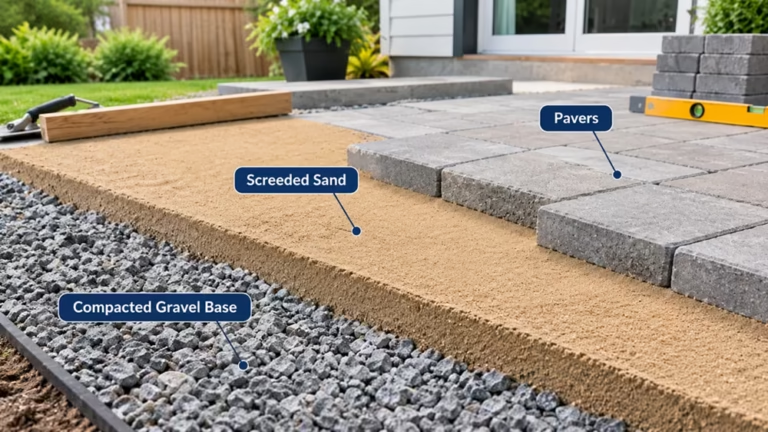 Masonry & HardscapePaver Base Material: What to Put Under Pavers and How DeepUnder pavers you need two built layers: a compacted base of crushed stone and a thin bed of…Read the guide →9 min read
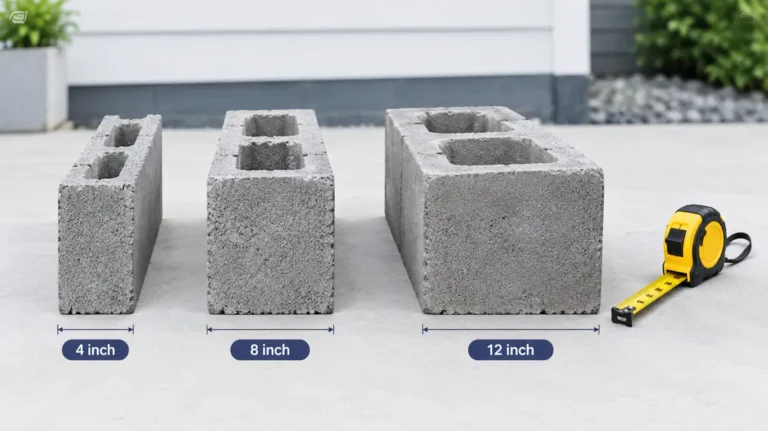 Masonry & HardscapeCMU Block Sizes: Standard Concrete and Cinder Block DimensionsA standard concrete block, often called a cinder block or CMU (concrete masonry unit), is 8 × 8…Read the guide →9 min read
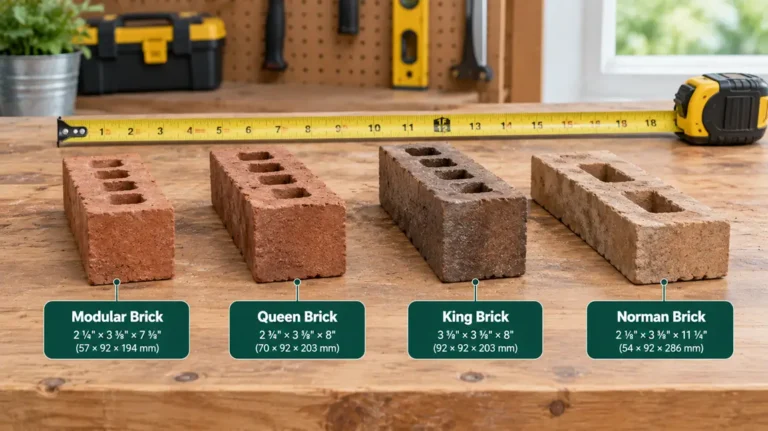 Masonry & HardscapeStandard Brick Dimensions: Size Chart, Types and WeightsThe most common brick in the United States is the modular brick: 3⅝ in deep, 2¼ in tall…Read the guide →9 min read