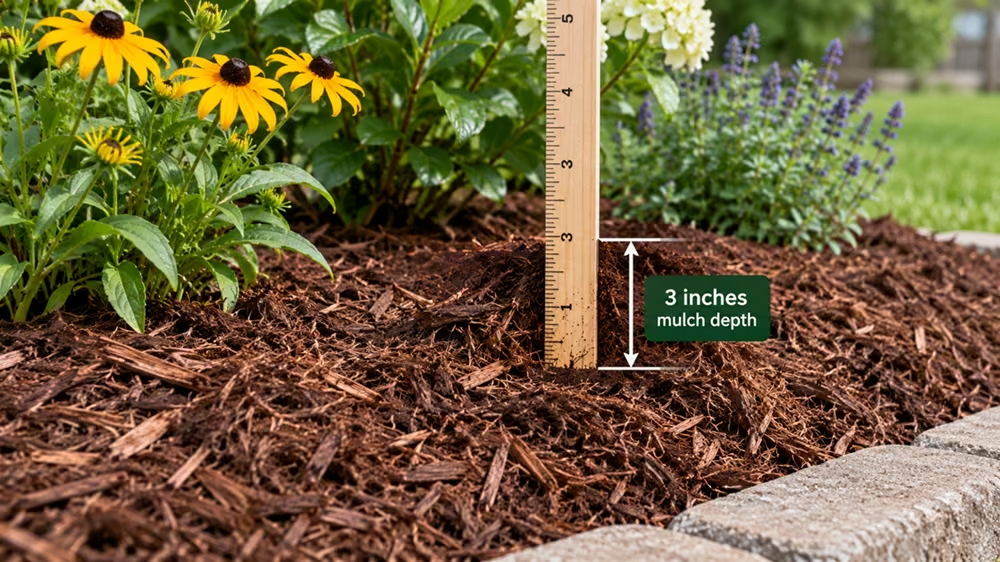
Spread mulch 2 to 4 inches deep. Fine or shredded mulch works best at 2 to 3 in, and coarse bark nuggets or wood chips at 3 to 4 in. Around trees, keep it about 3 in deep in a wide, flat ring that never touches the trunk. On clay or poorly drained soil, about 2 in is enough, and more than 4 in of mulch does more harm than good.
This guide covers the right depth for beds, trees, vegetable gardens and slopes, how to avoid a mulch volcano, how often to top up and how far a yard or a bag goes at each depth. To turn your bed size and depth into cubic yards and bags, use the mulch calculator.
Mulch depth chart
Depths are for settled mulch, measured from the soil surface. Old mulch that is still in place counts toward the total.
| Where | Mulch depth | Notes |
|---|---|---|
| Flower and shrub beds | 2–3 in | Shredded hardwood, fine bark, compost |
| Beds with coarse mulch | 3–4 in | Bark nuggets, wood chips |
| Around trees | 2–4 in | 3 in is a good target; never against the trunk |
| Vegetable gardens | 3–4 in | Straw and shredded leaves settle, so start thicker |
| Pine straw | 4–5 in loose | Settles to about 2 in |
| Clay or wet soil | About 2 in | A thin layer lets the soil dry out |
| Slopes | 2–3 in | Shredded mulch or pine straw stays in place |
| Next to the house | Under 2 in | Keep it off the siding and the foundation |
These ranges follow common university extension advice. The University of Illinois Extension mulching guide, for example, gives 2 to 4 in for well-drained soil, 2 to 3 in for fine mulch and 3 to 4 in for coarse mulch. Treat them as typical guidance, not exact rules.
Why mulch texture changes the depth
Fine mulch packs tighter. Double-shredded hardwood, sawdust and compost settle into a dense mat, so a thick layer can shed water and cut off air to the roots below. Keep these to 2 to 3 in. Coarse mulch, such as pine bark nuggets and wood chips, has larger gaps that let water and air through, so it can go to 3 to 4 in without harm, and it blocks weeds better at that depth.
Light, fluffy mulches work the other way. Pine straw and garden straw are mostly air when they go down and settle quickly after rain, so you spread them thicker than the depth you want to end up with. Rubber mulch doesn’t break down or pack down, and about 2 in is the usual depth in landscape beds; our calculator starts rubber mulch at 2 in. Playground surfaces are a different case and follow separate safety depths that are much deeper than garden mulch.
How deep to mulch around trees (and how to avoid a mulch volcano)
Around a tree, mulch should look like a flat donut, not a cone. A mulch volcano is mulch piled high against the trunk, often 8 in or more. It keeps the bark wet so it can rot, gives voles a hidden place to chew the trunk, and lets roots grow up into the mulch and circle the trunk. Over time these girdling roots can choke the tree, and extension services rank mulch piled against the trunk among the most common causes of tree decline.
Many arborists sum up the right way as the 3-3-3 rule:
- 3 in away: leave a gap of at least 3 in between the mulch and the trunk, so the root flare (where the trunk widens into the roots) stays visible. Around big, mature trees, make the gap wider, up to about a foot.
- 3 in deep: aim for about 3 in, within the usual 2 to 4 in, and never more than 4 in.
- 3 ft wide: make the ring at least 3 ft across, and wider where you can. Many extension guides suggest 3 to 6 ft out from the trunk, or all the way to the drip line (the outer edge of the branches). A wide ring also keeps mowers and string trimmers away from the trunk.
The University of Vermont Extension also warns that more than 4 in of mulch can make a tree grow roots from the trunk instead of from its root system. If an old volcano is already in place, pull the mulch back until you can see the flare and rake the rest flat. Where many roots have grown up into a deep pile, take it down over a season or two, or ask an arborist.
To size a tree ring, choose Circle in the mulch calculator. Its default 10 ft circle (a ring 5 ft out from the trunk) at 3 in needs about 0.80 cubic yards, or 11 bags of 2 cu ft, including 10% extra for settling. The bare gap at the trunk is too small to change the total.
Grass often struggles in the shade and among the roots right under a tree, so a wide mulch ring is usually easier to keep healthy there than lawn. If you are planning new turf for the sunny parts of the yard, see our guide to the best time to lay sod.
Seeding bare patches of lawn instead of mulching them? See the best time to plant grass seed for your grass type.
Flower beds, shrubs and vegetable gardens
Flower and shrub beds: use 2 to 3 in of shredded hardwood or fine bark, or 3 to 4 in of nuggets. Pull the mulch back an inch or two from the stems of shrubs and perennials, the same way you would around a tree trunk. Around small annuals and new transplants, 2 in is plenty; tuck it around the plants, not over them.
Vegetable gardens: use about 3 to 4 in of straw, shredded leaves or pine straw, spread after the soil has warmed and the plants are up. University of Georgia Extension notes that light materials like pine straw settle quickly, so they may need to go down a little deeper. Compost works as a thinner 2 to 3 in layer. Keep wood chips on the paths between beds rather than mixing them into the soil.
Pine straw: spread 4 to 5 in of fresh straw. It settles to about 2 in, and UGA Extension says a settled 2 in layer does most of the weed-blocking work of landscape fabric. When you refresh it, add new straw on top of the old instead of raking it all out.
Slopes, clay soil and next to the house
Slopes and hills
Use a mulch that knits together, such as shredded hardwood, double-shredded bark or pine straw, at 2 to 3 in. Round bark nuggets and light chips roll or float away in heavy rain. On steep banks, a jute or coir erosion net under the mulch helps hold it until plants fill in.
Clay or poorly drained soil
Keep mulch to about 2 in. Wet clay already holds plenty of water, and a thick layer keeps it soggy, which can rot roots and bark.
Next to the house
Keep mulch off the siding and leave the bottom of the foundation visible, so you can spot termite mud tubes. Within about a foot of the foundation, keep the layer thin, under 2 in, so the soil there can dry out. Deep mulch against the wall holds moisture where termites like it and can bridge the treated soil around a house. Slope the soil under the mulch away from the walls.
What happens if mulch is too deep
- Roots run short of air: more than about 4 in, especially of fine mulch, slows the air and water that reach the roots.
- Roots grow into the mulch: plants put shallow roots into the damp mulch, and those roots dry out fast in hot weather.
- Matting: a thick, fine layer can form a crust that sheds rain instead of letting it soak in.
- Sour mulch: deep piles without air can turn sour, with a vinegar or ammonia smell, and can burn nearby plants.
- Pests and rot: deep mulch against stems and trunks keeps bark wet and hides voles.
If a bed has built up too deep after years of topping up, rake off the extra until 2 to 4 in is left, and break up any crust so water can get through. Fill low spots in a bed with soil, not extra mulch; the topsoil calculator works out the soil to raise an area.
Not sure which soil to use for filling low spots or building up a bed? See topsoil vs garden soil vs fill dirt.
How often to add or replace mulch
Organic mulch breaks down into the soil, which is part of its job. How fast depends on the material: fine shredded mulch and pine straw often need a top-up every year, chunky bark nuggets last a few years, and rubber or stone doesn’t break down at all. Dyed mulch usually loses its color before it loses its depth.
Before you add more, measure what is there. Push a trowel into the bed, check the depth with a ruler, and add only enough to bring the total back to 2 to 4 in. In many beds that is about 1 in a year. Adding a fresh 3 in every spring just for the color is how beds end up too deep and how mulch volcanoes grow.
You don’t need to remove old mulch every year. Rake it to loosen it and top it up. Remove it only when the layer is too deep, has formed a thick mat or smells sour, or when you want to work compost into the soil.
The most common time to mulch is mid to late spring, after the soil has warmed and the weeds are pulled. Early fall works too, and a winter mulch over perennials goes on after the ground freezes.
Thinking about stone instead of mulch for a bed or border? See pea gravel vs river rock for where each one works.
How far mulch goes at each depth
Depth decides how much you buy. One cubic yard is 27 cubic feet, which is 13.5 bags of 2 cubic feet or 9 bags of 3 cubic feet. Spread at different depths, it covers:
| Depth | 1 cubic yard covers | 2 cu ft bag covers | 3 cu ft bag covers |
|---|---|---|---|
| 1 in | 324 sq ft | 24 sq ft | 36 sq ft |
| 2 in | 162 sq ft | 12 sq ft | 18 sq ft |
| 3 in | 108 sq ft | 8 sq ft | 12 sq ft |
| 4 in | 81 sq ft | 6 sq ft | 9 sq ft |
These are exact volumes with nothing added. Fresh mulch settles after rain and watering, so plan on about 10% extra.
Worked example: a 20 × 10 ft bed
The mulch calculator starts with a 20 × 10 ft bed (200 sq ft) of shredded hardwood at 3 in deep, with 10% extra for settling:
- Volume: 200 × 3 ÷ 12 = 50 cubic feet, plus 10% = 55 cubic feet
- Cubic yards: 55 ÷ 27 = 2.04 cubic yards
- Bags: 55 ÷ 2 = 27.5, rounded up to 28 bags of 2 cu ft
Changing only the depth on the same bed:
| Depth | Cubic yards | 2 cu ft bags |
|---|---|---|
| 2 in | 1.36 | 19 |
| 3 in | 2.04 | 28 |
| 4 in | 2.72 | 37 |
Each extra inch on this bed adds about two-thirds of a cubic yard, or 9 bags. That is why measuring the old mulch first pays off: if 1 in is still in place, a 3 in target needs only 2 in of new mulch. For bulk orders in other units, the cubic yard calculator converts between cubic feet, cubic yards and cubic metres.
Frequently asked questions
How deep should mulch be in flower beds?
About 2 to 3 in of shredded hardwood or fine bark, or 3 to 4 in of coarse bark nuggets or wood chips. Keep it an inch or two back from plant stems, and don’t go over 4 in.
Is 2 inches of mulch enough?
Yes, for fine mulch, clay or poorly drained soil, beds next to the house and settled pine straw. For weed control with coarse bark or wood chips, 3 in works better.
How thick should mulch be to prevent weeds?
About 2 to 3 in of fine mulch or 3 to 4 in of coarse mulch blocks the light most weed seeds need. Pull existing weeds first, because mulch stops new seedlings better than it stops established perennial weeds.
How much mulch should go around a tree?
A flat ring 2 to 4 in deep (about 3 in is ideal), at least 3 ft across and wider where you can, with a gap of at least 3 in between the mulch and the trunk. The root flare at the base of the trunk should always stay visible.
What is a mulch volcano?
It is mulch piled in a cone against a tree trunk. It keeps the bark wet, invites rot and voles, and encourages roots that circle and girdle the trunk. Pull the mulch back from the trunk and spread it into a flat ring instead.
How long does mulch last?
Fine shredded mulch and pine straw usually need a top-up after about a year, while bark nuggets last a few years. Rubber and stone mulch don’t break down. Dyed mulch often fades within a season, even when the depth is still fine.
Should I remove old mulch before adding new mulch?
Usually not. Measure the old layer, loosen it with a rake and add only enough new mulch to reach 2 to 4 in in total. Remove old mulch only if the bed is too deep, matted or smells sour.
Can you put mulch over grass?
A normal layer of mulch won’t kill healthy grass, which grows back through it. To turn lawn into a bed, remove the sod or smother it first, for example with a layer of cardboard, then add about 3 in of mulch on top.
How many bags of mulch are in a yard?
One cubic yard is 27 cubic feet, which equals 13.5 bags of 2 cubic feet or 9 bags of 3 cubic feet. Round up when you buy, since bag sizes vary and mulch settles.
How much does a yard of mulch cover?
About 162 sq ft at 2 in deep, 108 sq ft at 3 in and 81 sq ft at 4 in. Add about 10% for settling when you order.
Mulch depths on this page are typical guidance from university extension services for home landscapes. Soil, climate and the mulch you choose change what works best, so check with your local extension office for plants with special needs. Use the mulch calculator to turn your bed size and depth into cubic yards and bags.
Keep reading
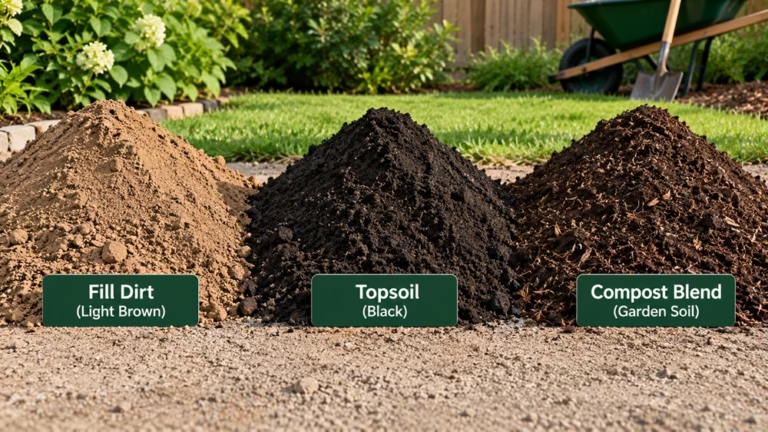 Soil, Mulch & LawnTopsoil vs Garden Soil vs Fill Dirt: Which Soil to Use WhereThe short answer: fill dirt is subsoil with little organic matter, used to fill holes and raise the…Read the guide →9 min read
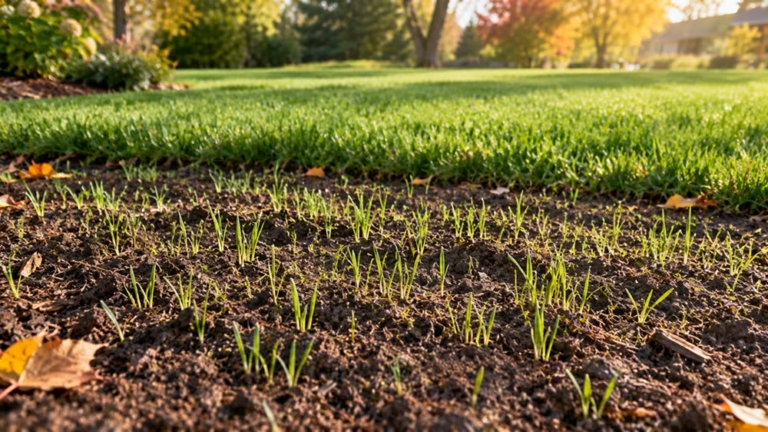 Soil, Mulch & LawnBest Time to Plant Grass Seed (and When to Overseed)The best time to plant grass seed depends on your grass type. For cool-season grasses such as tall…Read the guide →9 min read
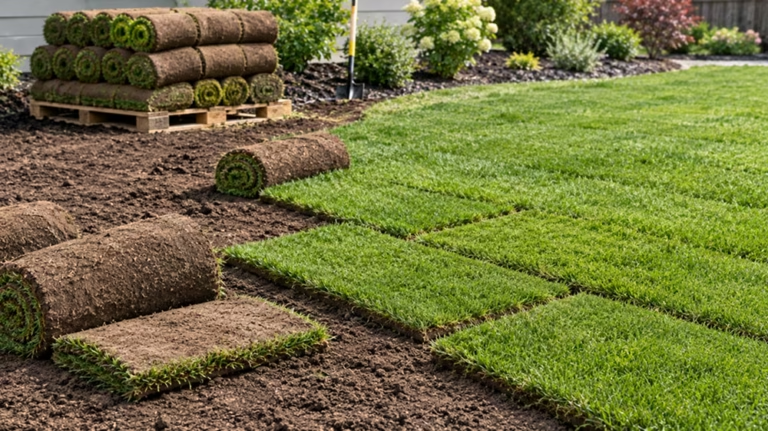 Soil, Mulch & LawnBest Time to Lay Sod: By Season, Region and Grass TypeThe best time to lay sod depends on your grass. Cool-season grasses such as tall fescue and Kentucky…Read the guide →10 min read