Use this grout calculator to work out how much grout you need for a tile job, and how many bags of thinset to set the tile. Enter the area, the tile size and thickness, and the grout joint width. It works for sanded, unsanded and premixed grout.
Picked from the tile size. Change it if your tile maker says otherwise.
Extra and cost
Grout uses the joint volume and typical weights. Thinset uses typical coverage per trowel notch. The chart on the bag comes first.
How the grout calculator works
- Joint length per sq ft = 144 × (tile length + tile width) ÷ (tile length × tile width), in inches
- Joint volume per sq ft = joint length × joint width × tile thickness, in cubic inches
- Cement grout = joint volume ÷ 1,728 × about 110 lb per cubic foot, plus 10% extra
- Premixed or epoxy grout = joint volume ÷ 231 cubic inches per gallon, plus 10%
- Thinset = area ÷ coverage of one 50 lb bag for the trowel notch
- The trowel is picked from the largest side of the tile, as most tile makers suggest
Grout weights and thinset coverage are typical figures. The coverage chart on your bag comes first.
Worked example
A 100 sq ft floor in 12 × 12 in tile, ⅜ in thick, with ⅛ in joints and sanded grout:
- Joint length: 144 × 24 ÷ 144 = 24 in per sq ft
- Joint volume: 24 × ⅛ × ⅜ = 1.13 cu in per sq ft
- Grout: 100 × 1.125 × 1.10 = 123.8 cu in, ÷ 1,728 × 110 = 7.9 lb, so 1 bag of 25 lb
- Thinset: 12 in tile takes a ¼ × ⅜ in notch, about 65 sq ft per bag, so 100 ÷ 65 = 1.5, rounded up to 2 bags
The same floor in 3 × 6 in subway tile with 1/16 in joints needs about 9.8 lb of grout, and unsanded or premixed grout suits that thin joint better. In 24 × 24 in tile it needs only about 3.9 lb of grout, but 3 bags of thinset with a ½ × ½ in notch.
Grout per 100 sq ft
Pounds of cement grout, before extra:
| Tile and thickness | 1/16 in joint | ⅛ in joint | 3/16 in joint | ¼ in joint |
|---|---|---|---|---|
| 2 × 2 in mosaic, ¼ in | 14.3 lb | 28.6 lb | 43.0 lb | 57.3 lb |
| 3 × 6 in subway, 5/16 in | 9.0 lb | 17.9 lb | 26.9 lb | 35.8 lb |
| 4 × 4 in, ¼ in | 7.2 lb | 14.3 lb | 21.5 lb | 28.6 lb |
| 6 × 6 in, 5/16 in | 6.0 lb | 11.9 lb | 17.9 lb | 23.9 lb |
| 12 × 12 in, ⅜ in | 3.6 lb | 7.2 lb | 10.7 lb | 14.3 lb |
| 12 × 24 in, ⅜ in | 2.7 lb | 5.4 lb | 8.1 lb | 10.7 lb |
| 24 × 24 in, ⅜ in | 1.8 lb | 3.6 lb | 5.4 lb | 7.2 lb |
Thinset coverage by trowel
| Trowel notch | Typical tile | Sq ft per 50 lb bag, about |
|---|---|---|
| 3/16 in V-notch | Mosaics and small wall tile | 110 |
| ¼ × ¼ in square | Tile up to 8 in | 95 |
| ¼ × ⅜ in square | Tile up to 15 in | 65 |
| ½ × ½ in square | Tile over 15 in | 43 |
Tips for grouting
- Use unsanded grout for joints up to ⅛ in and sanded grout for ⅛ in and wider. Premixed and epoxy grouts often cover both, so check the label.
- Mix only what you can use in about 30 minutes, and keep the water to what the bag says. Extra water weakens grout and causes color spots.
- Back-butter large tiles with a thin coat of thinset as well, so there are no hollow spots. That uses more thinset than the trowel figure.
- Seal cement grout in wet areas once it has cured, as the maker suggests.
- The tile calculator works out the area and the tiles for the same job.
Frequently asked questions
How much grout do I need?
It depends on the tile size, the tile thickness and the joint width. Small tiles and wide joints use much more grout. For 100 sq ft of 12 × 12 in tile with ⅛ in joints, you need about 8 lb of cement grout, so one 25 lb bag.
How many square feet does a bag of grout cover?
A 25 lb bag covers about 350 sq ft of 12 × 12 in tile with ⅛ in joints, but only about 140 sq ft of 3 × 6 in subway tile with the same joint. The chart on the bag gives the figure for your tile.
How much thinset do I need?
It depends on the trowel. A 50 lb bag covers about 95 sq ft with a ¼ × ¼ in notch, about 65 sq ft with a ¼ × ⅜ in notch and about 43 sq ft with a ½ × ½ in notch. Large tiles use the bigger notches and need more thinset.
Should I use sanded or unsanded grout?
Use unsanded grout for joints of ⅛ in or less, and on polished stone or glass that sand could scratch. Use sanded grout for joints of ⅛ in and wider, because the sand stops it from shrinking and cracking.
How do I calculate grout for tiles?
Work out the joint length per square foot from the tile size, multiply by the joint width and tile thickness to get the volume, then convert to pounds or gallons. The calculator does this and adds 10% for waste.
Results are estimates for planning. Grout and thinset coverage varies by product, so check the bag. See How We Calculate for the formulas we use.
Guides for this project
 Flooring & TileHow to Clean Laminate and Vinyl Plank (LVP) Floors: What to Use and AvoidTo clean laminate floors, sweep or vacuum first, then wipe the floor with a microfiber mop that is…Read the guide →10 min read
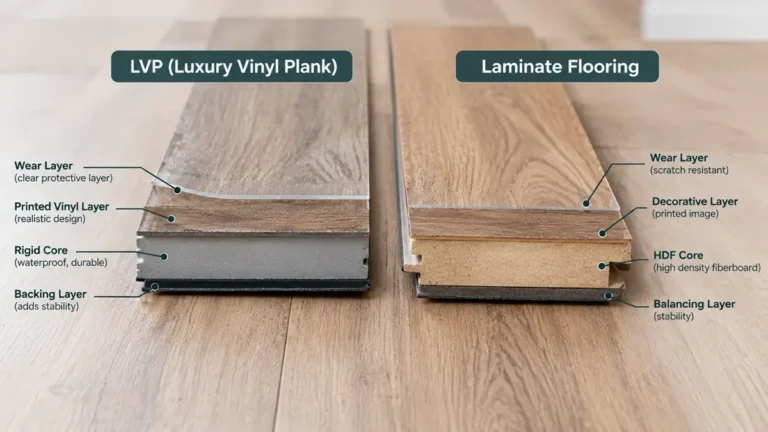 Flooring & TileLVP vs Laminate Flooring: Which Is Better?LVP (luxury vinyl plank) is the better choice for wet areas such as bathrooms, kitchens, laundry rooms and…Read the guide →9 min read