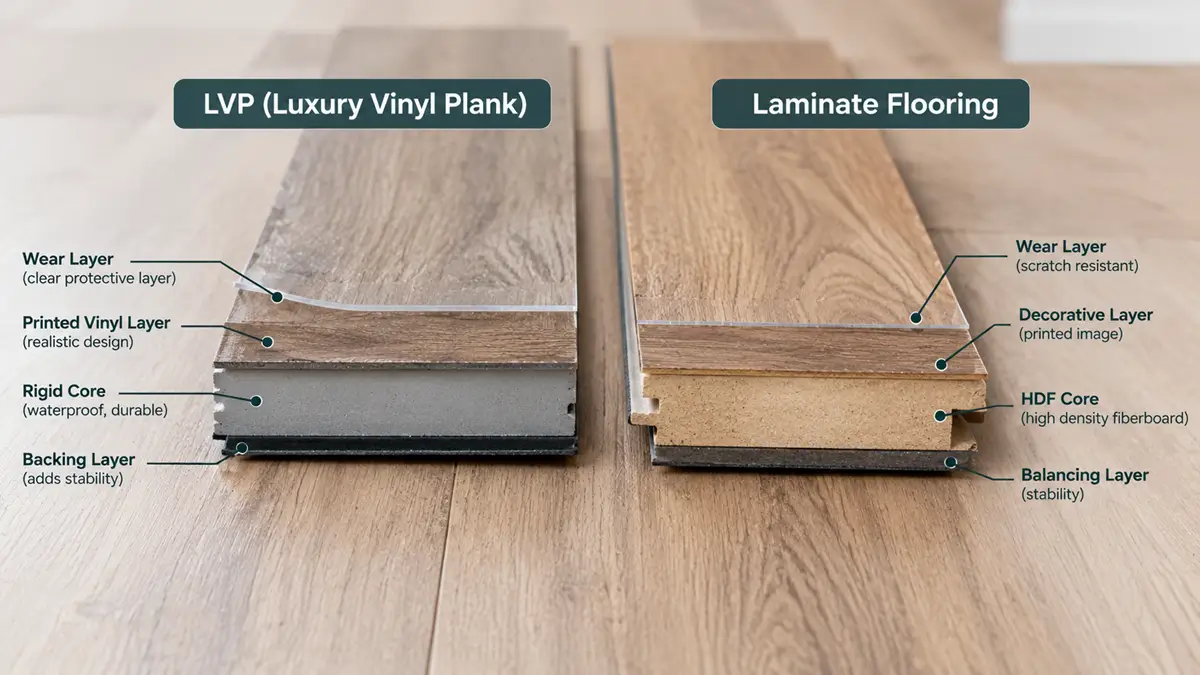
LVP (luxury vinyl plank) is the better choice for wet areas such as bathrooms, kitchens, laundry rooms and basements, because the planks are made of vinyl and won’t swell when they get wet. Laminate is the better choice for dry rooms with heavy wear, such as living rooms, hallways and bedrooms, because its hard top layer resists scratches better and it often looks more like real wood. Both are floating floors that click together, both suit DIY installation, and both cost far less than hardwood.
The biggest difference is what’s inside the plank. Laminate has a core made of wood fiber, which swells if water gets into it. LVP has a vinyl or vinyl composite core that water doesn’t harm. This guide compares the two side by side on water, durability, pets, feel, looks and installation.
LVP vs laminate at a glance
| LVP (luxury vinyl plank) | Laminate | |
|---|---|---|
| Core | Vinyl, WPC or SPC (stone-plastic) composite | High-density fiberboard (wood fiber) |
| Water | Planks are waterproof | Water resistant at best. Most swell if water reaches the core. |
| Scratch resistance | Good, depends on the wear layer | Very good, thanks to a hard aluminum oxide top layer |
| Dents | Softer types dent under heavy furniture. Rigid core resists better. | Hard and resists dents well |
| Feel underfoot | Softer, warmer and quieter | Harder, and can sound hollow without a good underlayment |
| Looks | Realistic wood and stone looks | Often more realistic wood texture, with grain you can feel |
| Thickness | About 2 to 8 mm | About 6 to 12 mm |
| Durability rating | Wear layer in mils (12 mil or more for homes) | AC rating (AC3 or higher for homes) |
| Strong sun and heat | Can fade or expand in hot, sunny rooms | More stable in heat and sun |
| Typical lifespan | About 15 to 25 years | About 15 to 25 years |
| Best rooms | Bathrooms, kitchens, laundry rooms, basements, mudrooms | Living rooms, bedrooms, hallways, home offices |
What is LVP flooring?
LVP stands for luxury vinyl plank. It’s a plank floor made in layers: a clear wear layer on top, a printed design layer that looks like wood or stone, and a vinyl-based core, often with a foam or cork pad attached underneath. Square and rectangular tiles made the same way are called LVT (luxury vinyl tile).
There are three main core types:
- Flexible LVP: thin, bendable vinyl, often glued down. It shows bumps in the subfloor.
- WPC (wood-plastic composite): a thicker, foamed core that feels soft and warm underfoot.
- SPC (stone-plastic composite): a dense, rigid core made with limestone powder. It resists dents better and hides small subfloor flaws. SPC is often sold as “rigid core” or “hybrid” flooring.
Vinyl isn’t the same as linoleum. Linoleum is made from natural materials such as linseed oil, cork and wood flour, while vinyl is made from PVC plastic.
What is laminate flooring?
Laminate is a plank made of a high-density fiberboard core (compressed wood fiber) with a high-resolution photo layer on top and a tough, clear wear layer over it. The wear layer contains aluminum oxide, which is why laminate is so hard to scratch. A backing layer on the bottom keeps the plank stable.
Laminate is graded by its AC rating, a wear test from AC1 to AC5. AC3 is suitable for every room in a home, AC4 handles busy homes and light commercial use, and AC5 is for heavy commercial traffic. Thicker laminate, about 10 to 12 mm, feels more solid and sounds less hollow than thin 6 to 8 mm boards.
Is laminate flooring waterproof?
Most laminate is water resistant, not waterproof. The top layer sheds spills, but if water sits on the floor and seeps into the seams, the fiberboard core swells and the edges peak or bubble. Once laminate swells, it doesn’t go back down, and the damaged planks have to be replaced.
Some newer laminates are sold as “waterproof”. They have water-repellent cores and tightly sealed joints, and makers rate them to hold standing water on the surface for a set number of hours. They’re a big improvement for kitchens and entryways, but they still aren’t meant for floods, wet basements or water coming up from below. Check the warranty to see exactly what it covers.
Is LVP waterproof?
The planks are. Vinyl doesn’t swell or soften when it’s wet, so spills, pet accidents and wet shoes won’t hurt the floor itself. Water can still run through the seams and around the edges to the subfloor below, where it can cause mold or damage. In bathrooms, seal the edges along the tub and walls with flexible caulk, and in basements, fix the source of any moisture first.
Durability, scratches and pets
Laminate’s hard top layer resists scratches from grit, shoes and claws better than most LVP. LVP’s durability depends on its wear layer, measured in mils (thousandths of an inch): 12 mil is a good minimum for homes, and 20 mil or more is better for busy households and pets.
For dogs and cats, the choice comes down to what worries you more. LVP handles accidents and water bowls without swelling and is quieter under claws. Laminate resists scratches better but can be ruined by urine left in the seams. Many pet owners choose rigid core LVP with a thick wear layer, or a waterproof laminate with an AC4 rating.
Neither floor can be sanded and refinished like hardwood. If a plank is badly scratched or damaged, it’s replaced, so keep a box of spare planks after installation.
Comfort, sound and looks
- Feel: LVP, especially WPC, is softer and warmer underfoot. Laminate feels harder, more like wood.
- Sound: laminate can make a hollow clicking sound when you walk on it. A good underlayment reduces this. LVP is usually quieter.
- Looks: both copy wood and stone well. Laminate often has deeper, more realistic texture that lines up with the printed grain, and from a few feet away many people can’t tell it from hardwood.
- Sunlight: LVP can fade or expand in rooms with strong, direct sun, such as sunrooms. Laminate handles heat better.
Which is better for each room?
| Room | Better choice | Why |
|---|---|---|
| Bathroom | LVP | Water from showers and tubs would swell most laminate. |
| Kitchen | LVP, or waterproof laminate | Spills and dishwasher leaks are common. |
| Laundry room and mudroom | LVP | Wet shoes, leaks and washer overflow. |
| Basement | LVP | Concrete slabs can give off moisture. |
| Living room and hallways | Laminate or LVP | Laminate resists scratches from heavy traffic. |
| Bedrooms and offices | Laminate or LVP | Dry rooms where either works well. |
| Sunroom | Laminate | Handles heat and strong sun better. |
Installation differences
Both floors usually install as floating floors with click-lock edges, so they rest on the subfloor without nails or glue. A few differences matter:
- Cutting: most LVP can be cut by scoring it with a utility knife and snapping it. Laminate needs a saw or a laminate cutter.
- Underlayment: laminate needs a foam underlayment unless one is attached. Many LVP planks have a pad attached, and adding another layer under them can void the warranty, so follow the maker’s instructions.
- Over concrete: laminate needs a vapor barrier, usually 6 mil plastic or an underlayment with a built-in barrier. Check the LVP instructions too, because some require one.
- Acclimation: laminate usually needs to sit in the room for about 48 hours before installation. Many rigid core LVP products need less time, but check the box.
- Expansion gap: leave the gap the maker calls for, often about ¼ inch, around the walls, and cover it with baseboard or quarter round.
- Over tile: both can usually go over old tile if it’s solid and flat, often within about 3/16 inch over 10 feet. Fill deep grout lines first.
How much flooring do you need? A worked example
Say you’re covering a 14 × 12 ft room with one doorway, and the boxes say they hold 20 sq ft each:
- Room area: 14 × 12 = 168 sq ft
- Add 10% for cuts and waste with a straight layout: 168 × 1.10 = 184.8 sq ft
- Boxes: 184.8 ÷ 20 = 9.2, rounded up to 10 boxes (200 sq ft)
- Underlayment, if needed: 168 sq ft in 100 sq ft rolls = 2 rolls
- Baseboard or quarter round: room perimeter 52 ft, minus 3 ft for the doorway = 49 ft
The numbers are the same for LVP and laminate when the boxes hold the same area, so check the label on the products you’re comparing. These are the default numbers in our flooring calculator, which handles several rooms at once and adds up the cost with your own prices. For L-shaped or odd-shaped rooms, the square footage calculator helps you get the area first. If you’re thinking about tile for a bathroom instead, the tile calculator counts the tiles.
LVP and laminate vs hardwood and engineered wood
Solid hardwood is real wood all the way through and can be sanded and refinished many times. Engineered hardwood has a real wood top layer over plywood, so it looks and feels like hardwood and can usually be refinished once or twice. Both cost more than LVP and laminate, and both are easily damaged by water. Laminate and LVP are photographs of wood under a protective layer, so they can’t be refinished, but they cost less, are easier to install and handle daily wear better.
Caring for LVP and laminate floors
- Sweep or vacuum often. Grit is what scratches both floors.
- Clean with a barely damp microfiber mop and a cleaner made for that floor type. Don’t flood the floor with water, especially laminate.
- Most makers say not to use steam mops on either floor, because heat and moisture are forced into the seams.
- Skip wax, polish and oil soaps, which leave a dull film.
- Put felt pads under furniture legs and use mats at entry doors.
For a full cleaning routine, see our guide on how to clean laminate and vinyl plank floors, including what to use, what to avoid and how to remove stains.
Frequently asked questions
Is LVP better than laminate?
It depends on the room. LVP is better anywhere water is likely, such as bathrooms, kitchens and basements. Laminate is better for scratch resistance and a realistic wood look in dry rooms like living rooms and bedrooms.
Which lasts longer, LVP or laminate?
Both last about 15 to 25 years with good care. A thick LVP wear layer (20 mil or more) or a high laminate AC rating (AC4) helps either floor last longer. Water damage is what usually ends a laminate floor early.
Can you put laminate flooring in a bathroom?
Standard laminate isn’t a good choice for bathrooms, because water around tubs, showers and toilets swells the core. Some waterproof laminates are rated for bathrooms, but LVP or tile is the safer choice.
Do you need underlayment for laminate flooring?
Yes, unless the planks have underlayment attached. It cushions the floor, reduces noise and smooths small subfloor flaws. Over concrete, you also need a vapor barrier.
Can you use a steam mop on laminate or LVP floors?
Most makers say no. Steam pushes heat and moisture into the seams, which can swell laminate and weaken the locking edges and adhesives in vinyl. Use a damp microfiber mop instead.
Is LVP the same as vinyl flooring?
LVP is one type of vinyl flooring. It’s thicker and more realistic than older sheet vinyl and comes in planks, while LVT is the same material in tile shapes.
Products vary a lot between brands, so check the wear layer, AC rating, water rating and installation instructions for the floor you’re buying. The quantities in this guide are estimates for planning, and the manufacturer’s instructions always come first.
Keep reading
 Flooring & TileHow to Clean Laminate and Vinyl Plank (LVP) Floors: What to Use and AvoidTo clean laminate floors, sweep or vacuum first, then wipe the floor with a microfiber mop that is…Read the guide →10 min read
 Walls, Ceilings & LightingPaint Sheens Explained: Flat, Eggshell, Satin, Semi-GlossPaint sheen is how shiny the dried paint looks. From least to most shiny, the common sheens are…Read the guide →8 min read
 Walls, Ceilings & LightingDrywall Thickness: Which Size Goes WhereThe standard drywall thickness for walls is ½ inch, and it is the most common board in homes.…Read the guide →7 min read