Use this tile calculator to find how much tile you need for a floor, a wall, a backsplash or a shower. Choose the tile size, the grout joint and the layout. You get the number of tiles, the square feet to buy and the boxes, with extra for cuts.
Extra and cost
Set by the layout. You can change it.
Tile sizes are nominal. Box coverage varies, so enter the figure printed on the box for an exact box count.
How the tile calculator works
- Floor area = length × width. Wall area = length × height, minus windows or a range hood.
- Shower area = (back wall + 2 side walls) × tile height, plus the floor if you tile it with the same tile
- Tiles per sq ft = 144 ÷ ((tile length + joint) × (tile width + joint))
- Tiles = area × tiles per sq ft × (1 + extra), rounded up
- Extra: 10% for straight and offset layouts, 15% for diagonal and 20% for herringbone
- Boxes = area × (1 + extra) ÷ coverage per box, rounded up
Worked example
A 12 × 10 ft bathroom floor in 12 × 12 in tile with ⅛ in grout joints, laid straight:
- Area: 12 × 10 = 120 sq ft
- Tiles per sq ft: 144 ÷ (12.125 × 12.125) = 0.98
- Tiles: 120 × 0.98 = 117.5, plus 10% = 129.3, rounded up to 130 tiles
- Area to buy: 120 × 1.10 = 132 sq ft. In boxes of 15 sq ft, that is 9 boxes.
Laid diagonally, the same floor takes 136 tiles. A 15 ft backsplash, 18 in high, in 3 × 6 in subway tile is 22.5 sq ft, or 187 tiles with 10% extra. A 5 × 3 ft shower tiled 7 ft high has 77 sq ft of wall, which takes 42 tiles of 12 × 24 in.
Tiles per square foot
With ⅛ in grout joints:
| Tile size | Tiles per sq ft | Tiles per 100 sq ft, with 10% extra |
|---|---|---|
| 3 × 6 in subway | 7.52 | 828 |
| 4 × 4 in | 8.46 | 931 |
| 4 × 12 in subway | 2.88 | 317 |
| 6 × 6 in | 3.84 | 423 |
| 6 × 24 in plank | 0.97 | 108 |
| 12 × 12 in | 0.98 | 108 |
| 18 × 18 in | 0.44 | 49 |
| 12 × 24 in | 0.49 | 55 |
| 24 × 24 in | 0.25 | 28 |
Common grout joints
| Tile | Typical joint |
|---|---|
| Rectified porcelain, large format | 1/16 to ⅛ in |
| Most floor and wall tile | ⅛ to 3/16 in |
| Handmade or uneven tile | 3/16 to ¼ in |
The tile maker’s guide gives the smallest joint for each tile, so check it before you buy spacers.
Tips for tiling
- Dry-lay a row before you start, so cut tiles at the edges are at least half a tile wide.
- Large tiles show any dip in the floor. Check that the floor is flat and use a leveling system for tiles over 15 in.
- Use cement board or a waterproof membrane behind tile in showers and tub surrounds, never plain drywall.
- Buy every box from the same lot, and mix tiles from several boxes as you lay them.
- For a plank or carpet floor, the flooring calculator counts boxes. For ceiling tiles in a suspended ceiling, use the drop ceiling calculator.
Frequently asked questions
How do I calculate how much tile I need?
Multiply the length by the width (or height) to get square feet. Add 10% for a straight layout, or 15 to 20% for diagonal or herringbone. That is the square footage to buy. To count tiles, multiply the area by the tiles per square foot for your tile size.
How much tile do I need for a shower?
Add the back wall and the two side walls, then multiply by the height you will tile. A 5 × 3 ft shower tiled 7 ft high has (5 + 3 + 3) × 7 = 77 sq ft of wall. Add the floor separately if it uses a different tile, which is common.
How much tile do I need for a backsplash?
Measure the length of the counter wall and the height from the counter to the cabinets, often about 18 in. A 15 ft backsplash, 18 in high, is 22.5 sq ft. Take off windows and a range hood if the tile stops there.
How much extra tile should I buy?
About 10% for straight and offset layouts, 15% for diagonal and 20% for herringbone. Add a little more for small rooms with many cuts, and keep a spare box for repairs.
How much does tile installation cost?
It depends on the tile, the size of the job and labor where you live, and prices vary a lot by region. Enter your price per sq ft for tile and installation to get a total.
Results are estimates for planning. Tile sizes are nominal and box coverage varies, so check the label. See How We Calculate for the formulas we use.
Guides for this project
 Flooring & TileHow to Clean Laminate and Vinyl Plank (LVP) Floors: What to Use and AvoidTo clean laminate floors, sweep or vacuum first, then wipe the floor with a microfiber mop that is…Read the guide →10 min read
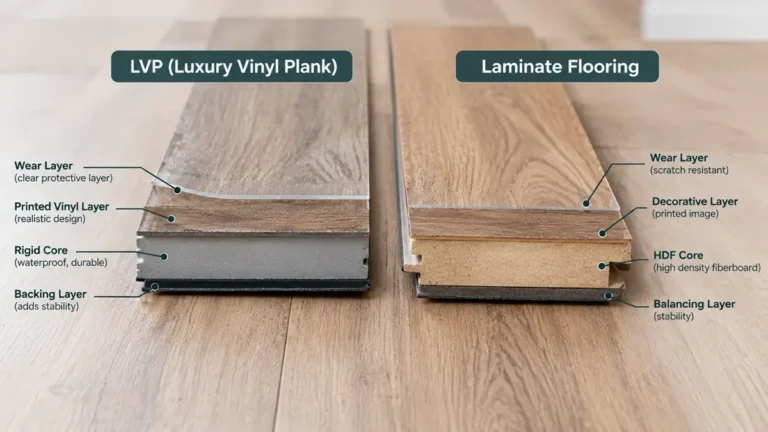 Flooring & TileLVP vs Laminate Flooring: Which Is Better?LVP (luxury vinyl plank) is the better choice for wet areas such as bathrooms, kitchens, laundry rooms and…Read the guide →9 min read