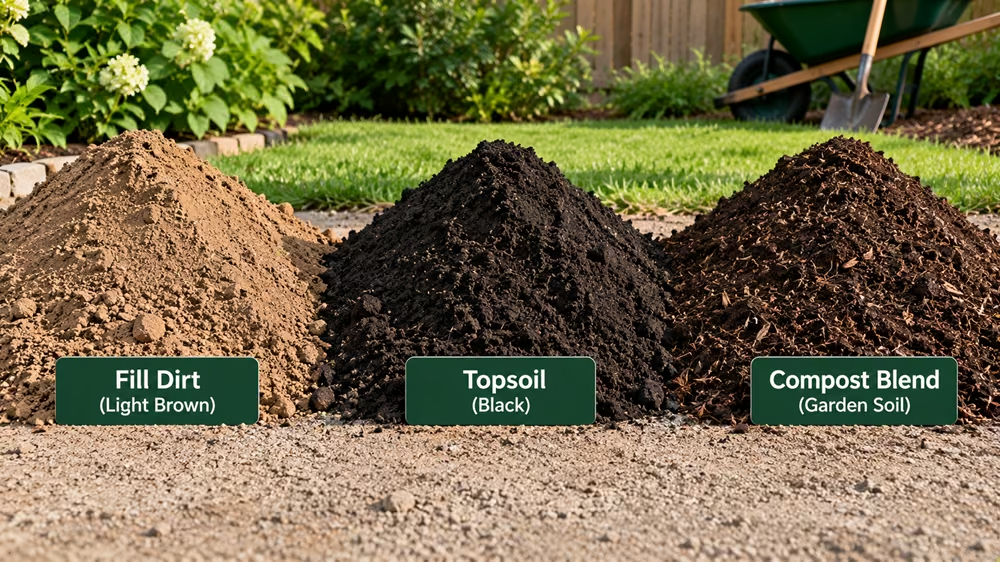
The short answer: fill dirt is subsoil with little organic matter, used to fill holes and raise the grade. Topsoil is the darker upper layer of soil, used on top of fill for lawns and general grading. Garden soil is topsoil blended with compost for planting beds. Potting mix usually contains no soil at all and is made for pots and containers. Use fill dirt for volume, topsoil for the top few inches where grass or plants grow, and garden soil or a topsoil and compost blend where you want plants to thrive.
This guide compares each one, shows which to use for lawns, beds, raised beds and containers, and explains how much each weighs per cubic yard. To work out how many cubic yards, tons or bags you need, use the topsoil calculator, which also covers fill dirt, garden soil and compost.
Topsoil vs garden soil vs fill dirt at a glance
| Material | What it is | Best for | Avoid using it for |
|---|---|---|---|
| Fill dirt | Subsoil with little organic matter, often clay or sand | Filling holes, raising grade, backfill, berms | The top layer where plants grow |
| Topsoil | The upper layer of soil, usually screened | New lawns, grading, top layer over fill | Pots; raised beds on its own |
| Garden soil | Topsoil blended with compost or other organic matter | In-ground flower and vegetable beds | Pots and containers |
| Potting mix | Soilless blend of peat or coir, bark, perlite or vermiculite | Pots, containers, hanging baskets | Filling large areas |
| Compost | Decomposed organic matter | Mixing into soil, topdressing | Planting straight into on its own |
What is topsoil?
Topsoil is the upper layer of soil, usually darker than the subsoil below because it holds more organic matter and soil life. In yards and fields that have been dug or plowed, it is roughly the top 5 to 12 in. When you buy topsoil, you get soil stripped from that layer somewhere else, usually screened to remove rocks, roots and clumps.
There is no legal standard for what can be sold as topsoil, so quality varies a lot between suppliers. The UConn Soil and Nutrient Analysis Lab notes that most topsoil is screened through a ¾ in mesh, that darker soil isn’t always better, and that purchased topsoil usually needs some amendment. Before you order, look at the pile if you can, ask whether it is screened, and ask for a soil test. Bagged products labeled topsoil are often mostly peat or composted organic material, so they behave more like a light garden soil than true field topsoil.
Topsoil vs garden soil
Garden soil is topsoil with compost or other organic matter mixed in. That organic matter holds water and nutrients and keeps the soil loose, which is what beds of flowers and vegetables need. Plain topsoil is mostly mineral soil: it gives volume, structure and weight, but most unamended topsoil is low in organic matter.
- Use topsoil for large areas and volume: a new lawn, grading, the top layer over fill dirt, or filling low spots.
- Use garden soil where plants need to grow well: new or refreshed planting beds, vegetable gardens and around shrubs.
- Make your own: topsoil with compost mixed in works like garden soil and often costs less in bulk.
Once a bed is planted, a layer of mulch on top keeps the soil moist and holds back weeds; see how deep mulch should be for the right depth.
Topsoil vs fill dirt
Fill dirt is subsoil, the layer under the topsoil. It has little organic matter and often contains clay, sand and some stones. That makes it poor for growing plants, but good for filling: it packs down firmly and doesn’t shrink much over time the way organic material does. It is also usually the cheapest soil you can buy.
- Use fill dirt to fill holes and old pool or stump sites, raise low areas, build berms and backfill behind walls or around foundations.
- Cover it with topsoil: spread about 4 to 6 in of topsoil over fill where grass will grow, and more for planting beds.
- Buy clean fill: clean fill dirt is free of trash, concrete chunks, stumps and other debris. Buried wood and roots rot away and leave the ground sinking.
- Pack it in layers: spread fill a few inches at a time and tamp or roll each layer, especially where anything will be built on top.
- Slope it away from the house: a common US code rule in the International Residential Code asks for the ground to drop at least 6 in over the first 10 ft from the foundation. Check your local code.
Garden soil vs potting soil vs potting mix
Potting mix is made for containers. Most are soilless blends of peat moss or coconut coir with bark, perlite or vermiculite, which stay light and drain well in a pot. Bags labeled potting soil are usually the same kind of product; the names are used almost interchangeably, so read the ingredient list rather than the name.
Garden soil and topsoil don’t work well in pots on their own. As Iowa State University Extension explains, garden soil compacts in a container, drains and breathes poorly, and pulls away from the sides when it dries, which makes watering hard. If you want to use your own soil in pots, mix equal parts garden soil, peat moss and perlite.
Going the other way, potting mix can be used in the ground, but it is an expensive way to improve a bed and breaks down quickly. Compost or garden soil does the same job for much less.
Topsoil vs compost
Compost is decomposed organic matter, not a soil. It improves soil when mixed in: it loosens clay, helps sandy soil hold water and feeds soil life. On its own it is very light, shrinks as it keeps breaking down and can stay too wet, so it works best mixed with topsoil or spread as a thin layer on top. Topsoil supplies the body of the soil and compost supplies the organic matter; most beds want both.
Which soil to use for raised beds
Pure topsoil is usually too dense for a raised bed, and pure compost settles and holds too much water. A blend works better. Three common options:
- 60% topsoil, 40% compost: an affordable mix for larger beds, and the default in our calculator.
- Equal thirds of compost, peat moss or coir, and vermiculite: a light, soilless mix that drains well.
- Bagged raised bed soil: the simplest choice for one or two small beds.
The raised bed soil calculator starts with one 8 × 4 ft bed filled 12 in deep. With 10% extra for settling, that is 35.2 cubic feet, or 1.30 cubic yards: about 21 cubic feet of topsoil and 14 cubic feet of compost for the 60/40 mix, or 24 bags of 1.5 cubic feet if you use bagged soil.
Topsoil for lawns: new lawns, low spots and top dressing
New lawns: spread about 4 to 6 in of topsoil over the subsoil or fill before seeding or laying sod, and work the first inch or two into the ground below so the layers blend instead of forming a sharp line. Then seed at the right time for your grass; see the best time to plant grass seed.
Putting topsoil on top of grass: you can, but only in thin layers. Spread no more than about ½ in at a time, rake or brush it in so the grass blades still show, and let the grass grow through before you add more. A thicker layer smothers the lawn.
Low spots and holes: fill shallow dips with ½ in at a time and repeat after a few weeks. For dips deeper than about an inch, cut and lift the sod, fill underneath with topsoil, firm it, and lay the sod back. Use a soil that matches your lawn’s soil, often topsoil mixed with sand or compost; a layer of very different soil, such as pure sand over clay, can hold water or dry out unevenly.
Ordering gravel or sand for the same project? Our guide to how much a yard of gravel weighs compares stone, sand and soil weights per cubic yard.
Worked example: weight of topsoil, fill dirt and compost
The topsoil calculator starts with a 20 × 10 ft area (200 sq ft) for a new lawn at 4 in deep, with 15% extra for settling:
- Volume: 200 × 4 ÷ 12 = 66.7 cubic feet, plus 15% = 76.7 cubic feet
- Cubic yards: 76.7 ÷ 27 = 2.84 cubic yards
- Bags: 76.7 ÷ 0.75 = 102.2, rounded up to 103 bags of 0.75 cubic feet
The volume is the same whatever you buy, but the weight is not. Using the calculator’s typical weights for dry, loose material:
| Material | Weight per cubic yard | 2.84 cubic yards weighs |
|---|---|---|
| Fill dirt | About 1.3 tons | 3.69 tons |
| Screened topsoil | About 1.1 tons | 3.12 tons |
| Garden soil blend | About 1.0 ton | 2.84 tons |
| Compost | About 0.55 tons | 1.56 tons |
Wet soil weighs more, so check your supplier’s figure if you plan to haul it yourself, and compare it with your truck or trailer’s payload rating. Top-dressing the same lawn at ½ in takes only about 0.35 cubic yards, or 13 bags.
Frequently asked questions
Is garden soil the same as topsoil?
No. Garden soil is topsoil with compost or other organic matter mixed in, made for planting beds. Topsoil is plain upper-layer soil, better for lawns, grading and large areas.
Can I use topsoil instead of garden soil?
Yes, especially if you mix in compost. Topsoil alone is fine for lawns and grading, but flower and vegetable beds grow better when the topsoil is blended with organic matter.
What is fill dirt used for?
Fill dirt is used to fill holes, raise low ground, build berms and backfill around foundations and walls. It packs down firmly and is cheap, but it is poor for growing plants, so cover it with topsoil where grass or plants will grow.
Can grass grow in fill dirt?
Poorly. Fill dirt has little organic matter and often compacts hard, so grass struggles to root in it. Spread about 4 to 6 in of topsoil over fill before you seed or lay sod.
What is clean fill dirt?
Clean fill is fill dirt free of trash, concrete, asphalt, stumps and other debris. Ask for it whenever you are filling near a house or under anything you will build, since buried debris can rot or shift and make the ground settle.
Can you use garden soil in pots?
Not on its own. Garden soil compacts in a container and drains poorly. Use a potting mix, or blend equal parts garden soil, peat moss and perlite.
Is potting mix the same as potting soil?
Usually, yes. Both names are used for container blends, and most contain little or no actual soil. Check the ingredients for peat or coir, bark, perlite or vermiculite.
Can I put topsoil on top of grass?
Yes, in thin layers of no more than about ½ in at a time, raked in so the grass blades still show. Thicker layers smother the grass; for deeper low spots, lift the sod and fill underneath.
What is black dirt?
Black dirt is a regional name, common in the Midwest, for very dark topsoil that is high in organic matter, often dug from peat or muck soils. It is rich but can be light and hold a lot of water, so it is often blended with regular topsoil or sand.
How much does a yard of topsoil weigh?
About 1.1 tons, or around 2,200 lb, for dry, loose screened topsoil, and more when it is wet. Fill dirt is heavier at about 1.3 tons per cubic yard, and compost is much lighter at about half a ton.
Soil names and quality vary by supplier and region, so ask what a product contains before you buy, and test your soil if plants struggle. Weights on this page are typical values for dry, loose material. Use the topsoil calculator to work out cubic yards, tons and bags for your project.
Keep reading
 Soil, Mulch & LawnBest Time to Plant Grass Seed (and When to Overseed)The best time to plant grass seed depends on your grass type. For cool-season grasses such as tall…Read the guide →9 min read
 Soil, Mulch & LawnHow Deep Should Mulch Be? Depth Chart for Beds, Trees and GardensSpread mulch 2 to 4 inches deep. Fine or shredded mulch works best at 2 to 3 in,…Read the guide →11 min read
 Soil, Mulch & LawnBest Time to Lay Sod: By Season, Region and Grass TypeThe best time to lay sod depends on your grass. Cool-season grasses such as tall fescue and Kentucky…Read the guide →10 min read