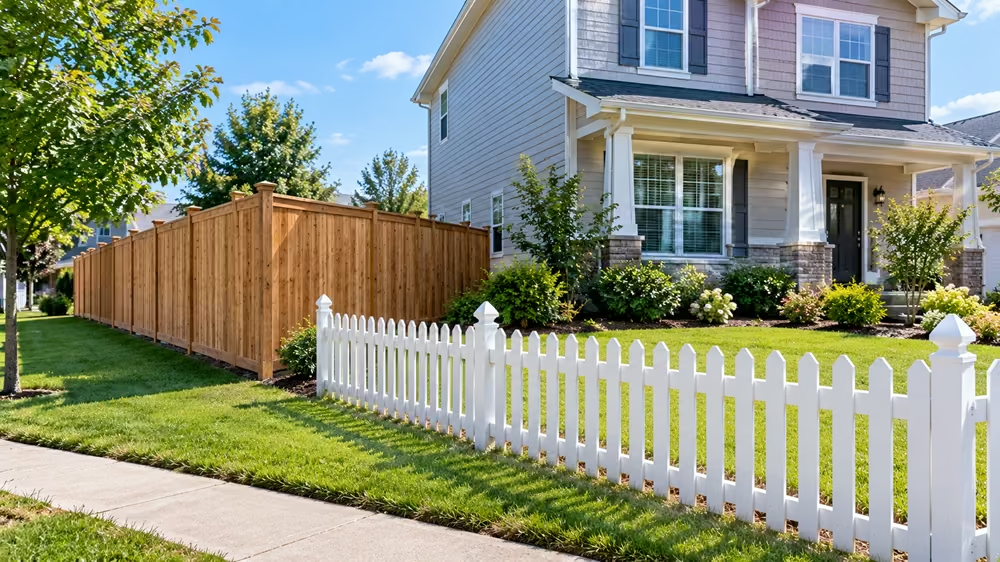
The standard fence height for a home is 6 feet in back and side yards and 3 to 4 feet in front yards. Most towns cap back-yard fences at 6 ft, though some allow 7 or 8 ft, and keep front-yard fences low so drivers and walkers can see past them. Fences near street corners and driveways are often limited to about 3 ft, and a pool fence must be at least 4 ft tall. There is no single national limit: your city or county zoning code and any homeowners association set the rules, so check them before you build.
This guide covers typical fence heights by yard and fence type, how height rules and permits work, setbacks from the property line and pool fence rules. To count posts, rails, pickets and concrete for a fence of any height, use the fence calculator.
Standard fence height by location
| Where the fence goes | Common height limit | Notes |
|---|---|---|
| Back yard | 6 ft | Some towns allow 7 or 8 ft |
| Side yard (behind the front of the house) | 6 ft | Usually follows back-yard rules |
| Front yard | 3 to 4 ft | Often 3 ft if solid, 4 ft if open like pickets |
| Near corners and driveways | About 2½ to 3 ft | Keeps a clear sight line for traffic |
| Around a pool | At least 4 ft | A minimum, not a maximum |
These are typical figures, not a law that applies everywhere. Many cities follow this pattern, but the exact numbers, where the front yard ends and how height is measured all vary, so look up your own rules before you buy materials.
Standard height by fence type
| Fence type | Common heights | Typical use |
|---|---|---|
| Wood or vinyl privacy fence | 6 ft (8 ft where allowed) | Back yards, screening |
| Picket fence | 3 to 4 ft | Front yards, gardens |
| Chain link fence | 4 ft most common; also 3, 5 and 6 ft | Pets, kids, property lines |
| Split rail fence | 3 to 4 ft | Boundaries, rural lots |
| Aluminum or steel ornamental | 4 to 6 ft | Front yards, pools |
| Pool fence | 4 to 5 ft | Pool barriers |
| Garden deer fence | 7 to 8 ft | Keeping deer out of gardens, where allowed |
Fence panels and pickets are made in these heights, so building to a standard height also keeps the job simpler. A 6 ft privacy fence uses 6 ft pickets or panels; going taller usually means special-order materials and longer posts.
How fence height rules work
Fence heights are set by local zoning ordinances, not by the building code. A typical ordinance sets a lower limit for the front yard, a higher one for side and back yards, and a clear-sight area near street corners and driveways where fences, walls and hedges must stay low. On top of that, a homeowners association can set its own limits on height, style, material and color, and these are often stricter than the city’s. Historic districts may also require design approval.
- How height is measured: usually from the ground at the fence line to the top of the fence. Towns differ on whether they measure from the lower or higher side and on whether post caps count.
- Sloped yards: stepped panels are usually measured section by section, so the highest point of each step must stay within the limit.
- Toppers count: lattice or trellis added to the top of a fence normally counts toward the total height.
- Where to find the rules: search your city or county name with “zoning code fence height”, call the planning or zoning office, and read your HOA covenants.
Do you need a permit for a fence?
It depends on where you live. The model building codes used in most US states (the IRC and IBC) exempt fences up to 7 ft tall from a building permit. Many towns still require a separate fence or zoning permit, though, and some require one for every fence. Pool barriers, fences over 7 ft and fences in front yards or historic districts are the ones most likely to need approval.
A fence permit application usually asks for a simple site plan showing the property line, the fence location, its height and the material. Whether or not you need a permit, call 811 a few days before you dig post holes. The free service has buried utility lines marked so you don’t hit a gas, power or water line.
Fence setbacks and property lines
Many towns let you build right up to the property line, while others require a setback of a few inches to several feet, especially from sidewalks and streets. Before you build, confirm where the line is with a property survey or the survey pins at the corners of your lot; building over the line is one of the most common causes of fence disputes.
- Finished side out: many ordinances require the finished or “good” side of the fence to face the neighbors and the street.
- Leave room to maintain it: setting the fence a few inches inside your line lets you reach both sides without stepping onto the neighbor’s land.
- Shared fences: some states, such as California, have good neighbor fence laws that presume adjoining owners share the cost of a boundary fence, usually after written notice. Talk to your neighbor before you build on a shared line.
Pool fence height
Pool fences are a safety barrier, so the rules work the other way: they set a minimum height. Model codes and the U.S. Consumer Product Safety Commission’s pool barrier guidelines call for a barrier at least 4 ft (48 in) tall, measured on the side away from the pool. Gates should open outward, away from the pool, and close and latch by themselves, with the latch out of a child’s reach. Gaps under and through the fence must be small enough that a child can’t squeeze through or climb it. Many towns set stricter rules, such as a 5 ft minimum, and require a permit and inspection for pool barriers.
Want a taller fence?
- Check for an 8 ft allowance: some towns allow 8 ft fences in back yards, sometimes only along certain lot lines or with a permit.
- Ask about a variance: if your situation is unusual, such as a busy road or a steep slope, the zoning office may grant an exception after an application and review.
- Plant for privacy: trees and shrubs inside the fence line can add height. Hedges near corners still have to respect sight-line rules in many towns.
- Build it stronger: taller fences catch more wind, so they need closer post spacing and deeper posts. See how far apart fence posts should be for spacing and depth by fence type.
Worked example: how height changes your material list
The fence calculator starts with a 100 ft fence line for a 6 ft privacy fence, with 2 corners, one 4 ft gate, posts 8 ft apart, 5½ in pickets with no gaps, 3 rails and 4×4 posts set 2 ft deep:
- Fence line: 100 ft minus the 4 ft gate = 96 ft
- Sections: 96 ÷ 8 = 12 sections
- Posts: 12 sections + 1, plus 1 per corner and 1 for the gate = 16 posts, 8 ft long
- Pickets: 96 ft × 12 ÷ 5.5 in = 209.5, plus 5% extra = 220 pickets, 6 ft long
- Rails: 12 sections × 3 rails = 36 rails, 8 ft long
- Concrete: about 1.5 bags per post = 25 bags of 80 lb
Changing only the height on the same fence line:
| Fence height | Pickets | Post length | Rails |
|---|---|---|---|
| 4 ft | 220 at 4 ft | 6 ft | 24 (2 per section) |
| 6 ft | 220 at 6 ft | 8 ft | 36 (3 per section) |
| 8 ft | 220 at 8 ft | 10 ft | 36 (3 per section) |
The number of pickets stays the same because it depends on the fence length, not its height, but each picket and post gets longer. These counts use the calculator’s default 2 ft post depth; tall fences, windy sites and cold climates where posts must reach below the frost line call for deeper holes.
Frequently asked questions
What is the standard fence height?
For homes, 6 ft is the standard height for back-yard privacy fences and 3 to 4 ft for front-yard fences. Pool fences must be at least 4 ft tall.
How tall can a backyard fence be?
Most towns allow back-yard fences up to 6 ft tall, and some allow 7 or 8 ft. Check your local zoning code and HOA rules for the exact limit.
How tall can a front yard fence be?
Usually 3 to 4 ft. Many towns allow 4 ft for open fences such as pickets or ornamental metal and only 3 ft for solid fences, and lower still near corners and driveways.
How tall can a privacy fence be?
Typically 6 ft, which is the most common limit for back and side yards. Where local rules allow it, privacy fences can go to 7 or 8 ft, sometimes with a permit.
Do I need a permit to build a fence?
Often, but not always. Building codes exempt most fences up to 7 ft tall from a building permit, but many towns require a fence or zoning permit, especially for front-yard fences, pool barriers and fences over 6 ft. Ask your local building or zoning office.
How close to the property line can I build a fence?
Many towns allow fences on or right next to the property line, while others require a setback of a few inches to a few feet. Confirm the line with a survey first, and check whether your town requires the finished side to face out.
How tall does a pool fence need to be?
At least 4 ft (48 in), with self-closing, self-latching gates that open away from the pool. Many towns require more, such as 5 ft, so check your local pool barrier rules.
How tall is a chain link fence?
The most common residential chain link height is 4 ft. It is also sold in 3, 5 and 6 ft heights, and commercial and security fences often go taller.
Can I add lattice to make my fence taller?
Only if the total height, including the lattice, stays within your local limit. Most towns count toppers as part of the fence height.
Fence height limits on this page are typical values for US homes; your city, county and HOA rules decide what is allowed on your lot, and they can differ a lot. Check them before you buy materials, and call 811 before you dig. Use the fence calculator to count posts, rails, pickets and concrete for your fence.
Keep reading
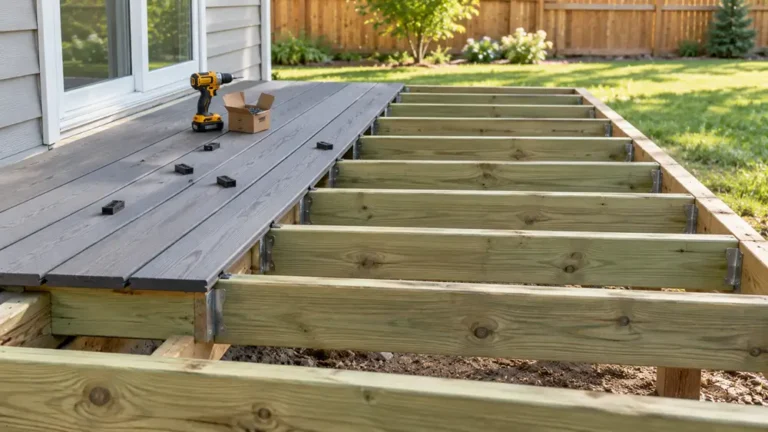 Decks, Stairs & FencesDeck Joist Spacing and Deck Board GapsMost decks use joists spaced 16 inches on center. That is the common limit for standard 5/4 wood…Read the guide →8 min read
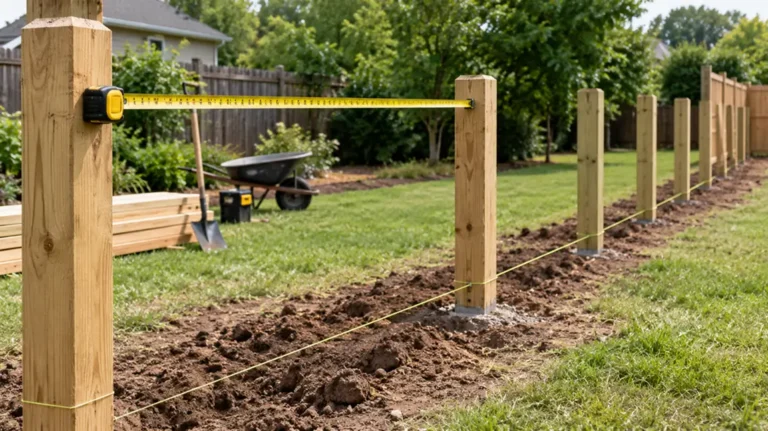 Decks, Stairs & FencesHow Far Apart Should Fence Posts Be? Spacing and Depth by Fence TypeMost wood fence posts should be 6 to 8 feet apart, measured center to center, with 8 feet…Read the guide →8 min read
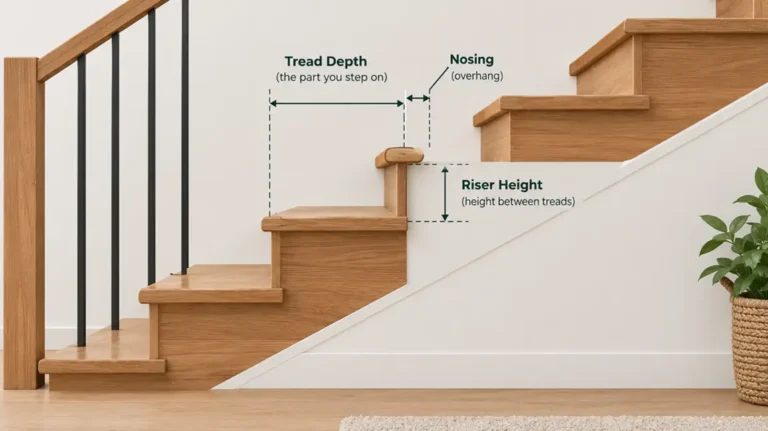 Decks, Stairs & FencesStandard Stair Dimensions: Rise, Run and Code LimitsIn most of the US, home stairs follow the International Residential Code (IRC): risers no taller than 7¾…Read the guide →9 min read