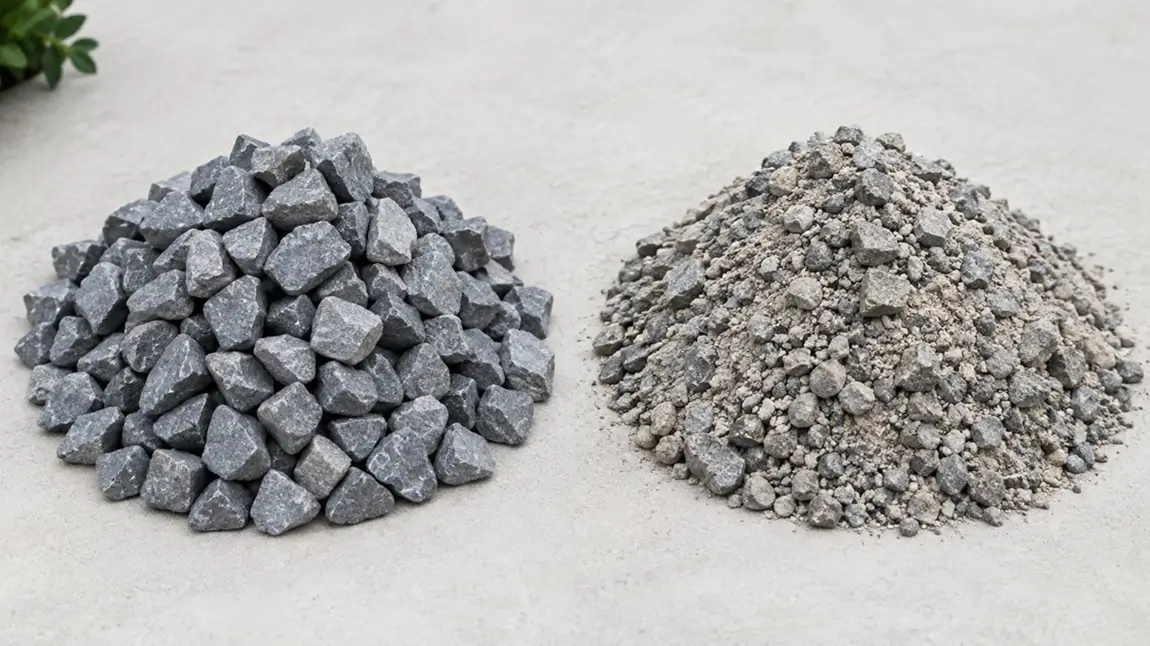
The main difference is stone dust. #57 stone is clean crushed stone, mostly ½ to 1 inch, with the fine dust washed or screened out, so water drains straight through it. Crusher run is crushed stone from about ¾ inch down to dust, and that dust fills the gaps so it packs into a hard, firm surface. Use #57 where you need drainage, and crusher run where you need a solid base or a surface to drive and walk on.
Many projects use both. A gravel driveway, for example, often has #57 in the middle layer and crusher run on top. This guide compares the two side by side, explains the names and sizes, and shows which one to order for driveways, patios, sheds, slabs and drains.
Crusher run vs #57 stone at a glance
| #57 stone | Crusher run | |
|---|---|---|
| Size | Mostly ½ to 1 in, often called ¾ in stone | About ¾ in down to dust |
| Fines (stone dust) | Little or none, usually washed | Yes, mixed through it |
| Drainage | Excellent. Water runs straight through. | Poor once compacted. Water runs off the top. |
| Compaction | Settles and locks a little, but stays loose on top | Packs into a hard, almost solid layer |
| Weight per cubic yard | About 1.35 tons (2,700 lb) | About 1.55 tons (3,100 lb) |
| Best for | Drainage, French drains, driveway middle layers, behind retaining walls | Driveway and path surfaces, paver bases, shed pads, road base |
| Avoid for | A smooth walking surface on its own | Anywhere water has to drain through |
Weights are planning values. Real weight depends on the type of rock and how wet it is.
What is #57 stone?
#57 stone is angular crushed stone screened to one standard size. The number comes from the standard aggregate sizes (ASTM D448 and AASHTO M 43) that quarries and road builders use. It’s called “57” because its size range combines size 5 and size 7 from that standard, which gives a stone mostly between ½ and 1 inch with a few smaller chips.
Most #57 is made from limestone or granite, depending on what your local quarry crushes. Granite is harder and holds its shape longer. Limestone is the most common in the East and Midwest and works well for nearly every home project. Ask for washed #57 when the stone is for drainage, because washing removes the dust that could clog a drain.
What #57 stone is used for
- French drains, drainage trenches and around drain pipes
- The middle layer of a gravel driveway
- Drainage stone behind retaining walls
- Bedding under pipes and around septic lines
- Base for permeable pavers
- Coarse aggregate in concrete
What is crusher run?
Crusher run is stone that comes straight from the crusher without being washed or screened down to one size. It contains pieces of about ¾ inch (sometimes up to 1½ inch) plus everything smaller, down to fine dust. When it’s spread, dampened and compacted, the dust fills the spaces between the stones and the whole layer locks into a firm surface that sheds rain.
It’s also called crush and run, crusher run gravel, dense grade aggregate (DGA), quarry process (QP) and road base. It can be made from limestone, granite or recycled concrete.
What crusher run is used for
- The top layer of a gravel driveway, or a single-layer driveway
- The compacted base under pavers, patios and walkways
- Shed pads, hot tub pads and parking areas
- Base under concrete slabs and asphalt
- Road base for farm and private roads
Regional names for crusher run
Crusher run goes by many names, often taken from state road department specs. These are common examples of similar dense-graded base:
| Name | Where you’ll often hear it |
|---|---|
| ABC (aggregate base course) | The Carolinas and other Southeast states |
| 21A | Virginia and Michigan |
| CR-6 | New Jersey |
| 2A (or 2A modified) | Pennsylvania |
| CA-6 | Illinois |
| Item 4 | New York |
| #304 | Ohio |
| Class 5 | Minnesota and nearby states |
| Class 2 road base | California |
| DGA | Kentucky and many other states |
The clean-stone names change too. In Pennsylvania, 2B is a clean stone close to #57, so “2A vs 2B” is the same choice as crusher run vs #57. In Illinois, CA-7 is a clean stone close to #67, while CA-6 packs like crusher run. Exact sizes vary by quarry, so ask your supplier whether a product has fines before you order.
Two products are often confused with crusher run. #411 is #57 stone mixed with stone dust, so it packs like crusher run but has larger stones. Crusher fines are much smaller, about ¼ inch down to dust, and are used for paths and patios rather than driveways.
#57 stone vs other stone sizes
If your supplier is out of #57, or you’re comparing quotes, here’s how the nearby sizes compare. For a full size chart, see our guide to the best gravel for a driveway.
| Stone | Approximate size | Compared with #57 |
|---|---|---|
| #2 | About 1½ to 2½ in | Much larger. Used for construction entrances and heavy base on soft ground. |
| #3 | About 1½ to 2 in | Larger. A common bottom layer for driveways. |
| #4 | About ¾ to 1½ in | Larger. Good for drainage where bigger voids are wanted. |
| #57 | About ½ to 1 in | The all-round clean stone. |
| #67 | About ¾ in down to ³⁄₁₆ in | A little smaller with more small pieces. Used in much the same way, and often in concrete. |
| #8 | About ⅜ in | Much smaller. Used as bedding for permeable pavers and as a fine drainage stone. |
Which one do you need? Project by project
| Project | Use | Why |
|---|---|---|
| Gravel driveway | Both: #57 in the middle, crusher run on top | #57 drains and spreads the load, crusher run gives a firm surface. |
| Single-layer driveway | Crusher run | It compacts on its own and doesn’t roll under tires. |
| French drain | Washed #57 | Water must flow through the stone. Crusher run would clog it. |
| Behind a retaining wall | #57 | Lets water drain away so it doesn’t push on the wall. |
| Paver patio or walkway | Crusher run base, sand on top | A compacted base keeps pavers from sinking. |
| Permeable pavers | #57 base, #8 bedding | The whole system has to let water through. |
| Shed base | Crusher run for a hard, level pad. #57 on wet sites. | Both work. Pick based on whether firmness or drainage matters more. |
| Under a concrete slab | Either, as the plans or local code require | Crusher run gives a firm, flat base. #57 drains better. |
For slabs, the base matters as much as the concrete itself. Our guide on how thick a concrete slab should be covers base depth for patios, driveways and garages.
Using #57 and crusher run together in a driveway
A long-lasting gravel driveway is usually built in layers: large stone at the bottom, #57 in the middle and crusher run on top. The #57 lets water drain out of the driveway and bridges soft spots, and the crusher run fills the top voids and packs into a smooth surface. #57 on its own drains well but stays loose and noisy underfoot. Crusher run on its own is firm, but on wet clay it can hold water and turn soft.
To work out tons for each layer at once, use the gravel driveway calculator, which lets you pick the stone for the base, middle and top layers.
For the full build, from digging and fabric to the final compacted layer, see our step-by-step guide on how to build a gravel driveway.
How much do you need? A worked example
Say you’re building a 20 × 10 ft pad, 4 inches deep:
- Area: 20 × 10 = 200 sq ft
- Volume: 200 × (4 ÷ 12) = 66.7 cubic feet, or 66.7 ÷ 27 = 2.47 cubic yards
- Add 15% for compaction: 2.47 × 1.15 = 2.84 cubic yards
- #57 stone at 1.35 tons per cubic yard: 2.84 × 1.35 = 3.83 tons
- Crusher run at 1.55 tons per cubic yard: 2.84 × 1.55 = 4.40 tons
The volume is the same, but crusher run weighs more because the dust fills the gaps. Since most quarries sell by the ton, order by weight, not just by the yard. At 4 inches deep, one cubic yard of either stone covers about 81 sq ft.
These are the default numbers in our crushed stone calculator, so you can change the size, depth and stone grade to match your project. If your supplier quotes by the yard and you need tons, the cubic yards to tons calculator converts either way.
Which costs more?
Crusher run is often a little cheaper per ton than washed #57, because it isn’t washed or screened as tightly. But it weighs more per cubic yard, so the gap can shrink when you compare the same area. Prices vary a lot by region, rock type and delivery distance, so get quotes that include delivery and enter your price per ton in the crushed stone calculator to compare them.
Tips for working with each stone
- Compact crusher run in layers. Spread about 4 inches at a time, dampen it lightly and run a plate compactor over it. Dry crusher run won’t pack well, and very wet crusher run turns to mud.
- Crown the surface. Crusher run sheds water, so shape driveways and pads slightly higher in the middle so rain runs off the sides.
- Keep #57 clean in drains. Wrap French drain stone in landscape fabric so soil doesn’t wash into the gaps over time.
- Edge #57. Loose stone spreads, so use timber, steel or stone edging where #57 is the top surface.
- Use fabric on soft soil. A layer of geotextile fabric under either stone stops it from sinking into clay.
- Check what’s on the truck. Names vary by quarry. A quick look at a sample tells you whether it’s clean stone or stone with dust.
Building a patio or walkway? Our guide to paver base material explains which stone and sand go under pavers and how deep each layer should be.
Frequently asked questions
What is the difference between crusher run and #57 stone?
#57 stone is clean crushed stone, mostly ½ to 1 inch, with no dust, so it drains well but stays loose. Crusher run is crushed stone from about ¾ inch down to dust, so it packs into a hard surface but doesn’t drain. Use #57 for drainage and crusher run for firm bases and surfaces.
Is crusher run good for drainage?
No. Once crusher run is compacted, the dust fills the gaps and water runs off the top instead of through it. That’s good for a driveway surface but bad for a French drain or drainage trench. Use washed #57 stone for drainage.
Can you use #57 stone for a driveway?
Yes, but it works best as the middle layer. On its own, #57 drains well but stays loose on top, so tires push it around and it’s uncomfortable to walk on. A top layer of crusher run or #411 gives a firmer surface.
How much does a cubic yard of #57 stone weigh?
About 1.35 tons, or roughly 2,700 lb, as a planning value. It can range from about 1.25 to 1.45 tons depending on the rock. A cubic yard of crusher run weighs more, about 1.55 tons, because the dust fills the spaces between stones.
What is the difference between #57 and #67 stone?
#67 stone is slightly smaller, about ¾ inch down to ³⁄₁₆ inch, with more small pieces than #57. Both are clean stones used for drainage and concrete, and in many home projects one can replace the other.
Is crusher run the same as road base?
Often, yes. In many areas “road base” is just another name for crusher run. Some states have their own road base specs, such as Class 2 in California, which are similar dense mixes with slightly different sizes. Ask your supplier for the size range and whether it has fines.
Stone names, sizes and weights vary by region and quarry, so confirm the product with your local supplier before you order. Weights and amounts in this guide are estimates for planning.
Keep reading
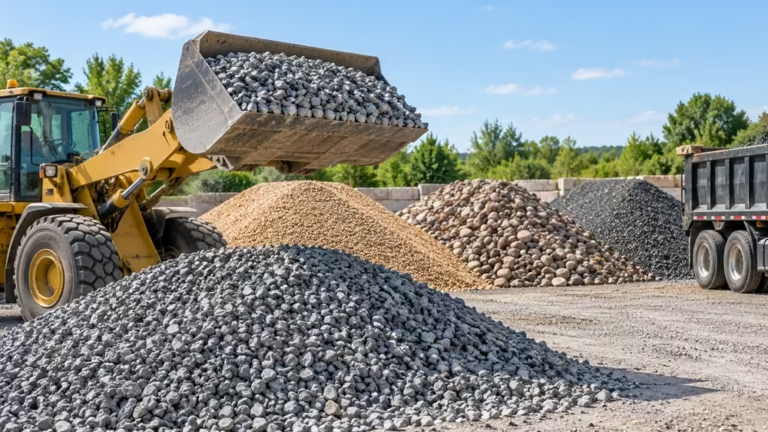 Gravel & StoneHow Much Does a Yard of Gravel Weigh? (By Stone Type)A cubic yard of gravel weighs about 1.4 tons, or roughly 2,800 lb. Most gravel and crushed stone…Read the guide →6 min read
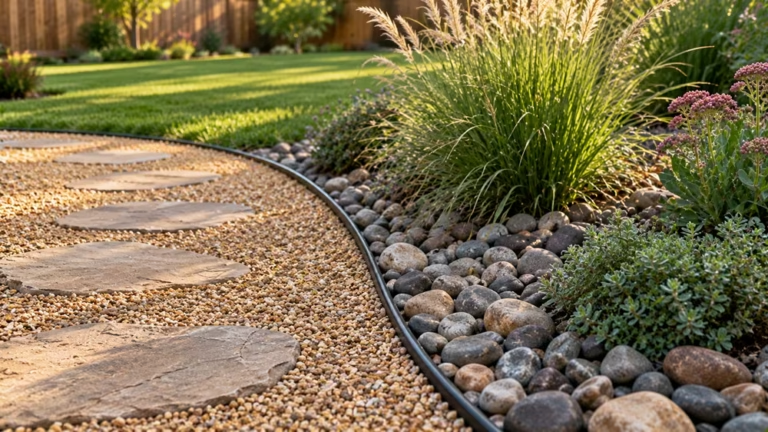 Gravel & StonePea Gravel vs River Rock: Which to Use WhereThe short answer: pea gravel is small, smooth stone about ⅜ in across that is comfortable to walk…Read the guide →9 min read
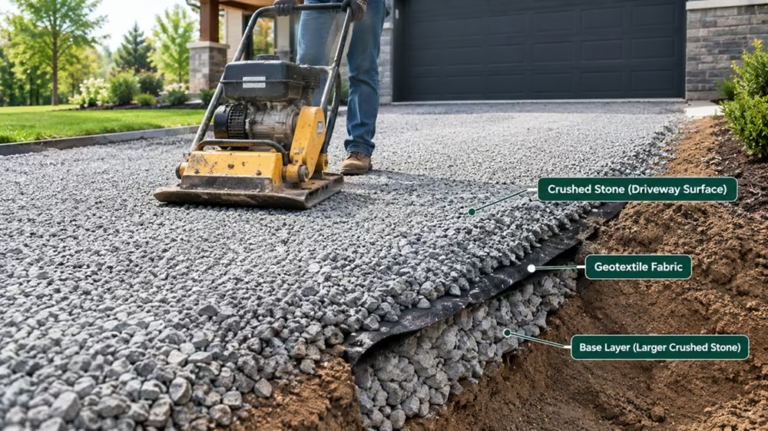 Gravel & StoneHow to Build a Gravel Driveway: Step by StepTo build a gravel driveway, dig out the grass and topsoil 8 to 12 inches deep, shape and…Read the guide →9 min read