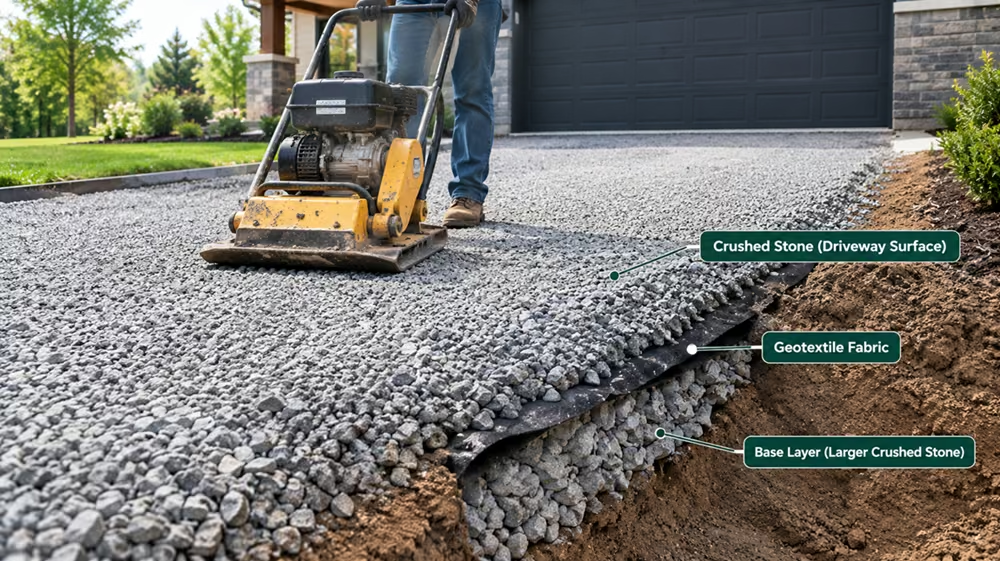
To build a gravel driveway, dig out the grass and topsoil 8 to 12 inches deep, shape and compact the soil with a crown so water runs off, lay woven geotextile fabric, then spread and compact crushed stone in layers: about 4 inches of large #3 stone, 4 inches of #57 and a 3-inch top layer of #411 or crusher run. Finish with edging and side ditches that carry water away.
Most of the work is in the digging and the compacting, not the gravel itself. With a rented skid steer and plate compactor, many homeowners can build a typical driveway in a few days. This guide walks through each step, explains which fabric to use and how deep to go, and works out the stone with our gravel driveway calculator.
Before you start: plan the driveway
- Call 811 a few business days before you dig. It’s the free US call-before-you-dig line, and the utilities will mark buried lines.
- Check local rules. Many towns and counties need a permit for a new driveway or a new entrance onto the road, and some require a culvert pipe under the entrance where it crosses a ditch.
- Pick the width. A single-car driveway is usually 10 to 12 ft wide and a two-car driveway 20 to 24 ft. Allow room for any turnaround or parking pad.
- Watch where water goes. Avoid low spots, and plan for water to run off the sides of the driveway, not along it or toward the house.
- Check the soil. Firm, well-drained soil needs less work. Clay and soft, wet ground need fabric and a thicker base.
Tools and materials
- A skid steer, compact track loader or mini excavator for digging, or a tractor with a box blade for shaping
- A plate compactor or a vibratory roller
- Stakes, string and marking paint
- A long level or a string line to set the crown
- Woven geotextile fabric and landscape staples
- Crushed stone for each layer, ordered by the ton (see the best gravel for a driveway for the types and sizes)
- Edging, if you want a clean border: timber, steel or stone
- Shovels, steel rakes and a wheelbarrow
How to build a gravel driveway step by step
- Mark the outline. Set stakes and string along both edges, or mark them with paint. Add about a foot on each side if you plan edging or a shoulder.
- Dig out the driveway. Remove the grass, topsoil and roots down to firm subsoil, usually 8 to 12 inches deep. Topsoil and roots rot and leave soft spots, so dig out any soft pockets and fill them with stone.
- Shape and compact the soil. Grade the bottom with a crown, so it’s higher in the middle than at the edges, or with a steady slope to one side. Then compact it with a roller or plate compactor.
- Lay the fabric. Roll woven geotextile fabric along the length of the driveway and run it up the sides of the trench. Overlap the seams by at least 12 inches, more on soft ground, and pin it with landscape staples.
- Spread and compact the base layer. Spread about 4 inches of #3 stone, the large 1½ to 2-inch stone that spreads the load and lets water drain. Compact it before you add the next layer.
- Add the middle layer. Spread about 4 inches of #57 stone and compact it. This layer locks into the base and keeps drainage open.
- Add the top layer. Spread about 3 inches of #411 or crusher run. These are crushed stone with fine dust mixed in, so they pack into a firm surface. Dampen the stone lightly, then compact it until it no longer moves underfoot, keeping the crown as you go.
- Finish the edges and drainage. Install edging if you want it, shape shallow ditches or swales along the sides, and make sure water can drain under or around the entrance.
Compact each layer separately. A plate compactor works best on layers of about 4 inches, so a thicker layer stays soft underneath. If your supplier can tailgate-spread the stone from the truck, it saves a lot of shoveling.
How deep should a gravel driveway be?
| Site and use | Total depth | Typical layers |
|---|---|---|
| Firm, well-drained soil, cars only | 6 to 8 in | 4 in of #3 or crusher run, plus a 3 to 4 in top layer |
| Most driveways | 8 to 12 in | 4 in #3, 4 in #57, 3 in #411 or crusher run |
| Clay or soft soil, or heavy trucks | 12 in or more | A thicker base over woven fabric, and geogrid on very soft ground |
The depths are compacted depths. Stone packs down when it’s compacted, so order about 15% more than the loose volume. Road base, also called crusher run or dense-grade stone, is the crushed stone with fines that packs hardest. Our guide to crusher run vs #57 stone explains when to use each one.
Do you need fabric under a gravel driveway?
On firm, well-drained soil you can build without it. On clay or soft ground, fabric is worth the cost. It keeps the base stone from sinking into the mud and stops mud from working up into the stone, so the driveway keeps its depth for longer.
Woven vs non-woven geotextile fabric
| Woven geotextile | Non-woven geotextile | |
|---|---|---|
| What it looks like | Flat, tightly woven plastic strips, like a feed sack | Thick and soft, like felt |
| Main job | Strength. It spreads the load and keeps stone and soil apart. | Drainage. It lets water through but holds back soil. |
| Water flow | Slow | Fast |
| Best for | Under driveways and roads, especially on soft soil | French drains, behind retaining walls, wet sites |
For most driveways, woven fabric is the right choice. Use non-woven where water needs to drain through, such as on wet ground or next to a drain. Thin landscape fabric sold as a weed barrier isn’t made to carry vehicles and tears under the stone, so don’t use it as driveway fabric.
Geogrid and gravel grid pavers
Geogrid is a stiff plastic mesh laid in or under the base stone. The stone locks into the openings, which helps on very soft ground. Gravel grid pavers are plastic panels with honeycomb cells that you fill with gravel. They keep the stone from moving on slopes and in parking areas, and they let rain soak through.
Crown and drainage
Water is what ruins gravel driveways. Standing water softens the base and turns into potholes, and water running down the length of a driveway carries the stone away. To keep it moving off the sides:
- Crown the driveway so the center is higher than the edges. About ½ inch of fall per foot of width (about 4%) is a common target for gravel.
- Keep the surface a little higher than the ground beside it, so water runs off instead of in.
- Add ditches or swales along the sides on flat or wet sites, and a culvert where the driveway crosses a ditch.
- On a slope, turn water off the driveway at intervals with a slight angle or a shallow dip across it, and consider gravel grids. Very steep driveways often hold up better paved.
How to edge a gravel driveway
Edging keeps the gravel out of the lawn and gives the driveway a clean line. Common choices are pressure-treated timbers staked in place, steel or aluminum landscape edging, a row of pavers or stone set in a concrete or gravel bed, or a concrete curb. A simpler option is a shoulder of larger stone along each side. Set the edging before the top layer, so you can compact the stone right up to it.
Building a driveway usually tears up the lawn along its edges. To patch it, see our guide on the best time to lay sod for your grass and region.
How to maintain and fix a gravel driveway
- Rake or drag the surface a few times a year to pull loose stone back into ruts and keep the crown.
- Fix potholes properly. Dig out the soft material, fill the hole with crusher run, then dampen and compact it. Just throwing loose stone in a pothole doesn’t last.
- Top up the surface with an inch or two of fresh top stone every few years.
- Control weeds by keeping the surface compacted and pulling or spot-treating weeds early. Fabric under the base stops weeds from below, but seeds still land in the fines on top.
- Regrade a worn driveway with a box blade before you add new stone, so the crown comes back.
DIY or hire a contractor?
Do it yourself when the driveway is fairly short and flat, the soil is firm, and you’re comfortable running rented equipment. Hire a contractor for long driveways, steep slopes, wet or clay sites, new road entrances that need a culvert or permit, or when you don’t want to handle dozens of tons of stone. To compare quotes with a DIY build, enter your supplier’s price per ton in the gravel driveway calculator.
Worked example: a two-layer driveway
Our guide to the best gravel for a driveway works out the calculator’s default three-layer build. Here’s a simpler two-layer driveway on firm soil instead: 80 ft long and 12 ft wide, with 4 inches of #3 stone under 4 inches of crusher run, plus 15% extra for compaction. In the gravel driveway calculator, switch off the middle layer and pick crusher run for the top.
- Area: 80 × 12 = 960 sq ft
- Each 4-inch layer: 960 × 4 ÷ 12 = 320 cubic feet, or 11.85 cubic yards
- With 15% extra: 11.85 × 1.15 = 13.6 cubic yards per layer
- Base, #3 stone at 1.30 tons per cubic yard: 17.7 tons
- Top, crusher run at 1.55 tons per cubic yard: 21.1 tons
- Total: 27.3 cubic yards, about 38.8 tons, 8 inches deep
You’d also need at least 960 sq ft of woven fabric, plus more for overlaps and for running it up the sides. Delivery trucks carry a limited weight, so a driveway like this usually takes more than one load. For a single layer or a patch, the crushed stone calculator gives tons and cubic yards for any stone grade.
Thinking about pavers instead of loose gravel? See what to put under pavers for the base depth and sand a paver driveway needs.
Frequently asked questions
Can you put gravel directly on dirt?
Yes, on firm, well-drained subsoil, after you remove the grass and topsoil. On soft or clay soil, the stone slowly sinks and mixes with the mud, so lay woven fabric first and build a thicker base.
Should a gravel driveway be crowned?
Yes. A crown sheds rain to the sides, so water doesn’t sit on the driveway and make potholes. About ½ inch of fall per foot of width is a common target.
How long does it take to build a gravel driveway?
Many DIY builds take two to three days: about a day to dig and shape, then a day or two to spread and compact the stone. Long driveways, wet weather and waiting for deliveries can add time.
Can you build a gravel driveway on a slope?
Yes, on a gentle to moderate slope. Use crushed stone with fines on top, keep a crown, turn water off the driveway at intervals, and consider gravel grid pavers. On steep slopes, gravel washes out easily, so paving may be the better choice.
How do you keep gravel from spreading into the lawn?
Install edging, such as treated timbers, steel edging, pavers or a concrete curb, and keep the driveway crowned so tires don’t push stone to the sides. A compacted top layer of #411 or crusher run also moves much less than loose clean stone.
Do you need a permit for a gravel driveway?
It depends on where you live. Many towns and counties require one for a new driveway, especially where it meets a public road, and some require a culvert. Check with your local building or roads department before you start.
Depths, layers and slopes in this guide are typical for planning. Soil, climate, traffic and local rules change what your driveway needs, so check with your local building department and your stone supplier before you order.
Keep reading
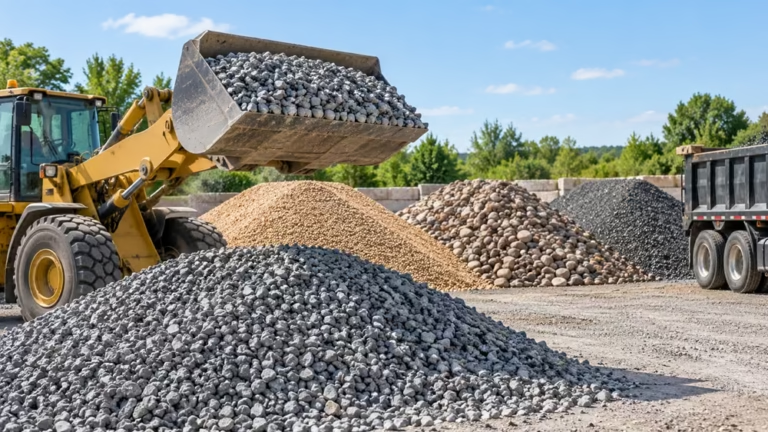 Gravel & StoneHow Much Does a Yard of Gravel Weigh? (By Stone Type)A cubic yard of gravel weighs about 1.4 tons, or roughly 2,800 lb. Most gravel and crushed stone…Read the guide →6 min read
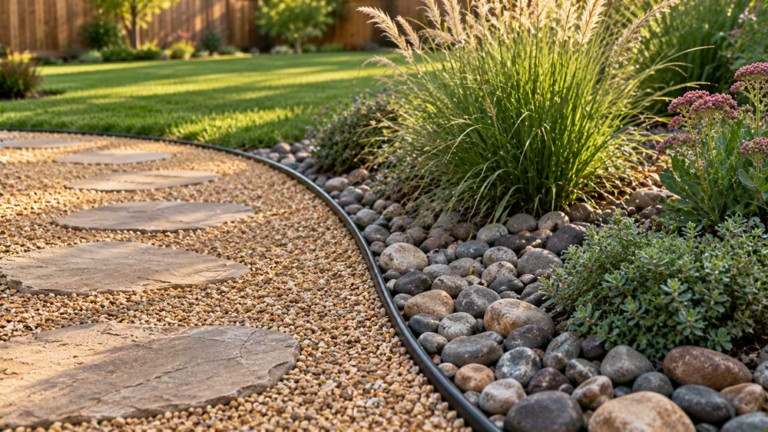 Gravel & StonePea Gravel vs River Rock: Which to Use WhereThe short answer: pea gravel is small, smooth stone about ⅜ in across that is comfortable to walk…Read the guide →9 min read
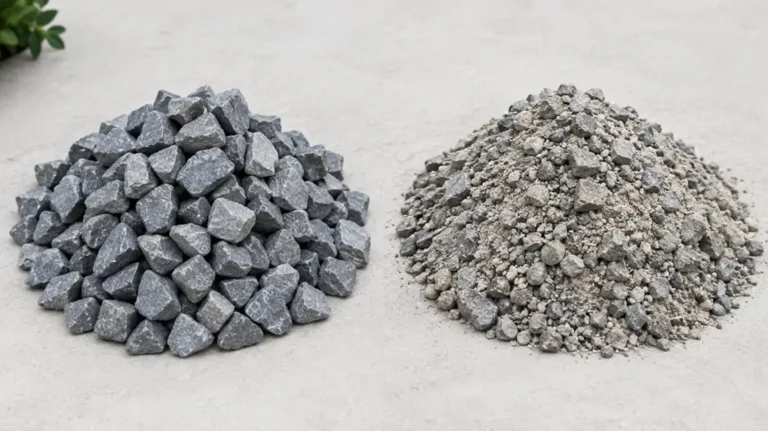 Gravel & StoneCrusher Run vs #57 Stone: Which One Do You Need?The main difference is stone dust. #57 stone is clean crushed stone, mostly ½ to 1 inch, with…Read the guide →9 min read