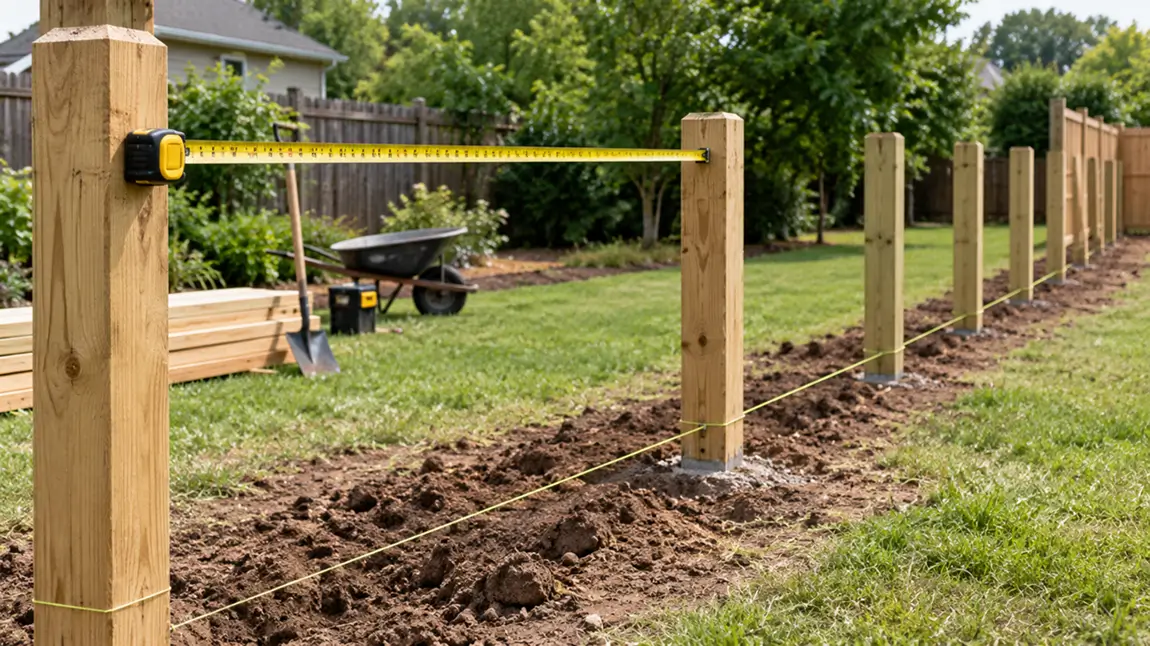
Most wood fence posts should be 6 to 8 feet apart, measured center to center, with 8 feet as the usual maximum because fence rails come in 8 foot lengths. Chain link line posts can be up to 10 feet apart. Wire fences for farms and pastures use wider spacing, usually 8 to 12 feet for T-posts and much more for high-tensile and electric fences.
Closer spacing makes a stronger fence. Use the shorter end of each range in windy areas, for tall or heavy fences, on hills and around curves. This guide gives the spacing for each fence type, how deep to set the posts, what size posts to use and how many you’ll need.
Fence post spacing chart
| Fence type | Typical post spacing | Why |
|---|---|---|
| Wood privacy fence | 6 to 8 ft | Rails come in 8 ft lengths. Solid fences catch a lot of wind. |
| Wood picket fence | 6 to 8 ft | Lighter than privacy fences, so 8 ft is common. |
| Prebuilt wood panels | Panel width, usually 8 ft | Measure the actual panel before you dig. |
| Vinyl fence | Panel width, usually 6 or 8 ft | Rails slot into the posts, so spacing must be exact. |
| Aluminum or steel ornamental | Panel width, usually 6 to 8 ft | Set by the manufacturer’s panel size. |
| Chain link | Up to 10 ft for line posts | The top rail and tight mesh carry the load between posts. |
| Board (horse) fence | 8 ft | 16 ft boards span two sections. |
| Split rail | 8 to 10 ft | Set by the rail length. |
| Woven wire or field fence (T-posts) | 8 to 12 ft | Closer for goats, sheep and pigs that push on the wire. |
| Barbed wire | 10 to 12 ft | Wider when wire stays are added between posts. |
| High-tensile wire (non-electric) | 15 to 20 ft | Tight wire needs fewer posts on level ground. |
| Electric fence | 30 to 50 ft on level ground | Animals avoid the wire, so posts mainly hold it up. |
These are common ranges for planning. Always follow the instructions for panel, vinyl and wire products, and check local rules for pool fences and fences near property lines.
How far apart should wood fence posts be?
For a wood fence, set posts no more than 8 feet apart on center. That’s the maximum for most wood fences because standard 2×4 rails are 8 feet long and need a post at each end. Many builders use 8 feet for picket fences and 6 to 8 feet for privacy fences.
Go closer, to about 6 feet, when:
- The fence is solid (privacy or board-on-board) in a windy area. A solid 6 foot fence acts like a sail.
- The fence is taller than 6 feet or uses heavy boards.
- The ground is soft, wet or sandy.
- The fence runs up a slope or around a curve.
A 6 foot privacy fence usually has three rails per section: one about 6 inches below the top, one about 6 inches above the ground, and one in the middle. Two rails are enough for most fences 4 feet tall or less.
Chain link fence post spacing
Chain link line posts are set up to 10 feet apart. Many installers space them a little closer so the sections come out equal, for example 9 ft 6 in apart on a run that doesn’t divide evenly by 10.
Chain link uses two kinds of posts:
- Terminal posts go at every end, corner and gate. They’re larger, because the mesh is stretched tight against them.
- Line posts are the smaller posts between terminal posts.
| Part | Common residential size (outside diameter) |
|---|---|
| Line post | About 1⅝ to 1⅞ in |
| Terminal post (end, corner) | About 2 to 2⅜ in |
| Gate post | 2⅜ in or larger for wide or heavy gates |
| Top rail | About 1⅜ in |
Residential chain link is most often 4 feet tall, with 3, 5 and 6 foot heights also common. Post sizes and wall thickness vary by brand and grade, so match the posts to the fabric height and the supplier’s guide.
Wire fence and T-post spacing
Farm and pasture fences use steel T-posts or wood line posts with wire stretched between strong corner and end braces. Typical T-post spacing:
- Woven wire or field fence: 8 to 12 feet. Use 8 to 10 feet for goats, sheep and pigs, which lean and climb on wire.
- Welded wire: 8 to 10 feet, because it’s less stiff than woven wire.
- Barbed wire: 10 to 12 feet. Four- and five-strand fences often add wire stays between posts.
- High-tensile wire: 15 to 20 feet for non-electric fences, with closer spacing on hills.
- Electric fence: 30 to 50 feet on flat ground, closer over dips, rises and curves.
Every wire fence needs braced corner, end and gate posts, usually an H-brace made from wood posts and a horizontal rail. The line posts only hold the wire in place. The braces hold the tension.
How deep should fence posts be?
A common rule of thumb is to bury about one third of the post’s total length, and never less than 2 feet. For most residential fences, that means holes 2 to 3 feet deep. In cold climates, posts set in concrete should go below the local frost line, or frost can push them up over the winter. Your building department can tell you the frost depth for your area.
| Fence height | Post depth | Post length to buy | Hole width for a 4×4 |
|---|---|---|---|
| 3 ft | 2 ft | 6 ft | About 10 in |
| 4 ft | 2 ft | 6 ft | About 10 in |
| 5 ft | 2 to 2½ ft | 8 ft | About 10 in |
| 6 ft | 2 to 3 ft | 8 or 9 ft | 10 to 12 in |
| 8 ft | 3 ft | 12 ft | 12 in, or use 6×6 posts |
A good hole is about three times as wide as the post: about 10 to 12 inches for a 4×4 (which actually measures 3½ × 3½ in) and 14 to 16 inches for a 6×6. Put 4 to 6 inches of gravel in the bottom so water can drain away from the end of the post, and slope the top of the concrete away from the post so rain runs off.
Chain link terminal posts need deeper, wider holes than line posts, because they hold the tension of the whole fence. Gate posts of any fence type should also go a little deeper than the rest.
What size posts should you use?
- 4×4 posts are standard for wood fences up to 6 feet tall.
- 6×6 posts are better for gate posts, fences taller than 6 feet, and very windy sites.
- Use posts rated for ground contact, or the buried part will rot long before the rest of the fence.
How many fence posts do you need?
For a straight fence with no gates: divide the length by the post spacing, round up, then add 1 for the post at the end. Then add posts for corners and gates.
| Fence length | Posts at 6 ft apart | Posts at 8 ft apart | Posts at 10 ft apart |
|---|---|---|---|
| 50 ft | 10 | 8 | 6 |
| 100 ft | 18 | 14 | 11 |
| 150 ft | 26 | 20 | 16 |
| 200 ft | 35 | 26 | 21 |
These counts are for one straight run with no gates or corners. Spacing the posts evenly is better than leaving a short gap at the end: for example, 100 feet at an 8 foot maximum gives 13 equal sections of about 7 ft 8 in.
If you need to measure an irregular fence line in feet and inches, the linear foot calculator adds up each side.
Worked example
Say you’re building a 100 foot, 6 foot tall wood privacy fence with 2 corners, one 4 foot gate and posts 8 feet apart, set 24 inches deep in 10 inch holes:
- Fence line without the gate: 100 − 4 = 96 ft
- Sections: 96 ÷ 8 = 12 sections
- Posts: 12 + 1 = 13, plus 1 for each corner and 1 for the gate = 16 posts
- Post length: 6 ft above ground + 2 ft below = 8 ft posts
- Rails: 12 sections × 3 rails = 36 rails, 8 ft long
- Concrete: about 1.5 bags of 80 lb concrete per post, or 25 bags in total
These are the default numbers in our fence calculator, which also counts the pickets and switches to chain link (terminal posts, line posts, top rail and fabric). For a single post hole or a different hole size, the concrete footing calculator gives the bags per hole. To price the whole job with your own material and labor costs, use the fence cost calculator.
Tips for setting fence posts
- Set the corner and end posts first. Stretch a string line between them, then set the line posts to the string so the fence stays straight.
- Measure center to center. Post spacing is measured from the middle of one post to the middle of the next, not the gap between them.
- Plan gate openings exactly. The gap between gate posts is the gate width plus the space the hinges and latch need, so check the hardware first.
- Check plumb on two sides. Use a post level or a level on two faces while the concrete is wet, and brace the post until it sets.
- Call 811 before you dig. It’s free in the US and marks buried utility lines.
- Check property lines and permits. Many towns limit fence height and how close a fence can be to the property line or sidewalk.
Building steps for a deck or a sloped yard too? Our guide to standard stair dimensions covers rise, run, width and the code limits.
Not sure how tall your fence can be? See standard fence heights for back yards, front yards, pools, permits and setbacks.
Frequently asked questions
What is the maximum distance between fence posts?
For wood fences, 8 feet is the usual maximum because rails are 8 feet long. Chain link line posts can go up to 10 feet apart. Wire farm fences can go wider, from about 12 feet for woven wire to 50 feet or more for some electric fences on level ground.
How far apart should chain link fence posts be?
Line posts should be no more than 10 feet apart, and evenly spaced between terminal posts. Terminal posts go at every end, corner and gate.
How far apart should T-posts be?
Usually 8 to 12 feet for woven wire and field fence, and 10 to 12 feet for barbed wire. Use closer spacing for goats, sheep and pigs, and on hills and curves.
How deep should a fence post be for a 6 foot fence?
About 2 to 3 feet deep, which means buying 8 or 9 foot posts. Go deeper in cold climates where posts need to sit below the frost line, and for gate posts.
What size hole do you need for a 4×4 fence post?
About 10 to 12 inches wide, roughly three times the width of the post. A 6×6 post needs a hole about 14 to 16 inches wide.
How many fence posts do I need for 100 feet?
For a straight 100 foot fence, you need 14 posts at 8 feet apart, 18 posts at 6 feet apart, or 11 posts at 10 feet apart for chain link. Add posts for each corner and gate.
Fence rules, frost depth and permit requirements vary by town, so check local codes and your property lines before you dig. Spacing and depth in this guide are common ranges for planning, and manufacturer instructions come first for panel, vinyl and wire fences.
Keep reading
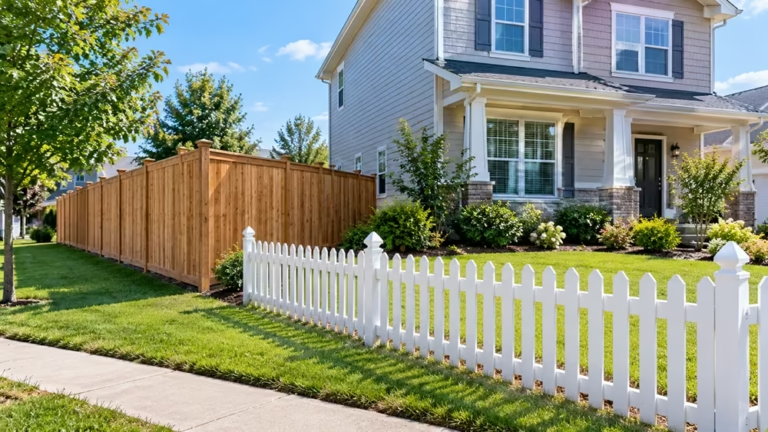 Decks, Stairs & FencesHow Tall Can a Fence Be? Standard Fence Heights and RulesThe standard fence height for a home is 6 feet in back and side yards and 3 to…Read the guide →8 min read
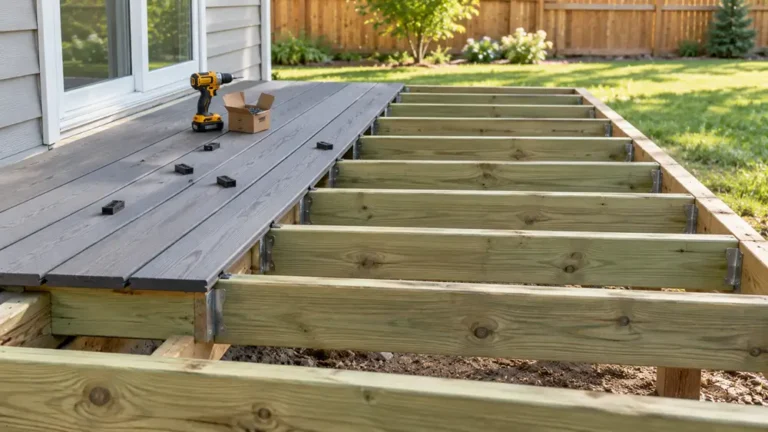 Decks, Stairs & FencesDeck Joist Spacing and Deck Board GapsMost decks use joists spaced 16 inches on center. That is the common limit for standard 5/4 wood…Read the guide →8 min read
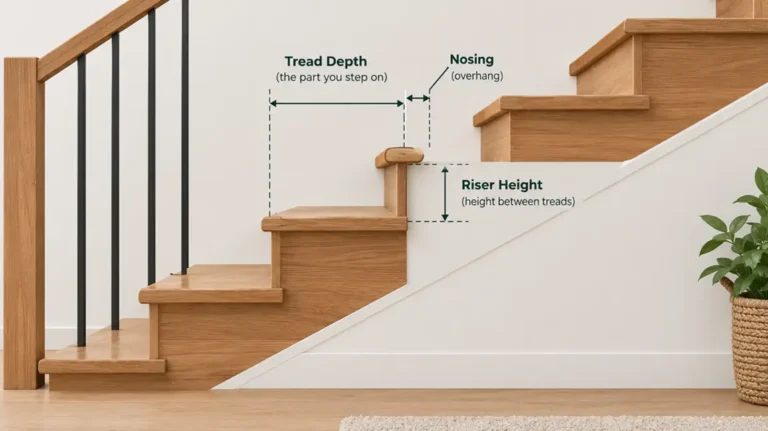 Decks, Stairs & FencesStandard Stair Dimensions: Rise, Run and Code LimitsIn most of the US, home stairs follow the International Residential Code (IRC): risers no taller than 7¾…Read the guide →9 min read