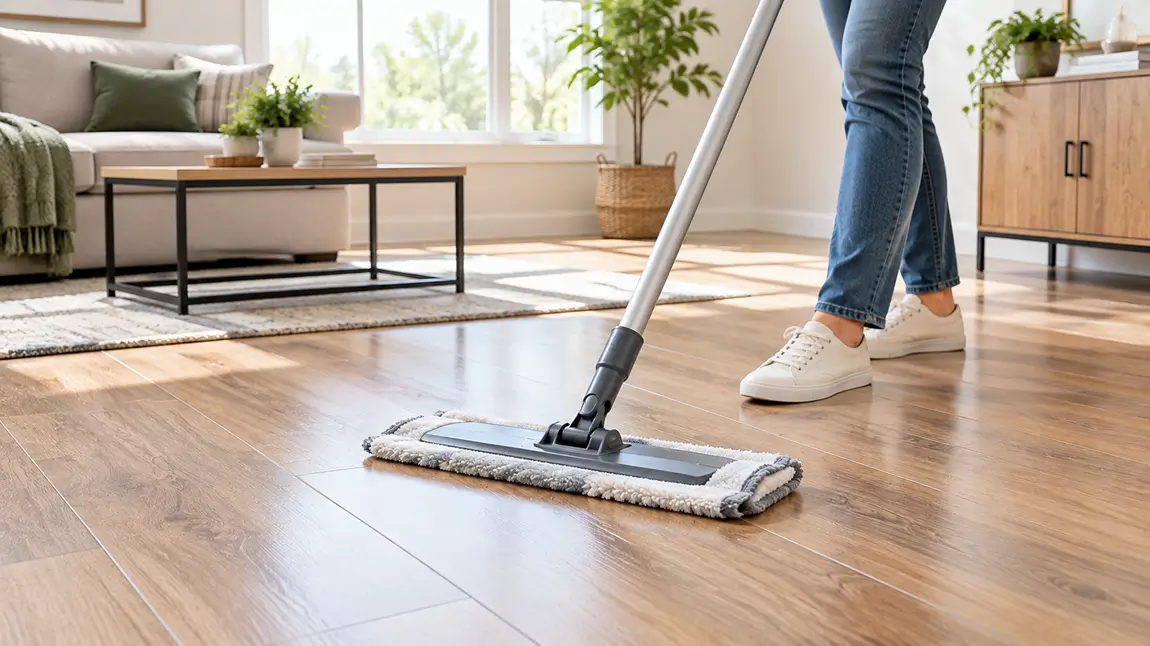
To clean laminate floors, sweep or vacuum first, then wipe the floor with a microfiber mop that is only slightly damp, using a cleaner made for laminate or a light mist of a pH-neutral floor cleaner. Laminate has a wood-fiber core that swells if water gets into the seams, so never wet mop or steam clean it, and wipe up spills right away.
Luxury vinyl plank (LVP) is cleaned the same way, but it’s more forgiving. The planks are waterproof, so a damp mop and a pH-neutral vinyl cleaner won’t harm them, although water still shouldn’t be left standing in the seams. On both floors, skip wax, polish, oil soaps and scouring pads, which leave a dull film or scratch the surface. This guide covers the step-by-step method, what to use and what to avoid, stains, streaks and how often to clean.
Laminate vs LVP: what changes when you clean
| Laminate | LVP (luxury vinyl plank) | |
|---|---|---|
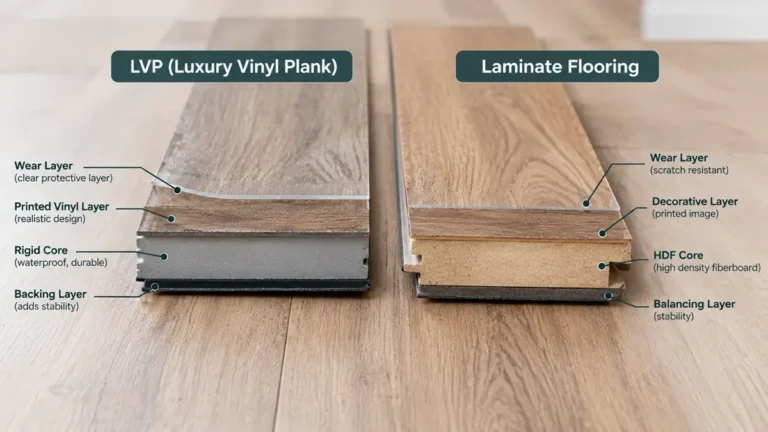
| Core | Wood fiber (HDF) that swells when wet | Vinyl or stone-plastic composite that water doesn’t harm |
| Mopping | Barely damp mop only. Wipe wet spots right away. | Damp mop. Don’t leave puddles in the seams. |
| Best cleaner | A laminate floor cleaner, or plain water on a damp mop | A pH-neutral cleaner made for vinyl |
| Steam mop | No | Only if your floor’s care guide allows it, on the lowest setting |
| Vinegar | A weak mix at most. Many makers prefer their own cleaner. | Often allowed, about 1 cup per gallon of water |
| Wax, polish, oil soap | Never | Never |
| Tough spots | Acetone (nail polish remover) on a white cloth | Rubbing alcohol on a cloth. Test in a hidden spot first. |
If you’re not sure which floor you have, check the box label or look at the edge of a spare plank. Laminate shows a brown fiberboard core, while LVP looks like solid vinyl or a stone-colored composite. Our guide to LVP vs laminate explains the differences in more detail. Older sheet vinyl and vinyl tile floors are cleaned the same way as LVP.
What you need
- A soft broom or dust mop, or a vacuum with a hard-floor setting and the brush roll turned off
- A flat microfiber mop with spare pads, or a spray mop
- A cleaner made for your floor: a laminate cleaner or a pH-neutral vinyl cleaner
- A spray bottle, if your cleaner doesn’t come in one
- Soft, clean cloths for drying and spot cleaning
- A plastic scraper, such as an old gift card, for gum and candle wax
How to clean laminate floors step by step
- Remove loose dirt and grit. Sweep, dust mop or vacuum with the hard-floor setting. Grit scratches the finish, and a spinning beater bar can mark it.
- Spray lightly, a small area at a time. Mist the cleaner onto the mop pad or onto about 3 × 3 ft of floor at a time. Never pour liquid onto laminate.
- Mop along the planks. Work in the same direction as the planks. This picks dirt out of the edges between planks and leaves fewer streaks.
- Change the pad when it gets dirty. A dirty pad only spreads grime around and leaves a film.
- Dry any wet spots. The floor should dry within a minute or two. If it stays wet longer, the mop is too wet. Buff with a dry microfiber cloth for extra shine.
How to clean vinyl plank (LVP) floors
The method is the same as for laminate, with a little more room for water:
- Sweep, dust mop or vacuum with the brush roll turned off.
- Mop with a damp, not dripping, microfiber mop and a pH-neutral cleaner made for vinyl.
- For a deeper clean, mop again with plain water to lift any cleaner left behind.
- Wipe up puddles, especially along walls, tubs and seams, where water can get under the planks.
Many LVP makers also allow a weak vinegar mix, and some allow a household steam mop on its lowest setting. Others don’t, so check the care guide for your floor before you use either.
Can you use a steam mop on laminate or vinyl floors?
Not on laminate. Steam forces hot moisture into the seams, where it can swell the core and cause peeling, bubbling or raised edges, and laminate makers tell you never to use one.
On LVP, it depends on the brand. Some makers allow a household steam mop on the lowest setting with a soft pad, moved steadily along the planks and never held in one spot. Others say no steam at all, because heat can weaken the locking edges and the wear layer. If your care guide doesn’t clearly allow steam, use a damp microfiber mop instead.
What to use and what to avoid
| Product or tool | Laminate | LVP |
|---|---|---|
| Cleaner made for your floor type | Yes, the best choice | Yes, the best choice |
| pH-neutral hard-floor cleaner | Yes, sprayed lightly | Yes |
| Plain water | Yes, on a well-wrung mop | Yes |
| White vinegar, about 1 cup per gallon of warm water | Only if your care guide allows it | Often allowed |
| A few drops of dish soap | For greasy spots only, then wipe with plain water | For greasy spots only |
| Steam mop | No | Only if your care guide allows it |
| Wax, polish and “mop and shine” products | No | No |
| Oil soaps and wood floor cleaners | No | No |
| Bleach or ammonia | No | No, unless your care guide allows a diluted mix |
| Steel wool, scouring powder, abrasive pads | No | No |
| Vacuum with a spinning beater bar | No | No |
| Rubber- or latex-backed mats | Use mats marked non-staining | No. They can leave yellow stains on vinyl. |
Homemade laminate floor cleaner
If your floor’s care guide allows it, a simple homemade cleaner is 1 cup of white vinegar in 1 gallon of warm water. Put some in a spray bottle, mist the floor lightly and wipe with a damp microfiber pad. On greasy kitchen floors, a drop or two of dish soap helps, but too much soap leaves a sticky film, so go over the area again with plain water.
Vinegar is an acid, and many laminate makers would rather you use their own cleaner, so test any homemade mix in a hidden spot first, such as inside a closet. Never use vinegar full strength.
How to remove stains and sticky spots
| Mess | What to do |
|---|---|
| Grease and food | Wipe with a cloth dipped in warm water and a few drops of dish soap, then wipe with plain water and dry. |
| Marker, ink, paint, nail polish or tar | On laminate, dab with acetone (nail polish remover) on a clean white cloth. On LVP, try rubbing alcohol first, and test in a hidden spot. |
| Candle wax and chewing gum | Harden it with ice in a plastic bag, then lift it off with a plastic scraper. |
| Black scuff marks | Rub with a soft dry cloth or a clean tennis ball. |
| Pet accidents | Wipe up right away, then clean the spot with your floor cleaner. On laminate, urine left in a seam can swell and stain the core. |
| Sticky film | Usually old cleaner or soap. Mop with plain warm water and a clean pad, then buff dry. |
These spot methods match the advice in laminate makers’ care guides, such as this laminate care guide from Shaw, but check the guide for your own floor first.
How to get rid of haze and streaks
Laminate and LVP have a factory finish that never needs wax or polish. When the floor looks dull, hazy or streaky, the cause is almost always build-up, not wear:
- Too much cleaner, or a cleaner not made for the floor
- Oil soap, wax or “mop and shine” products that leave a film
- A dirty mop pad or dirty rinse water
- A mop that’s too wet, leaving water spots as it dries
To make laminate floors shine again, mop with plain warm water, or the weak vinegar mix if your floor allows it, using a clean microfiber pad. Change pads often, then buff the floor dry with a soft cloth. Old build-up can take two passes. Don’t wax or polish laminate to bring the shine back, because the wax sits on top, turns dull and makes the floor slippery.
How often to clean laminate and vinyl floors
| How often | What to do |
|---|---|
| Right away | Wipe up spills, pet accidents and water from wet shoes |
| Daily or every few days | Sweep or dust mop kitchens, entries and other busy areas |
| Weekly | Vacuum the whole floor and damp mop kitchens and entries |
| Every 2 to 4 weeks | Damp mop the whole floor with your floor cleaner |
| Every few months | Deep clean, check the felt pads under furniture and wash entry mats |
To deep clean, vacuum first, then mop with your floor cleaner, a small area at a time, changing pads often. Go over the floor a second time with plain water to lift the residue, buff it dry, and treat stubborn spots one by one.
How to protect laminate and LVP floors
- Use mats at outside doors. They catch grit, water and driveway sealer before they reach the floor. On vinyl, choose mats without rubber backing.
- Put felt pads under furniture legs, and use soft wheels or a chair mat under rolling chairs.
- Lift furniture, don’t drag it. Use a dolly with a sheet of plywood for heavy appliances.
- Trim pet nails to cut down on scratches.
- Keep indoor humidity steady, within the range in your floor’s care guide. Very dry or very damp air makes laminate shrink or swell.
- Keep a few spare planks so a damaged plank can be replaced with a perfect match.
Keep spare planks for repairs: a worked example
Even with good care, a plank can get a deep scratch, a chip or water damage. The simplest fix is replacing that one plank, so it’s worth keeping spares from the same batch. Say you’re putting LVP in a 14 × 12 ft room, and the flooring comes 20 sq ft to a box:
- Room area: 14 × 12 = 168 sq ft
- Add 10% for cuts: 168 × 1.10 = 184.8, or 185 sq ft
- Boxes: 185 ÷ 20 = 9.2, so order 10 boxes (200 sq ft)
- Left over: about 15 sq ft, or about 6 planks at 48 × 7 inches (2.33 sq ft each)
These are the default numbers in our flooring calculator, which also works out underlayment and trim for one or more rooms. Store the spare planks flat in their box, inside the house, so they stay matched to the floor.
Frequently asked questions
Can you mop laminate floors?
Yes, with a damp mop, not a wet one. Wring the mop until it’s barely damp, or use a spray mop that puts down a light mist, and dry any spots that stay wet for more than a minute or two.
Can you use vinegar on laminate floors?
Some people use a weak mix of about 1 cup of white vinegar per gallon of warm water, but many laminate makers recommend their own cleaner instead. Check your care guide, test in a hidden spot, and never use vinegar full strength.
Can you use a spray mop on laminate or vinyl floors?
Yes. A spray mop with a microfiber pad works well on both, because it puts down only a light mist. Use a cleaner made for your floor and change the pad when it gets dirty.
Can you use bleach on vinyl floors?
It’s best to avoid it. Bleach can discolor vinyl and wear down the finish, and most vinyl care guides say not to use it. To disinfect, use a cleaner labeled safe for vinyl floors.
Can you wax laminate floors?
No. Laminate has a sealed factory finish, so wax can’t soak in. It sits on top, turns dull and slippery, and is hard to remove.
How do you clean very dirty laminate floors?
Vacuum first, then mop with a laminate cleaner and a clean microfiber pad, a small area at a time, changing pads often. Go over the floor again with plain water to lift the residue, buff it dry, and treat stubborn spots on their own.
What should you not use on vinyl plank flooring?
Avoid wax, polish, oil soaps, bleach, ammonia, abrasive pads, steel wool, vacuums with a spinning beater bar and rubber-backed mats. Skip steam too, unless your floor’s maker says it’s safe.
Floors and finishes vary by brand, so the care guide and warranty for your floor always come first. Test any new cleaner in a hidden spot, such as inside a closet, before using it on the whole floor.
Keep reading
 Flooring & TileLVP vs Laminate Flooring: Which Is Better?LVP (luxury vinyl plank) is the better choice for wet areas such as bathrooms, kitchens, laundry rooms and…Read the guide →9 min read
 Walls, Ceilings & LightingPaint Sheens Explained: Flat, Eggshell, Satin, Semi-GlossPaint sheen is how shiny the dried paint looks. From least to most shiny, the common sheens are…Read the guide →8 min read
 Walls, Ceilings & LightingDrywall Thickness: Which Size Goes WhereThe standard drywall thickness for walls is ½ inch, and it is the most common board in homes.…Read the guide →7 min read