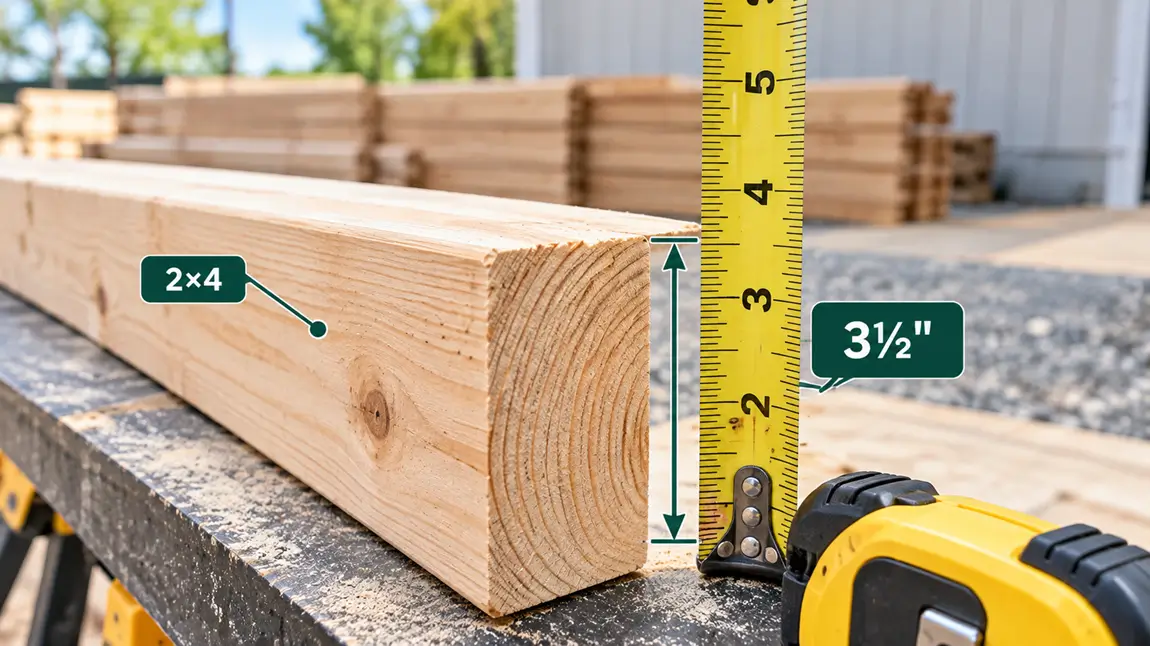
A 2×4 actually measures 1½ × 3½ inches. The name, 2 by 4, is its nominal size: the size the board is rough-sawn to before it’s dried and planed smooth. Nearly all dimensional lumber works the same way. A 2×6 is 1½ × 5½ inches, a 2×10 is 1½ × 9¼ inches, and a 1x board is only ¾ inch thick. Lengths are the exception: an 8-foot board really is 8 feet long.
Knowing the actual size matters whenever parts have to fit: wall thickness, stacked headers, deck joists, stair stringers and hardware. This guide gives the full nominal vs actual size chart, explains why lumber is smaller than its name, and shows how board feet are counted with our board foot calculator.
Nominal vs actual lumber size chart
Dimensional lumber (2x)
| Nominal size | Actual size (inches) | Actual size (mm) |
|---|---|---|
| 2×2 | 1½ × 1½ | 38 × 38 |
| 2×3 | 1½ × 2½ | 38 × 64 |
| 2×4 | 1½ × 3½ | 38 × 89 |
| 2×6 | 1½ × 5½ | 38 × 140 |
| 2×8 | 1½ × 7¼ | 38 × 184 |
| 2×10 | 1½ × 9¼ | 38 × 235 |
| 2×12 | 1½ × 11¼ | 38 × 286 |
Boards (1x)
| Nominal size | Actual size (inches) | Actual size (mm) |
|---|---|---|
| 1×2 | ¾ × 1½ | 19 × 38 |
| 1×3 | ¾ × 2½ | 19 × 64 |
| 1×4 | ¾ × 3½ | 19 × 89 |
| 1×6 | ¾ × 5½ | 19 × 140 |
| 1×8 | ¾ × 7¼ | 19 × 184 |
| 1×10 | ¾ × 9¼ | 19 × 235 |
| 1×12 | ¾ × 11¼ | 19 × 286 |
Posts and timbers
| Nominal size | Actual size (inches) | Actual size (mm) |
|---|---|---|
| 4×4 | 3½ × 3½ | 89 × 89 |
| 4×6 | 3½ × 5½ | 89 × 140 |
| 4×12 | 3½ × 11¼ | 89 × 286 |
| 6×6 | 5½ × 5½ | 140 × 140 |
| 8×8 | 7½ × 7½ | 191 × 191 |
These are the standard dry, surfaced sizes for softwood lumber in the US. Boards sold wet, such as some treated lumber and large timbers, can measure slightly more until they dry.
What does nominal size mean?
“Nominal” means “in name only.” A nominal size is the name used to sell and order a piece of lumber, not its finished measurement. The name comes from the rough size the board is cut to at the sawmill. Everyone in the trade uses it, so a 2×4 from any lumberyard in the country is the same 1½ × 3½ inches.
Dimensional lumber is softwood lumber cut to these standard sizes, from 2 up to just under 5 inches thick, and used for framing walls, floors, roofs and decks. It’s surfaced on all four sides, so the edges are smooth and slightly rounded.
Why is a 2×4 not 2 by 4 inches?
A 2×4 starts as a rough-sawn piece close to a full 2 × 4 inches. It then shrinks as it’s dried, and is planed smooth on all four sides, which takes off more wood. The US lumber standard sets the finished size at 1½ × 3½ inches, so every mill ends up at the same size.
The standard has changed over time. Lumber from the early 1900s often measures close to a full 2 × 4 inches, and mid-century 2x4s are often about 1⅝ × 3⅝ inches. If you’re repairing an older house, measure the existing framing before you buy, because new lumber may not line up.
A quick rule for the actual size
- 1-inch nominal thickness: subtract ¼ inch, so 1 becomes ¾.
- 2 to 6 inches nominal: subtract ½ inch, so 2 becomes 1½, 4 becomes 3½ and 6 becomes 5½.
- 8 inches and wider: subtract ¾ inch, so 8 becomes 7¼, 10 becomes 9¼ and 12 becomes 11¼.
- Large timbers (6×6 and up): usually ½ inch less on each side, so 8×8 is 7½ × 7½.
Are lumber lengths nominal too?
No. Lengths are true: an 8-foot 2×4 is at least 8 feet long and often a fraction of an inch more. Lumber is usually sold in 2-foot steps, from 8 up to 16 or 20 feet. Wall studs are the main exception. Precut studs come 92⅝ inches long for 8-foot walls and 104⅝ inches for 9-foot walls, so the wall reaches the right height once the plates are added. The stud calculator counts the studs and plates for a wall.
Quarter sizes: 4/4, 5/4 and 8/4 lumber
Hardwood and some boards are sold by thickness in quarters of an inch. 4/4 (said “four quarter”) means 4 quarters, or 1 inch, in the rough. Like dimensional lumber, the board ends up thinner once it’s planed.
| Quarter size | Rough thickness | Typical surfaced thickness |
|---|---|---|
| 4/4 | 1 in | About ¾ to 13/16 in |
| 5/4 | 1¼ in | About 1 to 1-1/16 in |
| 6/4 | 1½ in | About 1¼ to 1-5/16 in |
| 8/4 | 2 in | About 1¾ in |
5/4 also shows up in decking. A 5/4 × 6 deck board measures about 1 × 5½ inches, so it’s thicker than a 1×6 but thinner than a 2×6.
Rough-cut lumber vs dimensional lumber
Rough-cut, or rough-sawn, lumber comes straight off the saw without planing, usually from smaller sawmills. It’s often close to its full nominal size, so a rough 2×4 can measure about 2 × 4 inches, and its surface is rough and fuzzy. It’s often sold green (still wet), so it shrinks as it dries, and sizes can vary from board to board. It’s popular for barns, fences, rustic trim and timber framing, but it doesn’t mix well with standard dimensional lumber in the same wall.
Treated lumber sizes
Pressure-treated lumber uses the same nominal names and the same actual sizes: a treated 2×6 is 1½ × 5½ inches. Treated boards are often still wet from treating when you buy them, so they can measure a little larger and feel heavy, then shrink slightly as they dry.
Plywood is nominal too
Sheet goods follow the same idea. A sheet sold as ¾-inch plywood is often 23/32 inch thick, and ½-inch plywood is often 15/32 inch. The 4 × 8 ft sheet size is true. The plywood calculator counts sheets for floors, walls and roofs.
Why actual sizes matter when you build
- Wall thickness. A 2×4 wall is 3½ inches of framing. With ½-inch drywall on both sides, the finished wall is 4½ inches thick. A 2×6 wall is 6½ inches.
- Headers. Two 2x boards with a ½-inch plywood spacer between them make 3½ inches, the same width as a 2×4 wall.
- Decks and floors. A 2×8 joist is 7¼ inches deep, and a 2×10 is 9¼ inches, which sets the height of your deck or floor.
- Stairs. Stair stringers are usually cut from 2x12s, which are 11¼ inches wide. Our guide to standard stair dimensions covers the rise and run.
- Fence posts. A 4×4 post is 3½ inches square, so brackets and post caps are sized to that. See how far apart fence posts should be for spacing and depth.
- Hardware. Joist hangers, post bases and brackets are made for the actual sizes, so buy them by the nominal name on the label.
Worked example: board feet use nominal sizes
Board feet measure lumber volume: thickness (in) × width (in) × length (ft) ÷ 12. Dimensional lumber is counted by its nominal size. Say you buy ten 2x4s, 8 feet long. These are the default numbers in the board foot calculator:
- Nominal: 10 × 2 × 4 × 8 ÷ 12 = 53.33 board feet
- Actual wood: 10 × 1.5 × 3.5 × 8 ÷ 12 = 35 board feet
- Linear feet: 10 × 8 = 80 ft
So the actual wood is only about two thirds of the nominal board feet. That’s normal, and every lumberyard counts the same way. Home centers usually price dimensional lumber by the piece, while hardwood dealers and lumberyards often price by the board foot. Hardwood is measured by its rough quarter thickness, so 4/4 counts as 1 inch.
Bricks work the same way: a modular brick is called 4 × 2⅔ × 8 in, but it actually measures 3⅝ × 2¼ × 7⅝ in. See standard brick dimensions for the full size chart.
Framing a deck with these boards? See deck joist spacing and deck board gaps for 12, 16 and 24-inch spacing by decking type.
Frequently asked questions
What is the actual size of a 2×6?
A 2×6 measures 1½ × 5½ inches, or 38 × 140 mm.
How thick is a 2×4?
A modern 2×4 is 1½ inches thick and 3½ inches wide. All 2x lumber is 1½ inches thick.
Is a 4×4 really 4 inches?
No. A 4×4 post measures 3½ × 3½ inches. A 6×6 measures 5½ × 5½ inches.
How thick is 5/4 lumber?
5/4 lumber is 1¼ inches thick in the rough and about 1 inch after planing. A 5/4 deck board is about 1 inch thick.
Why are 2x4s in old houses bigger?
The lumber standard has shrunk over time. Lumber from the early 1900s is often close to a full 2 × 4 inches, and mid-century 2x4s are often about 1⅝ × 3⅝ inches. Today’s standard size is 1½ × 3½ inches.
Are lumber lengths nominal?
No. Lengths are true, and boards are often a fraction of an inch longer than the stated length. Precut studs are the exception, sized to build an 8 or 9-foot wall.
Sizes in this guide are the standard dry, surfaced sizes for US softwood lumber. Wet, treated, rough-cut and older lumber can differ, so measure the boards you have before you cut.
Keep reading
 Walls, Ceilings & LightingPaint Sheens Explained: Flat, Eggshell, Satin, Semi-GlossPaint sheen is how shiny the dried paint looks. From least to most shiny, the common sheens are…Read the guide →8 min read
 Walls, Ceilings & LightingDrywall Thickness: Which Size Goes WhereThe standard drywall thickness for walls is ½ inch, and it is the most common board in homes.…Read the guide →7 min read
 Roofing & SidingRoof Pitch Chart: Common Roof Pitches Explained (4/12, 6/12, 8/12 and More)Roof pitch is how many inches a roof rises for every 12 inches it runs across, written as…Read the guide →7 min read