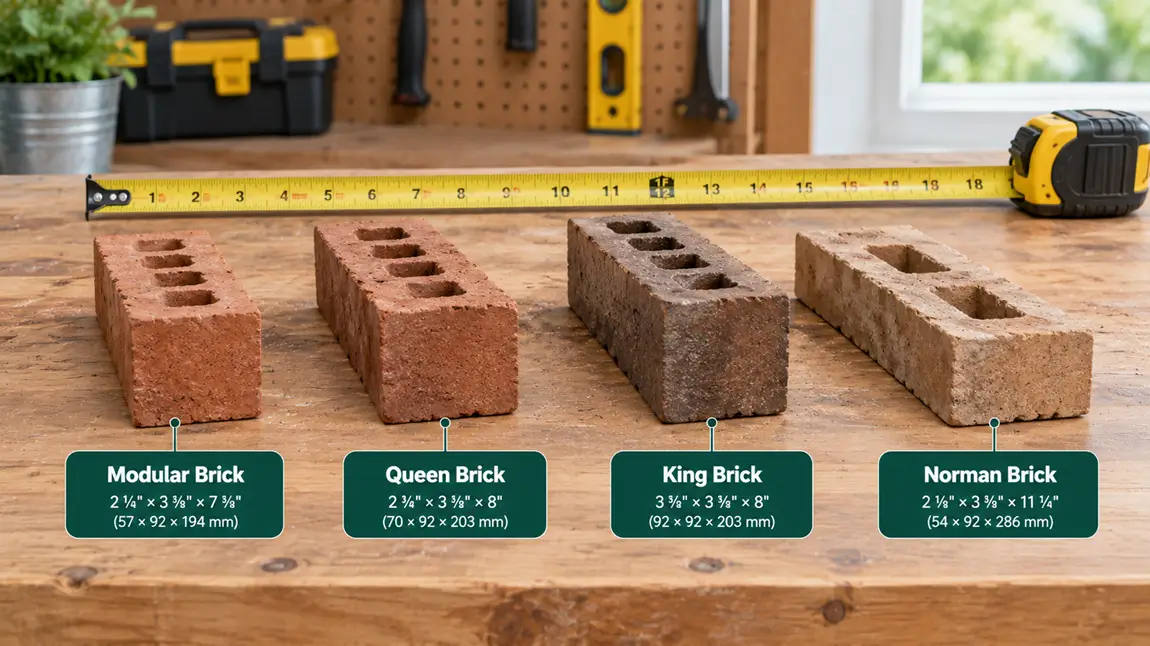
The most common brick in the United States is the modular brick: 3⅝ in deep, 2¼ in tall and 7⅝ in long (92 × 57 × 194 mm). With a standard ⅜ in mortar joint it takes up a nominal 4 × 2⅔ × 8 in, so three courses rise exactly 8 inches. The older non-modular “standard” brick has the same depth and height but is a full 8 in long. Queen and king bricks are thinner, about 3 in deep, and are often used for house veneer.
Below you will find a size chart for common US bricks, what nominal and actual sizes mean, the main types of brick and how much a brick weighs. If you already know which brick you will use, the brick calculator counts the bricks and mortar for your wall.
Standard brick dimensions chart
Sizes are listed the way the Brick Industry Association (BIA) recommends ordering brick: width (depth) × height × length, in inches, for ⅜ in mortar joints.
| Brick | Actual size (in) | Nominal size (in) | Coursing | Bricks per sq ft |
|---|---|---|---|---|
| Modular | 3⅝ × 2¼ × 7⅝ | 4 × 2⅔ × 8 | 3 rows = 8 in | 6.75 |
| Standard (non-modular) | 3⅝ × 2¼ × 8 | None | 3 rows = 8 in | 6.55 |
| Engineer modular | 3⅝ × 2 13/16 × 7⅝ | 4 × 3⅕ × 8 | 5 rows = 16 in | 5.63 |
| Closure modular | 3⅝ × 3⅝ × 7⅝ | 4 × 4 × 8 | 1 row = 4 in | 4.50 |
| Queen | 2¾–3 × 2¾ × 7⅝–8 | None | 5 rows = 16 in | 5.50 |
| King | 2¾–3 × 2⅝–2¾ × 9⅝–9¾ | None | 5 rows = 16 in | 4.55 |
| Roman | 3⅝ × 1⅝ × 11⅝ | 4 × 2 × 12 | 2 rows = 4 in | 6.00 |
| Norman | 3⅝ × 2¼ × 11⅝ | 4 × 2⅔ × 12 | 3 rows = 8 in | 4.50 |
| Engineer Norman | 3⅝ × 2 13/16 × 11⅝ | 4 × 3⅕ × 12 | 5 rows = 16 in | 3.75 |
| Utility | 3⅝ × 3⅝ × 11⅝ | 4 × 4 × 12 | 1 row = 4 in | 3.00 |
Source: BIA Technical Note 10, Dimensioning and Estimating Brick Masonry. Coursing shows how many rows of brick, with their joints, add up to a round height. Bricks per sq ft are BIA’s figures before waste. When ½ in joints are used, makers trim modular sizes by ⅛ in, so a modular brick becomes 3½ × 2¼ × 7½ in. Queen and king sizes vary by maker within the ranges shown, and names like “jumbo” or “oversize” mean different sizes at different plants, so always order by the actual dimensions, not the name.
Brick length, height and width
For the modular brick used on most US homes, compared with the standard brick:
| Measurement | Modular brick | Standard brick |
|---|---|---|
| Length | 7⅝ in (194 mm) | 8 in (203 mm) |
| Height | 2¼ in (57 mm) | 2¼ in (57 mm) |
| Width (depth) | 3⅝ in (92 mm) | 3⅝ in (92 mm) |
| Length plus one joint | 8 in | 8⅜ in |
| Three courses with joints | 8 in | 8 in |
The width is also called the depth or thickness, because it is how thick a wall one brick deep will be. Real bricks can be a little larger or smaller than these numbers. ASTM standards allow a small tolerance, and bricks from one production run are closer to each other than to bricks from another plant.
Nominal vs actual brick size
Brick has three sets of sizes. The specified size is what the maker aims to produce and what you order. The actual size is what a brick really measures, within a small tolerance of the specified size. The nominal size is the specified size plus the mortar joint, in round numbers, and only modular brick has one.
It is the same idea as lumber, where a 2×4 really measures 1½ × 3½ in. The difference is that a brick’s nominal size includes the mortar joint, so the finished wall really is built to the nominal size: ten modular bricks with their joints make an 80 in run. Our guide to nominal vs actual lumber sizes explains the lumber side of this.
Modular sizes fit a 4 in grid. Two brick widths plus one joint equal one brick length (3⅝ + ⅜ + 3⅝ = 7⅝ in), which keeps corners simple, and three modular courses equal 8 in, the same height as one course of 8 in concrete block. That is why modular brick and block line up so well; the concrete block calculator works with the same 8 × 16 in block face. Non-modular brick, such as standard, queen and king, does not fit the 4 in grid along the wall, so more bricks get cut at corners and openings.
Concrete block follows the same 8 in module, with one block course equal to three modular brick courses. See CMU block sizes for standard concrete and cinder block dimensions.
Common brick sizes and where they are used
- Modular: the everyday size for homes, schools and offices. It fits the 4 in grid and lines up with concrete block, so it is the safe choice when you are not matching an old wall.
- Queen: about 3 in deep and 2¾ in tall. A thinner brick weighs less and covers more wall per brick than modular (5.5 per sq ft instead of 6.75), which is why it is common on house veneer.
- King: about the same depth as queen but around 9⅝ in long, so a wall needs only about 4½ to 5 bricks per sq ft. Fewer bricks means less laying time.
- Norman: modular depth and height but 11⅝ in long, for a long, low look.
- Roman: long and only 1⅝ in tall, for a strong horizontal look. It needs nearly as many bricks per sq ft as modular.
- Engineer: taller than modular at 2 13/16 in, so five courses make 16 in, the height of two courses of concrete block.
- Closure: a square-faced 4 × 4 × 8 in nominal unit, where each course is 4 in tall.
- Utility: 4 × 4 × 12 in nominal and only 3 bricks per sq ft. Large and quick to lay, and often used on commercial buildings.
Types of bricks
Size tells you how big a brick is; type tells you what it is made for. Clay brick sold in the US is made to ASTM standards that set its use, durability and size tolerances.
| Type | Used for | Standard |
|---|---|---|
| Face brick | Walls you see, such as house veneer and exposed walls | ASTM C216 |
| Building (common) brick | Backup and hidden walls, where looks matter less | ASTM C62 |
| Hollow brick | Bricks with cores over 25% of the bed area | ASTM C652 |
| Paving brick | Patios, walks and driveways | ASTM C902, C1272 |
| Thin brick | Slices about ½ to 1 in thick, set on a wall like tile | ASTM C1088 |
| Fire brick | Lining fireboxes, pizza ovens and kilns | Refractory grade |
| Concrete brick | Brick-shaped units made from cement and aggregate | Concrete standards |
Face brick also comes in weathering grades: SW (severe weathering) for climates with hard freezes and MW (moderate weathering). For appearance there are types FBS (standard), FBX (tighter size limits for a crisp, uniform look) and FBA (architectural, irregular on purpose). Many face bricks have holes, called cores, which cut weight and help the mortar grip. A brick with cores up to 25% of its bed area still counts as a solid unit; above that it is hollow brick, and some makers produce their queen and king sizes this way.
Concrete brick looks similar to clay brick but behaves differently as it ages, so don’t mix the two in one wall without checking with the maker. Fire brick is a different size from building brick and is laid with refractory mortar, not regular mortar.
How much does a brick weigh?
A modular clay brick usually weighs about 3.5 to 4.2 lb (1.6 to 1.9 kg). The exact weight depends on the size, the density of the clay and how much of the brick is cored, so check the spec sheet for the brick you buy.
| Brick | Typical weight each | Metric |
|---|---|---|
| Modular | 3.5–4.2 lb | 1.6–1.9 kg |
| Queen | 2.7–3.7 lb | 1.2–1.7 kg |
| King | 3.4–4.2 lb | 1.5–1.9 kg |
| Utility | About 8.8 lb | About 4 kg |
| Modular thin brick | 0.7–1 lb | 0.3–0.45 kg |
These are typical values from US maker spec sheets, such as US Brick’s technical data. Solid paving brick weighs more than cored face brick of the same size. Suppliers often sell modular brick by the cube, a strapped pallet of about 500 to 530 bricks. At 3.5 to 4 lb each, that is roughly 1,750 to 2,100 lb of brick before the pallet, so plan the delivery and any truck or trailer load around it.
Worked example: one wall, different brick sizes
The brick calculator starts with a 20 × 6 ft wall (120 sq ft), modular brick, ⅜ in joints, one brick thick, 80 lb bags of premixed mortar and 5% extra. It works from the actual brick size plus the joint, so each modular brick takes up 8 × 2⅝ in of wall face:
- Bricks per sq ft: 144 ÷ (8 × 2⅝) = 6.86
- Bricks: 120 sq ft × 6.86 = 823, plus 5% extra = 864 bricks
- Mortar: about 37 bricks per bag, so 24 bags
Changing only the brick size on the same wall gives these results (the calculator uses 3 × 2¾ × 8 in for queen and 3 × 2⅝ × 9⅝ in for king):
| Brick | Bricks per sq ft | Bricks with 5% extra | 80 lb mortar bags |
|---|---|---|---|
| Modular | 6.86 | 864 | 24 |
| Standard | 6.55 | 826 | 24 |
| Queen | 5.50 | 694 | 17 |
| King | 4.80 | 605 | 17 |
| Norman | 4.57 | 576 | 22 |
| Utility | 3.00 | 378 | 16 |
Two things stand out. Bigger bricks cut the count a lot: utility brick needs less than half as many bricks as modular. Mortar drops more slowly, because it follows the joints and the depth of the brick: Norman needs fewer bricks than king but more mortar, since Norman is 3⅝ in deep and king about 3 in. The calculator’s modular figure (6.86 per sq ft) is a little above BIA’s 6.75 because it adds a ⅜ in joint to the 2¼ in height, while BIA sets three courses to exactly 8 in with a slightly thicker bed joint. The 5% extra covers the difference.
How to choose and match a brick size
- Matching an existing wall: measure one brick’s width, height and length, then measure the height of 3 or 5 courses including the joints. Modular and standard brick rise 8 in every 3 courses; queen, king and engineer brick rise 16 in every 5 courses.
- Order by size, not by name: give the supplier the width × height × length, because “queen” or “jumbo” can mean different sizes at different plants.
- Brick next to block: choose modular brick so the courses line up with 8 in block every 3 courses.
- Fewer bricks, faster work: king, Norman and utility cut the brick count. Queen and king also cut weight and mortar because they are thinner.
- Buy it all at once: order all the brick, plus at least 5% extra for cuts and breakage, from one production run so the color matches.
- Patios and walks: use paving brick, not face brick. The paver calculator works out the pavers, base gravel and sand.
Frequently asked questions
What is the most common brick size in the US?
The modular brick, 3⅝ × 2¼ × 7⅝ in (92 × 57 × 194 mm). With ⅜ in joints it takes up 4 × 2⅔ × 8 in, so it fits the 4 in building grid and lines up with concrete block.
What are king and queen brick dimensions?
A queen brick is about 3 × 2¾ × 8 in, and some makers make it 2¾ in deep or 7⅝ in long. A king brick is about 3 × 2⅝ × 9⅝ in, and some plants make it 2¾ in deep or tall, or 9¾ in long. Both lay up five courses to 16 in.
How many bricks are in a square foot?
About 6.75 modular bricks per square foot of wall with ⅜ in joints, or close to 7 if you round up. King brick needs about 4½ to 5 per square foot and utility brick 3. Add at least 5% for cuts and breakage.
How thick is a brick wall?
A brick veneer wall is one brick thick: about 3⅝ in with modular brick, or about 3 in with queen or king brick. A solid wall two bricks thick is about 8 in nominal. Thin brick is only about ½ to 1 in thick and is set on a backing wall.
How many bricks are in a cube?
Usually around 500 to 530 modular bricks, but the count depends on the plant and the brick size, so ask the supplier how many bricks are in their cube before you order.
What size is a fire brick?
A standard straight fire brick is about 9 × 4½ × 2½ in, larger than a building brick, and a split fire brick is about half as thick. Fire brick is made from refractory clay for fireboxes and ovens and is laid with refractory mortar.
Is a US brick the same size as a UK brick?
No. A UK standard brick is 215 × 102.5 × 65 mm and is laid with 10 mm joints, while a US modular brick is 194 × 92 × 57 mm. A UK brick is longer, deeper and taller.
Is an engineer brick the same as an engineering brick?
No. In the US, “engineer” is a size: a brick 2 13/16 in tall that lays five courses to 16 in. In the UK, an “engineering brick” is a dense, low-absorption brick graded for strength (Class A or B), not a size.
Brick sizes on this page follow BIA Technical Note 10. Real bricks vary within ASTM tolerances, and size names differ between makers, so check the supplier’s spec sheet for the exact size and weight before you order. To work out bricks, block, pavers and mortar for your project, see the Masonry & Hardscape calculators.
Keep reading
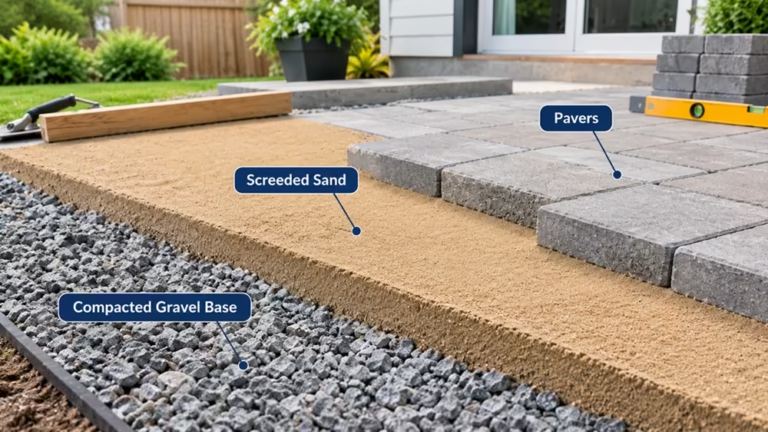 Masonry & HardscapePaver Base Material: What to Put Under Pavers and How DeepUnder pavers you need two built layers: a compacted base of crushed stone and a thin bed of…Read the guide →9 min read
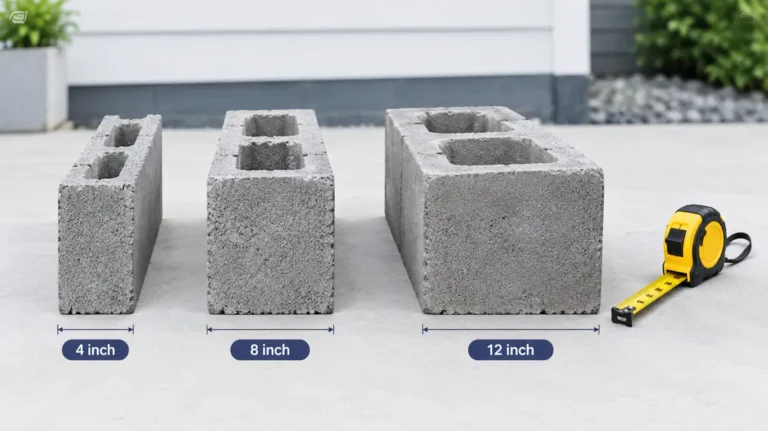 Masonry & HardscapeCMU Block Sizes: Standard Concrete and Cinder Block DimensionsA standard concrete block, often called a cinder block or CMU (concrete masonry unit), is 8 × 8…Read the guide →9 min read
 Walls, Ceilings & LightingPaint Sheens Explained: Flat, Eggshell, Satin, Semi-GlossPaint sheen is how shiny the dried paint looks. From least to most shiny, the common sheens are…Read the guide →8 min read