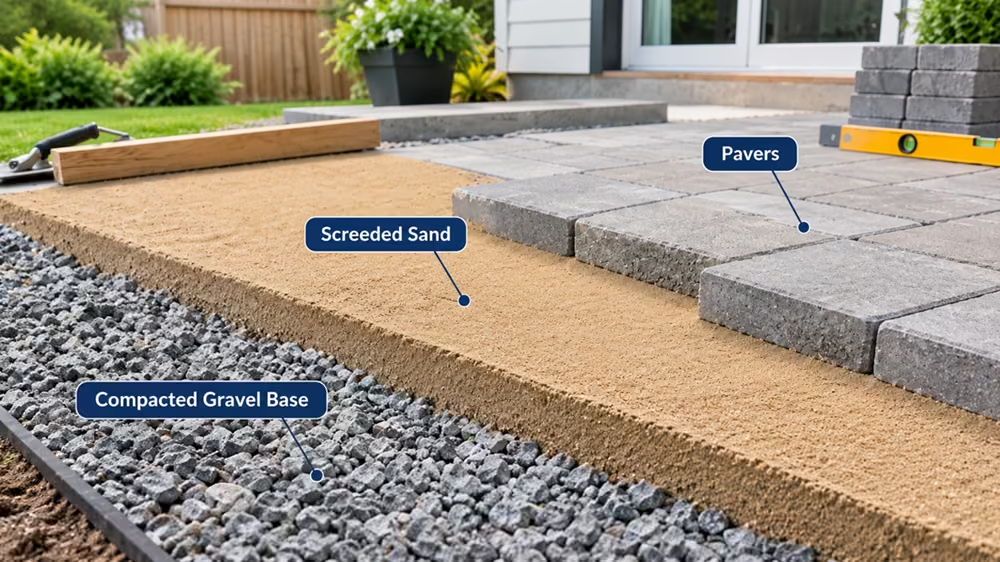
Under pavers you need two built layers: a compacted base of crushed stone and a thin bed of sand. For a patio or walkway on firm, well-drained soil, use at least 4 inches of compacted dense-graded crushed stone (often sold as crusher run, road base or paver base), topped with 1 inch of coarse concrete sand. Driveways need a thicker base, usually 6 to 8 in. Joint sand or polymeric sand fills the gaps, and an edge restraint holds the sides in place.
This guide covers each layer, the best paver base material, how deep to dig and which sand goes where. To work out the pavers, base gravel, sand and edging for your area, use the paver calculator.
The layers under a paver patio
A standard sand-set paver patio is built in layers from the ground up. Each one has a job, and skipping one is the most common reason pavers sink, rock or shift.
| Layer (top to bottom) | Material | Typical depth |
|---|---|---|
| Pavers | Concrete or clay pavers | 2⅜ in for patios and home driveways |
| Joints | Joint sand or polymeric sand | Filled to full depth |
| Bedding sand | Washed concrete sand (ASTM C33) | 1 in, screeded flat |
| Base | Dense-graded crushed stone, compacted | 4–6 in for walks and patios, 6–8 in for driveways |
| Geotextile (if needed) | Fabric between soil and base | Used on clay or soft soil |
| Subgrade | The native soil, compacted | Dug to the total depth |
An edge restraint, such as plastic or metal paver edging spiked into the base or a concrete curb, runs along every open edge so the pavers can’t creep outward. These depths follow the industry guidance from the Interlocking Concrete Pavement Institute (ICPI, now part of the Concrete Masonry & Hardscapes Association). Pavers 2⅜ in (60 mm) thick are recommended for walks, patios and home driveways, while streets and heavier traffic use 3⅛ in (80 mm) pavers.
Paver base material: which gravel to use
The best paver base is dense-graded crushed stone: angular crushed rock in a range of sizes, from about ¾ in down to fine dust. The fines fill the gaps between the larger pieces, so the layer compacts into a hard, stable slab that doesn’t shift under load. It is sold under several names, including crusher run, road base, ¾ in minus, Class II base and bagged “paver base”. Crushed limestone or granite both work, as long as the stone is dense-graded. In general, the same kind of base that goes under asphalt works under pavers.
Clean stone with no fines, such as #57, is a different material. It drains fast but doesn’t lock together the same way, and in a standard sand-set patio the bedding sand can wash down into its gaps. It is used under permeable pavers, which are a different system built with no sand at all. Our comparison of crusher run vs #57 stone explains the difference in detail. Avoid round rock such as pea gravel or river rock as a base: round stones roll instead of locking.
Spread the base in layers of a few inches and compact each layer with a plate compactor before adding the next, the same way you would build the base for a gravel driveway. A thick layer compacted only from the top stays soft underneath.
How deep should paver base be?
Base depth depends on what the pavers will carry, the soil and the climate. These are typical compacted depths for home projects:
| Project | Compacted base | Bedding sand | Paver | Total depth to dig |
|---|---|---|---|---|
| Walkway or patio, well-drained soil | 4 in | 1 in | 2⅜ in | 7⅜ in |
| Patio on clay, wet or freezing ground | 6 in | 1 in | 2⅜ in | 9⅜ in |
| Home driveway | 6–8 in | 1 in | 2⅜ in | 9⅜–11⅜ in |
Use the thicker end of each range on clay, poorly drained soil or where the ground freezes, and lay geotextile fabric over clay or soft soil before the base goes in. Our paver calculator uses 4 in for patios and 8 in for driveways, so a driveway on less-than-ideal soil is covered. Driveways for heavy trucks, or on very poor soil, need a design from a local engineer or paving contractor.
Two more details make a big difference. Make the base wider than the paved area, by at least the base depth, so the edges and the edge restraint sit on compacted stone instead of loose soil. And slope the base about ¼ in per foot away from the house, so water runs off the surface instead of soaking into the sand bed.
Paver sand: bedding sand vs joint sand vs polymeric sand
“Paver sand” can mean different products, so check what the bag is for. Pavers use sand in two places, and they need different kinds:
| Sand | Where it goes | What to use |
|---|---|---|
| Bedding (leveling) sand | 1 in layer under the pavers | Coarse, washed concrete sand (ASTM C33) |
| Joint sand | The gaps between pavers | Fine sand swept in and vibrated down |
| Polymeric sand | The gaps between pavers | Sand with a binder that hardens when wet |
For the bedding layer, ICPI guidance calls for concrete sand and says not to use masonry sand, limestone screenings or stone dust. Fine, dusty material doesn’t compact evenly and holds water in the bed instead of letting it drain, which leads to sinking and uneven pavers over time. Play sand and all-purpose sand are too fine and rounded for the same reason. Screed the bedding sand to an even 1 in over screed rails and leave it loose; the pavers are set on it and then compacted together. Never use extra sand to fill low spots in the base. Fill dips with base material and compact them instead.
Polymeric sand is fine sand mixed with polymer binders. Once it is swept into dry joints and misted with water, it hardens enough to resist washout, weeds and ants while still allowing a little movement. Follow the maker’s directions for joint width, depth and weather, because rain too soon can wash it out or haze the pavers. Don’t use it in permeable paver systems, which are built to let water through the joints.
Worked example: a 16 × 12 ft patio
The paver calculator starts with a 16 × 12 ft patio (192 sq ft) using 4 × 8 in brick pavers in a straight pattern, a 4 in base, 1 in of bedding sand, ⅛ in joints and 2⅜ in thick pavers. Brick pavers are usually a full 4 × 8 in on the face so they can be laid tight; our guide to standard brick dimensions covers the sizes used for walls. The calculator gives:
- Pavers: 192 sq ft × 4.5 per sq ft = 864, plus 5% for cuts = 908 pavers
- Base gravel: 2.73 cu yd, about 4.23 tons, including 15% extra for compaction
- Bedding sand: 0.65 cu yd, about 0.88 tons, including 10% extra
- Polymeric sand: four 50 lb bags for the joints
- Edge restraint: 56 ft around the patio
- Depth to dig: 4 + 1 + 2⅜ = 7⅜ in
Changing only the base depth on the same patio shows how fast the base grows:
| Compacted base | Base gravel | Weight | Depth to dig |
|---|---|---|---|
| 4 in (patio) | 2.73 cu yd | 4.23 tons | 7⅜ in |
| 6 in | 4.09 cu yd | 6.34 tons | 9⅜ in |
| 8 in (driveway) | 5.45 cu yd | 8.45 tons | 11⅜ in |
The base is the heaviest part of the job: doubling it from 4 to 8 in doubles the gravel, while the pavers and sand stay the same. Base gravel is bought loose, so the calculator adds 15% because it packs down when compacted. If you are ordering bulk stone by the ton, the crushed stone calculator converts any depth and area into yards and tons for crusher run and other grades.
Common paver base mistakes
- A base that is too thin: 2 in of gravel under a patio, or a patio-depth base under a driveway, is the main cause of sunken pavers and ruts.
- Not compacting in layers: compacting a deep base only from the top leaves loose stone below that settles later.
- Using sand to level the base: a sand bed thicker than about 1 in shifts under load. Level the base itself.
- The wrong bedding material: stone dust, screenings and masonry sand hold water and compact unevenly.
- No edge restraint: without it, the outer pavers spread and the joints open up.
- No slope: a flat patio holds water on the surface and in the sand bed.
- A base no wider than the pavers: the edge pavers then sit on the soft edge of the base and sink first.
Planning a loose-stone patio or path instead of pavers? Our guide to pea gravel vs river rock covers depths, edging and the base underneath.
Frequently asked questions
How deep should paver base be?
At least 4 in of compacted crushed stone for a patio or walkway on firm, well-drained soil, and 6 to 8 in for a home driveway. Use the deeper end on clay, wet soil or where the ground freezes, and add 1 in of bedding sand on top.
Can you use stone dust under pavers?
Not as the bedding layer. Industry guidance for pavers says to use coarse concrete sand there, because stone dust and screenings hold water and don’t compact evenly, which lets pavers sink and shift. Stone dust is part of dense-graded base material, but the 1 in bed on top should be concrete sand.
What is the difference between paver base and paver sand?
Paver base is the thick layer of compacted crushed stone that carries the load. Paver sand is either the thin 1 in layer of concrete sand the pavers sit in, or the sand swept into the joints. The base gives the strength; the sand only beds and locks the pavers.
Can you lay pavers directly on dirt?
You can set them on soil, but they won’t stay level. Bare soil softens when wet, settles and heaves in freezing weather, so pavers laid on it sink, tilt and grow weeds in the joints. Even a small walkway lasts far longer on a compacted gravel base with a sand bed.
What do you put between pavers?
Fine joint sand or polymeric sand, swept into the joints and vibrated down until they are full. Polymeric sand hardens when misted with water, so it resists washout and weeds better than plain sand. Permeable pavers use small clean stone in the joints instead.
Can I use play sand or mason sand under pavers?
No. Both are too fine and rounded for the bedding layer, so they shift and hold water. Use coarse, washed concrete sand under the pavers.
How deep do I dig for a paver patio?
Add up the layers: base, sand and paver thickness. For a typical patio that is 4 in of base, 1 in of sand and 2⅜ in pavers, or about 7⅜ in below the finished surface. Dig a little wider than the patio so the base extends past the edges.
Do paver base panels replace gravel?
Plastic or foam base panels are sold as a way to cut down on gravel for patios and walkways on firm, well-drained soil. Check the maker’s rating before you use them: they are generally made for foot traffic, not driveways, and a compacted gravel base is still the standard choice.
Base depths on this page are typical guidance for home patios, walkways and driveways. Soil, drainage and climate change what a site needs, so check with your local supplier or a paving contractor on poor soil or for heavy vehicles. Use the paver calculator above to turn your patio size into pavers, base gravel, sand and edging.
Keep reading
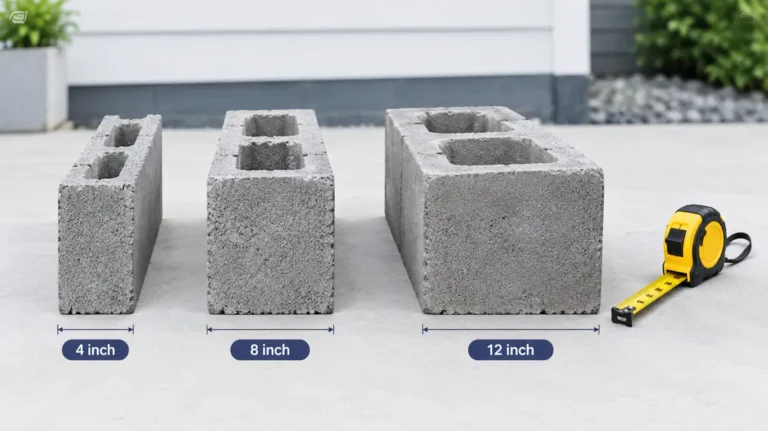 Masonry & HardscapeCMU Block Sizes: Standard Concrete and Cinder Block DimensionsA standard concrete block, often called a cinder block or CMU (concrete masonry unit), is 8 × 8…Read the guide →9 min read
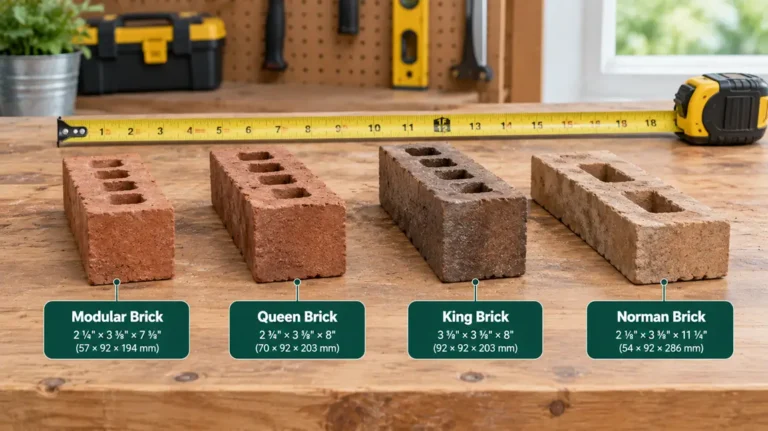 Masonry & HardscapeStandard Brick Dimensions: Size Chart, Types and WeightsThe most common brick in the United States is the modular brick: 3⅝ in deep, 2¼ in tall…Read the guide →9 min read
 Walls, Ceilings & LightingPaint Sheens Explained: Flat, Eggshell, Satin, Semi-GlossPaint sheen is how shiny the dried paint looks. From least to most shiny, the common sheens are…Read the guide →8 min read